

With Sculpture in the Garden: The Storytellers, co-curators Iwona Blazwick and Katie Delamere introduce a contemporary approach to figurative sculpture into the historical setting of Worcester College. With a nod to the college’s heritage as home of Oxford’s oldest student dramatic society, the exhibition is presented in five acts, each inspired by a line from a Shakespeare play and located in distinctly different scenery.
Visitors are invited to discover the thirteen physical works as they wander through lavish grounds that are not usually open to the public. Some may even encounter performers who complement the static displays.
 Antony Gormley, Ballast, Photo FisherStudios.
Antony Gormley opens the first act with one of his instantly recognisable figures composed of rusted metal blocks. In visual dialogue with Kira Freije’s skeletal parachutist, both seem to be unsure about their place in the world – the former resembling an upside-down body with its legs in the air, the latter pointing upwards to whence they came, perhaps. Overlooking the college’s medieval courtyard and formal garden, both are perfect illustrations of the first act’s theme of ‘We know what we are, but not what we may be’ which continues with Daniel Silver’s pair of embodied inner realities in marble and bronze at the far end of the manicured lawn.
Act II is reached via a narrow passageway that opens onto a natural lawn and long border, with sculptures that combine natural and manmade materials and become one with their environment. Anderson Borba’s flute-playing triptych is composed of bronze, stone and wood from a fallen tree. It sets the tone for ‘One touch of nature makes the whole world kin’. Grace Schwindt’s monumental ceramic has tendrils growing from the ground into the figure’s spine, its tilted head resting with an ear to the ground, while the ‘man ferns’ surrounding Lucia Pizzani’s totemic seed pots become a natural counterpart to the earthenware works that personify the life-giving female relationship to Earth.
 Lucia Pizzani, Ser Vegetal Totem, Photo Fisher Studios
The promenade continues along an ornamental lake with ‘Therefore I tell my sorrows to the stones’ and two artists capturing memories of pain and trauma in stone. Dorothy Cross carved feet into a block of flesh-coloured Damascus marble, the rest of the body held within the stone found in Syria. Kneel references displacement and forced migration of contemporary Damascus, as well as the obvious biblical references.
Reza Aramesh’s young male figure carved in white marble is probably the most powerful example of subverting traditional understanding of public sculpture as synonymous with statues of dead men on pedestals. Nowadays, fewer monuments are erected to commemorate war heroes in favour of those honouring figures previously overlooked by history. Referencing the Renaissance approach to sculpture making, in particular Michelangelo’s Young Slave, Aramesh carves the likeness of ordinary people in precious material to comment on themes of power, race, masculinity and martyrdom with titles referring to a specific moment of conflict.
 Reza Aramesh, Site of the Fall, Photo FisherStudios
A relatively long walk eventually leads to a modernist Plaza flanked by two reflective pools, each hosting a sculpture in an act titled ‘There was speech in their dumbness, language in their very gesture’. Elizabeth Frink’s Seated Man II is well placed in the plaza; both were created around the same time. Adopting a pose similar to Rodin’s Thinker, he may well have been a former general, without his uniform, his ‘dumbness’ remains faithful to the literary interpretation of physical gestures as more powerful than spoken language for expressing inner drama.
 Elisabeth Frink, Seated Man II, Photo Fisher Studios
Francis Upritchard’s gangly figure in the opposing pool gives ‘dumbness’ a different meaning as the struggling eel catcher’s elongated limbs become indistinguishable from his prey. Western in appearance, he acts as a metaphor for the European destruction of indigenous culture symbolised by the eel, which is deeply embedded in Maori culture.
The final act is set in a bountiful orchard, which provides the perfect setting for Renee So’s earthy representations of the female body, which incorporate different shapes and beauty standards from across time and space. So’s three clay Woman VI, X, and X1 are the smallest participants in The Storytellers, Leilah’ Bairye’s Gyagenda the tallest at almost 3 metres. Informed by the experience of being publicly outed and persecuted, her totem combines objects of personal significance with traditional symbolism. Cast in bronze, it ensures that the queer community cannot be overlooked or erased.
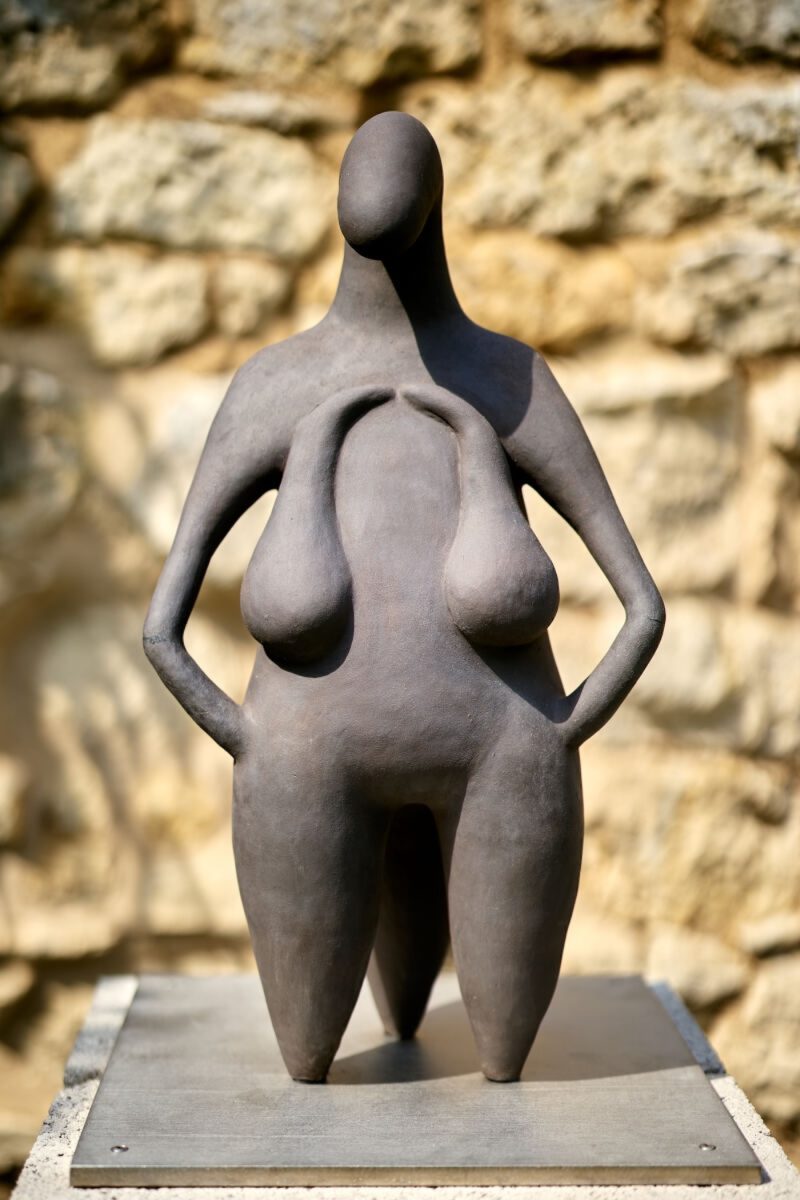
Oren Pinhassi’s Guardian is placed in the Provost’s private garden, the abstract figure’s flat head mirroring the beekeepers’ silhouettes as they tend to the beehives at the far end of the wild flower meadow. The multi-breasted fertility goddess cast from sand-finished bronze concludes the final act, which is aptly titled ‘Thou, Nature, art my goddess’. This quote from King Lear is generally described as ‘a declaration of defiance and an embrace of ruthless natural merit over inherited social privilege’ – which invites a spin of the narrative in response to an educational institution that didn’t admit its first female student until 1979.
Separating the lines from their literary context frees Shakespeare’s words from any colonial, classist or sexist connotations and allows for a narrative that links back to ordinary people and humanity’s connection to nature. The sculptures also strictly meet the definition of statues as “free-standing life-size or monumental representations of a person, animal or deity”, yet rather than depicting notable or famous individuals, they come together as a truly diverse assembly of realistic and abstracted forms placed in meaningful dialogue with landscape.
The medieval wall surrounding the gardens gives sanctuary to The Storytellers and separates them from Oxford’s more uncomfortable histories. Contested statues like that of leading colonialist Cecil Rhodes stay outside.
The exhibition continues until 5th July, tickets are free but must be booked in advance.
Categories Tags Author 
Meike Brunkhorst
Meike Brunkhorst runs factor-m, a marketing consultancy with artists at heart. She is also a freelance writer and translator, event manager and curator. www.factor-m.co.uk
Comments are closed.