
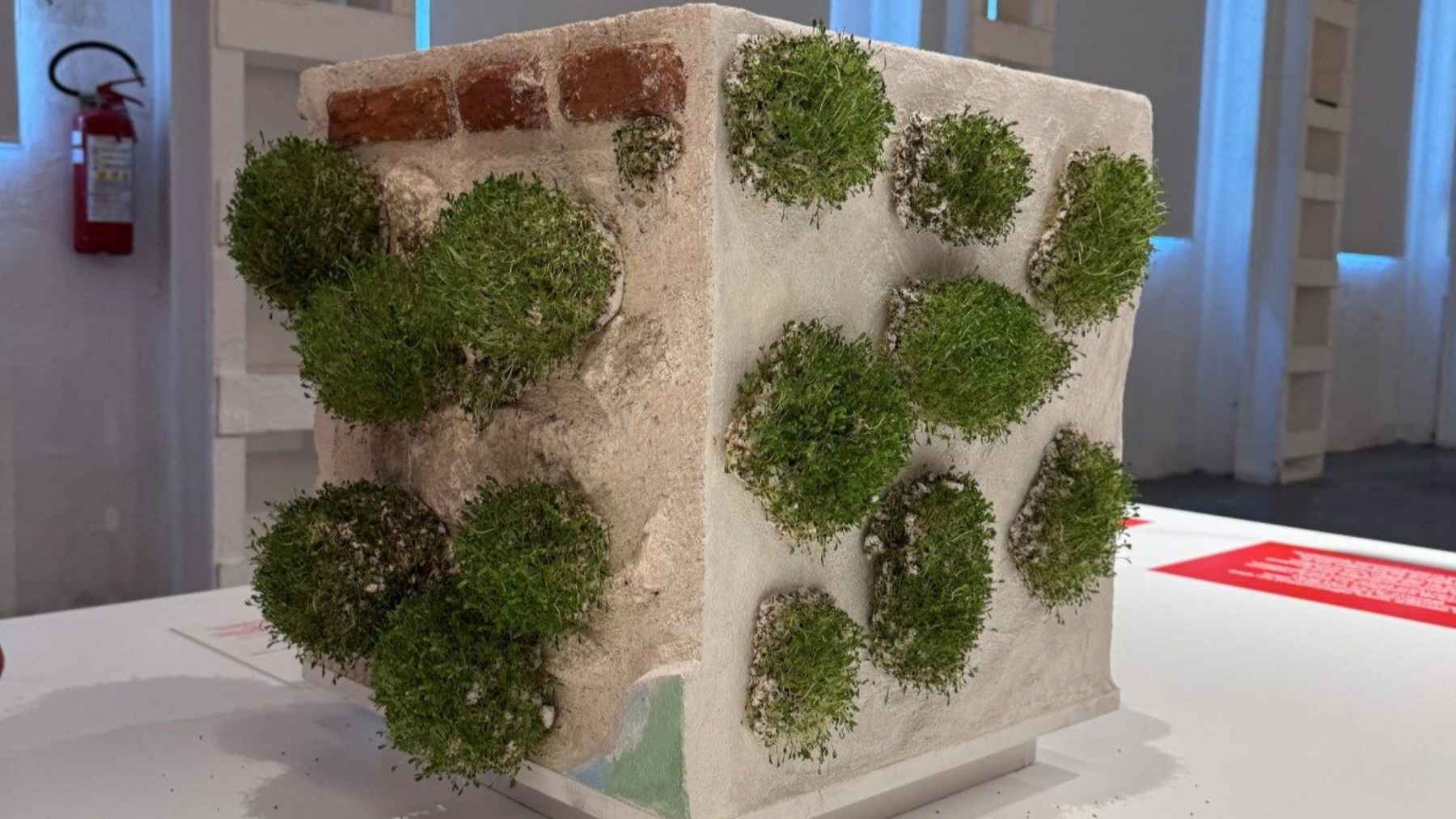
A cracked wall usually tells a city to repair it, repaint it, or ignore it until the damage gets worse. A Turkish design project asks a different question. What if some of those scars could become places for plants to grow?
The idea is called Green Anarchy, and it turns broken facades into small vertical habitats with a seed-filled biodegradable sticker. Developed by Yasemin Keyif at Bahçeşehir University in Istanbul, the project is not a Turkish government program or a finished public works plan. For now, it is an academic design proposal, but its angle is simple and unusual.
How the sticker works
At the center of the project is a small adhesive patch that behaves more like a living starter kit than a normal sticker. “Biodegradable” simply means it is designed to break down naturally instead of lingering as plastic waste.
Yanko Design reported that the body of the patch is made with paper pulp, coco peat, perlite, and seeds, while the adhesive uses gum arabic, methyl cellulose, and glycerin.
The same report says the project avoids synthetic materials and was tested around the dense historic neighborhood of Karaköy, where damaged walls were mapped in four stages, from surface cracks to severe collapse.
The application is meant to be hands-on. A person wets the patch, shapes it, and presses it into a crack or hollow spot in the wall. After moisture reaches the seeds, they can germinate and send roots into the rough surface.
Why cracked walls matter
Cracks are usually treated as failure, and often they are. But in this proposal, small breaks also act like pockets, giving the organic material a place to grip.
That distinction matters. A hairline crack in old plaster is not the same as a dangerous structural gap. Green Anarchy works best as a design idea for neglected surfaces, not as an excuse to leave unsafe buildings unrepaired.
The clever part is the reversal. The most worn sections of a facade may give the patch more texture and more shelter, much like a seed finding a tiny ledge in a sidewalk. It is nature using the city’s rough edges.
A different green wall
Green walls are not new. They usually involve frames, irrigation systems, maintenance crews, and a clear design plan: the sort of thing you might see on a hotel, museum, or office lobby.
Green Anarchy is smaller and messier by design. The point is not to cover a whole building in a perfect curtain of leaves. It is to place life in overlooked spots where traffic, noise, exhaust fumes, and blank concrete often dominate the view.
There is a practical reason cities care about greenery. The U.S. Environmental Protection Agency says trees, green roofs, and vegetation can reduce heat islands by shading surfaces, deflecting sunlight, and releasing moisture into the air. That matters on hot days when the electric bill climbs and pavement keeps giving back that sticky summer heat we all know.
 The Green Anarchy project uses biodegradable adhesive patches filled with seeds to transform damaged walls into green spaces.
What the science suggests
A related 2025 study from Utrecht University found that plant-covered facades can cool urban areas and support biodiversity. The researchers reported that green walls in Singapore hosted more than 100 animal species and produced small daytime cooling effects of about 1 degree Fahrenheit around buildings.
That does not prove the Turkish stickers would perform the same way. A few small patches on damaged walls are not the same as a full green wall system. But the study helps explain why designers are looking upward, not just toward parks and street trees.
The Milan debut
Green Anarchy was presented during UNFOLD 2026 at Milan Design Week, where the official event listing placed the exhibition at BASE Milano from April 20 to April 26, 2026. The listing said the edition brought together 20 universities from 14 countries to explore the theme “Engage Friction, Designing Through Conflict.”
That theme fits the project neatly. Cities need safe buildings, clean streets, and maintenance. On the other hand, they also need more room for plants, insects, birds, and cooler air.
The project sits inside that tension. It does not pretend concrete and nature are easy partners. Instead, it asks whether some urban damage can become a small point of contact between the two.
What still needs testing
Romanticizing damaged walls would be a mistake. A deep crack can be a warning sign, not a garden bed. Building owners would need to know when a surface is safe, when roots could make damage worse, and how heavy rain would affect the adhesive.
Species choice also matters. A plant that works in Istanbul may not belong in Phoenix, Detroit, or Miami. Local climate, native species, historic preservation rules, and facade regulations would all shape whether a system like this could be used responsibly.
Maintenance is another open question. Who waters it during a dry week? Who removes it if it blocks drainage? The beauty of a sticker is its simplicity, but cities are never simple.
Cracks as a climate clue
The broader context is clear. More than 55% of people already live in urban areas, and the World Health Organization says that share is expected to reach 68% by 2050. The same overview warns that cities face heat islands, pollution, limited green space, and other pressures tied to the way urban areas are built.
At the end of the day, Green Anarchy is less about decorating ruins than changing the way people read them. A crack can signal neglect. With the right care, it might also become a beginning.
The official presentation was published by Domus Academy.
Comments are closed.