

There’s a wren in the ivy telling anyone who’ll listen that this is his patch. His song spills down on Anthony Freeman-O’Brien’s greenhouse where rows of seedlings are unfolding new leaves to the sun. The greenhouse was built with timber and Covid screens that Freeman-O’Brien rescued from a skip. Nearby are his two hives. The bees are zooming up in straight lines to orientate themselves to the sun.
This inner city garden is behind the former Bank of Ireland on the corner of Dublin’s James’ Street and Watling Street. The old bank is now an exhibition space run by the Digital Hub. What’s happening behind is another kind of mixed media practice.
Freeman-O’Brien has transformed the garden and it has transformed him. “I truly believe I sort of co-evolved with this space, a bit of mutualism went on,” he says. “Because everything, the bees, the plants, me art practice, comes from this space.”
The 43-year-old works as social enterprise operational manager with The Liberties Community Project. Bees and plants have given him a direction he couldn’t have imagined. “Even my family say it’s a total transformation,” he says.
Nature has worked her magic in the heart of Ireland’s most nature-deprived neighbourhood.
It started six years ago when he became an accidental beekeeper. The then chief executive of the Robert Emmet Community Resource Centre, Maureen O’Connell, asked him to take on two beehives.
“I had no interest at all, but Maureen did a lot for me so I felt like I owed her,” he explains during a public interview at the Digital Hub to celebrate the upcoming Earth Day on April 22nd. It took him a long time to take to the bees, he says. They stung him repeatedly. “I was battered, constantly. I spent most days looking like Rocky, swollen everywhere.”
We talk twice, first at the public picnic interview and then later in the garden. He grew up in the Oliver Bond Flats, a City Council complex a few minutes from where we sit beside a shed with a sunny yellow door and a mossy roof, like a rural cottage. I’m sitting on a draw horse, a woodworking bench that Freeman-O’Brien made, designed to clamp wood securely.
“I was a waster most of me life. I’ve no shame in saying that,” Freeman-O’Brien says bluntly. “I had a struggle with drugs and I had a battle with cancer about 10 years ago.”
 Anthony Freeman-O’Brien tends to the inner city garden: ‘I truly believe I sort of co-evolved with this space, a bit of mutualism went on.’ Photograph: Nick Bradshaw
 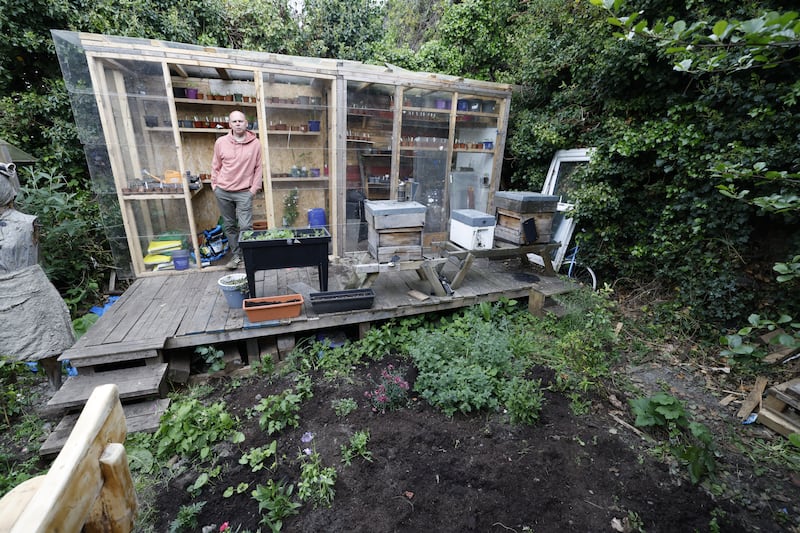 Anthony Freeman-O’Brien in his greenhouse, built with Covid screens and timber. Photograph: Nick Bradshaw
He worried that his kids were going to think less of him. “I knew something had to change and then I had a bit of a breakdown. When I came out of the breakdown, a poster appeared in Oliver Bond saying ‘Come around to Robert Emmet and we’ll help you find work’.” Maureen convinced him to become a tour guide with the In Our Shoes walking tours. She helped him get on a course at the National College of Art and Design. And then came the bees.
At first he dreaded them. In the second season, Austin Campbell – who took over from Maureen as chief executive – loved the project and ordered more hives “so it was a steep learning curve straight away”.
Then one day, he says, “everything clicked”.
“I was in here and I was sitting with the bees and it was like a dance around me. They weren’t bothering me. I was just moving slow. I was just enjoying it for the first time and it just clicked and I fell in love. And it was that day it dawned on me what I was sitting in, in this space. This could be something special.”
Since then, his love of urban greening has grown like the towering young alder tree he planted in the shadow of St Patrick’s tower. The tree’s name is Big Jake. “When I was growing up I couldn’t have cared less about nature. Up until five years ago I couldn’ta gave a bollocks and now everything amazes me,” he says with a wide grin. “Strawberries blew me mind. I didn’t know strawberries turn into flowers before they turn into strawberries.”
In April, a study by Trinity College Dublin economist Barra Roantree found that crime rates and drug deaths in the southwest inner city were twice the national average. Only slightly more than one in three young people goes to college – less than half the national average. What does Freeman-O’Brien make of these grim statistics?
 Honeybees on one of two hives at the Liberties city garden, Dublin 8. Photograph: Nick Bradshaw
  A smoker, which beekeeper Anthony Freeman-O’Brien uses to calm the bees. Photograph: Nick Bradshaw
“I don’t think it’s any coincidence that we have all these social problems and we’re the most culturally and socially deprived community in the country,” he says. “I don’t think it’s any coincidence that they occur at the same time. Because there is a stark lack of anything around here.”
The Liberties Community Project is working to change that, taking on new urban gardens, some of them in social housing complexes like Oliver Bond and Queen Street flats.
“If you live in social housing there’s a lot of history where you weren’t allowed plant in the gardens,” Freeman-O’Brien explains. “For most of my life we weren’t allowed use the gardens in Oliver Bond. That’s in the back of people’s consciousness. If you done it you were going to be forced to remove it. So that’s the message we’re trying to change.
“I want to encourage people to just take some space. Just take it. You don’t have to ask for permission. Pick a spot, get a shovel and go out and start digging. You find people actually get on board quick enough when you’re doing something good.”
This garden gives him respite – and he’s keen to share it. “I always think nature is like a zoo animal to inner city children. It’s something they visit now and again and it’s behind a fence and you can’t really interact with it.”
He doesn’t advise people to get into beekeeping now as honey bees compete for limited resources with wild bees. One hive needs about 180lb of pollen in a season, he says. “So it takes around 20,000 flowers to make a pound of honey.”
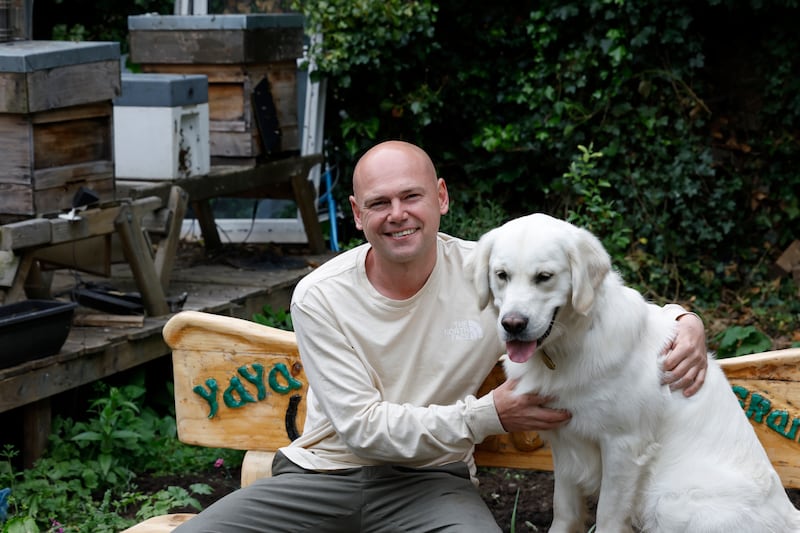 Anthony Freeman-O’Brien with his dog Ryder. Photograph Nick Bradshaw
  Beekeeper Anthony Freeman-O’Brien holding honeycomb from one of his beehives. Photograph: Nick Bradshaw
Honey is no longer harvested from the 42 project hives on rooftops and gardens around the area; it is left in the hive to feed the bees. But the hive has taught Freeman-O’Brien a lot. “It’s co-operation. Everything is for the whole. The individual doesn’t really matter as much as the whole. Like in the winter, you’ll find winter bees don’t sting you because they don’t want to sacrifice themselves, and lose the numbers, whereas in the summer they’ll hit you in a second, as soon as you make the wrong move,” he says.
“It’s impressive because if a bee finds a problem in a hive it’s their problem to solve. It’s all co-ordinated. They all have their own roles. Everything is debated. There’s this misconception that the queen bee is in charge. That couldn’t be further from the truth. She’s only there to lay eggs. It’s the rest of the workers are in charge and they communicate through pheromones and through dance about what’s needed in the hive.”
Explaining the difference between the waggle dance and the circle dance is something he loves to do, especially with schoolchildren. Both dances are ways that a worker bee returning to the hive tells her co-workers where to find the best food.
Gardening has been a refuge for Freeman-O’Brien. “It’s just a very strong tool in your kit when it comes to being overwhelmed. The city is very overwhelming. I didn’t realise how much it affected me till I got peace … flowers just cheer you up.”
Passersby drop in for chats, and he often talks to tourists. “This sort of stuff is life skills, and by life skills I mean how to deal with life. There’s a lot we miss out by not teaching skills like that in schools. [Gardening] teaches you a lot about life and death, like things don’t last and things can be hard. There’s a lot that it does to you inside without you realising it. You’re putting your hands in the soil, just sitting here some days, and you hear the birds and it’s quiet. There’s a lot it does for you without you putting in the effort for it to do it for you.”
Ivy has clambered up the wall behind Big Jake. “The blue tits all nest along there and then I get a show near the end of the season because all the chicks come out and they practise flying by jumping from ivy to ivy. So I went from feeling the world was against me a few years ago to being very conscious I have a very privileged life now,” he says.
[ ‘They’re lifelines’: How community gardens boost mental health and social inclusionOpens in new window ]
“I still struggle financially like everybody else in the country, but emotionally I have a lot of privilege now. I really appreciate what I have in my life. I feel like the people around here gave it to me as well because they could. Bringing the tours into Oliver Bond, anybody could have caused me problems or made a complaint. It never happened. Everybody was the exact opposite to what I thought was going to happen. The lads next door with their pigeon lofts, they could have easily said, ‘We can’t have 50,000 bees behind our wall,’ but actually for the first few years they were the ones supplying me with electricity and water.”
Sitting here, it’s easy to forget we are in the inner city. The relentless traffic noise is dimmed by the solid bank building in front and the high walls on the other three sides. When they get busier, the bees will begin to generate a low hum – a sound that he finds deeply relaxing, and great for anyone with anger issues.
Freeman-O’Brien would love to see more people taking ownership of urban green spaces. “I just feel free. The big thing I’d love people to do in Tallaght, Finglas, all these large social housing projects, they have massive green spaces but they’re just green deserts: just go out and make yourself a giant hedge maze, enjoy these spaces, take them and see what it does for you. Trying something new brings you to new places. Beekeeping introduced me to all the wilding stuff. One thing you do evolves into something else,” he says.
“When I start an art piece I usually don’t finish making what I started the idea with. And that’s what greening is. You go out and take a space you, don’t know what opportunities that’s going to lead to. It mightn’t be the one you’d want but you’ll get something, and something good will come in your life.”
Comments are closed.