
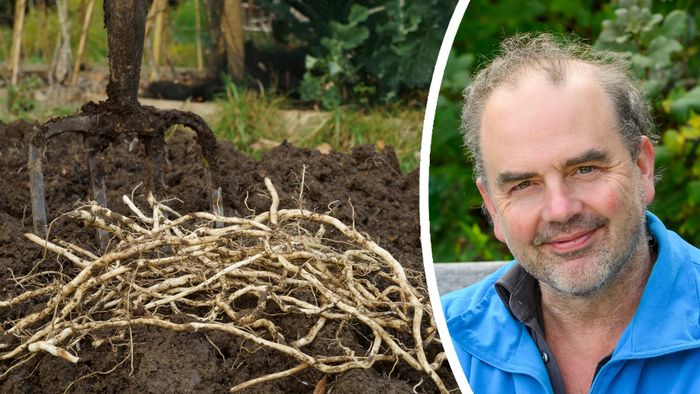
Green-fingered expert Simon Akeroyd likes to simplify gardening, drawing on decades of hands-on experience. The RHS-trained gardener has more than 2.4 million followers on social media, thanks to his inspiring and straightforward advice.
“Nature doesn’t really have any rules, so I just do things my way by experimenting,” says Akeroyd, who has written more than 30 gardening books. His latest, Way To Grow, is packed with handy tips to save both time and money in the garden.
“I think we make it really long-winded because there are so many different ways of growing things,” he says. The Devon-based horticulturalist has shared six clever (and slightly unusual) tips based on his hugely popular social media shorts.
READ MORE1. Keyhole gardening
Rather than having a separate compost heap, he suggests piling the materials in the centre of a circular raised bed, allowing nutrients to seep out into the area where your plants are growing. Viewed from above, it resembles a keyhole with a notch in the circle to allow access to the compost, says PA’s Hannah Stephenson.
Originally developed in parts of Africa during the 1990s, the technique was designed to help gardeners grow food in dry conditions with limited resources. As the water is delivered through the compost, it helps maintain consistent moisture levels, reducing the need for frequent watering.
The bed itself can be made from a variety of materials, including bricks, logs or anything else you have available. “Almost any vegetable would benefit, from lettuces and cabbages to courgettes and pumpkin,” says Akeroyd.
 KEYHOLE GARDENING: A circular raised bed with a compost heap in the middle (Image: PA)2. Liquid feed from bindweed
Bindweed can be a nuisance but the roots make a great feed if you chuck them in a bucket of water and let them rot. Akeroyd says: “The problem with bindweed is that you can’t add it to your compost heap because the roots will just start growing in your compost.
“But if you drown it you can use it as a liquid feed as it’s high in nitrogen and potassium. Make sure it has rotted, which takes a good few weeks. The roots, which look like white spaghetti, should have gone black and feel squishy. Then you have this lovely liquid feed.”
3. Catch slugs with damp planks
Akeroyd says: “The easiest way to get rid of slugs is to take a plank of wood and lean it on to the shady side of your raised bed to create a shelter for them to gather. I water it in the evening, as slugs and snails like it slightly damp. The next morning, pick your plank up and you’re likely to find loads of slugs and snails on the underside of the plank.”

4. Mesh potato tower
“This is great for space-saving and you don’t have to do any digging or earthing up. Put three or four little posts in a small circle and wrap chicken wire around them in a cylinder shape, securing the wire with string to stop it unrolling. I didn’t dig up the grass where I made one.”
Add about 25cm of compost to the base of the tower, then place four evenly spaced potatoes on top. Cover these with another 25cm layer of compost before adding more potatoes. Continue this process until you reach the top of the tower.
“You could put a maincrop in the bottom, then second earlies a bit higher up and your first earlies at the top and more compost – then you could gradually harvest them. Your first earlies ripen first, so you’ll work your way down the tower as and when you want the potatoes,” says Akeroyd.
5. Feather and potato bird-scarer
“Basically you take an old potato, stick feathers in it, then use a skewer to make a hole through the middle of it, get a piece of string and thread it through and tie the potato up, suspending it over your crops. It moves in the wind and scares birds,” he says.
 BIRD SCARER: It might look strange but Simon says it works (Image: PA)6. White stones to speed ripening
Akeroyd says: “Before I studied horticulture, I studied viticulture. What I noticed travelling through vineyards in France and Spain is that they use white pebbles underneath the rows of their vineyard to reflect the light, because of course white reflects the light up into the bunches of grapes.
“Now I use it for ripening tomatoes, aubergines, peppers and fruit. I put white pebbles on the layer of compost and it reflects up into the canopy, and helps ripen cucumbers, squashes and many other fruit and veg.” They also help conserve moisture and prevent weeds.
Money-saving growing 🌱📚
This article contains affiliate links and we may receive a commission on any sales we generate from it. Learn more.
Save 21% on Way To Grow: Over 100 Hacks For Green-fingered Greatness by Simon Akeroyd, now £13.45 on Amazon. Keyhole gardening, watering pots with lengths of string and many more tips. Save 21% on Grow Your Groceries by Simon Akeroyd, also £13.45 on Amazon. 40 simple hacks for growing plants from your weekly shop, using tomato slices, split teabags and much more. The Money-Saving Gardener by Anya Lautenbach, costs £16.99 at Waterstones. Learn how to repurpose what you have, make the most of garden ‘waste’, and boost your plant collection for next to nothing.
Prices correct at the time of publication.
MORE FOR GARDENERS
Comments are closed.