

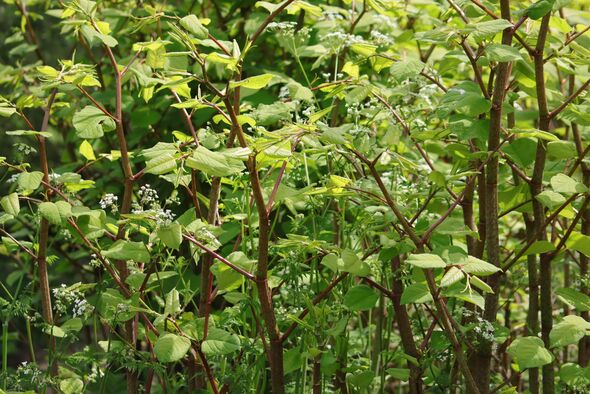
The stems of young Japanese knotweed have a reddish colouring (Image: Getty)
Gardeners across the UK are being urged to remove the red shoots of highly invasive Japanese knotweed from gardens in May.
Japanese knotweed is listed by the World Conservation Union as one of the world’s most invasive plant species, with a root system strong enough to damage concrete, roads and buildings. The plant is particularly active during spring when reddish-purple shoots will emerge from pink buds at ground level, and by summer it becomes fully formed with tall canes up to 3.5m and large shovel-like green leaves. The resilient weed spreads rapidly and has bamboo-like stems that are capable of growing up to 10cm in a single day.
Its roots, known as rhizomes, emerge deep underground and can stretch for more than two metres (7ft), which can cause damage to buildings and their foundations. The plant will grow through small cracks which can damage walls and patios, as well as building foundations, and it can also strangle other plants due to its invasive roots.
Read More: Hydrangeas will bloom bright blue if 1 kitchen scrap is added to soil
Read More: Gardeners urged to pour white vinegar on patios in May
As it’s so invasive, Japanese knotweed is subject to various legal controls and while it’s not an offence to have it growing in your garden it is an offence to plant or cause it to grow in the wild, so you should take steps to stop it from spreading.
Lawns will turn extra green in May if fed 1 kitchen scrap
The Royal Horticultural Society (RHS) says the easiest and most effective way to remove Japanese knotweed is to hire a professional company that specialises in the removal of invasive weeds, but it can also be controlled using weedkillers.
The RHS said: “The RHS does not support the use of weedkillers and usually recommends that alternative control methods are used. However, when invasive plants are a threat to biodiversity, pose legal problems, and gardeners struggle to control them with cultural methods, targeted use of a regulated weedkiller is an option.
“It usually takes at least three growing seasons to eradicate Japanese knotweed using weedkiller. Professional contractors are often able to achieve complete eradication in less time.”
The RHS added: “For home gardeners, the most effective chemical control to tackle Japanese knotweed is a glyphosate-based weedkiller (bearing in mind that, in this specific instance, the control of this plant prevents the loss of biodiversity in gardens). Garden centres and large retailers selling weedkillers have trained staff who can advise on suitable products for your needs.”
If you are planning on selling your home, it is a legal requirement to state whether the weed is on your property. If the plant is present in your garden it must be kept under control or you could risk being sued or even prosecuted.
According to home insurance experts at Quotezone.co.uk, the average cost of removing and excavating Japanese knotweed is around £6,500, but depending on the size of the infestation and the type of removal method, prices can range from £1,000 up to £20,000.
Its roots are strong enough to grow beneath slabs and surfaces, causing them to lift or crack, and it can even grow through cracks in brickwork and retaining walls. If the invasive plant makes its way onto nearby properties, neighbours can also sue.
Japanese knotweed can be difficult to identify, but it will often have red or purple shoots in the spring. It also has creamy white flowers, hollow, bamboo-like stems and heart-shaped leaves.
Helen Rolph, insurance expert at Quotezone.co.uk, said: “Japanese Knotweed is a seriously invasive plant that can cause some real damage to homes and gardens, so it’s important people are aware of how to recognise it and what to do if it’s present on their property.
“Since standard home insurance won’t normally cover damage caused by the plant, it means homeowners have to deal with its removal on their own as well as paying for any damage it may have caused. This is why spotting the plant early and treating it as soon as possible is key.
“There are some examples where homeowners must legally declare Japanese knotweed on their property. This includes when they’re selling the home and if their insurance provider specifically asks them about it directly.
“Homeowners should also be aware of the consequences that come with not containing the growth properly. If the plant grows into a neighbour’s garden, they could sue, and if it reaches the wild, homeowners could face prosecution.”
Comments are closed.