
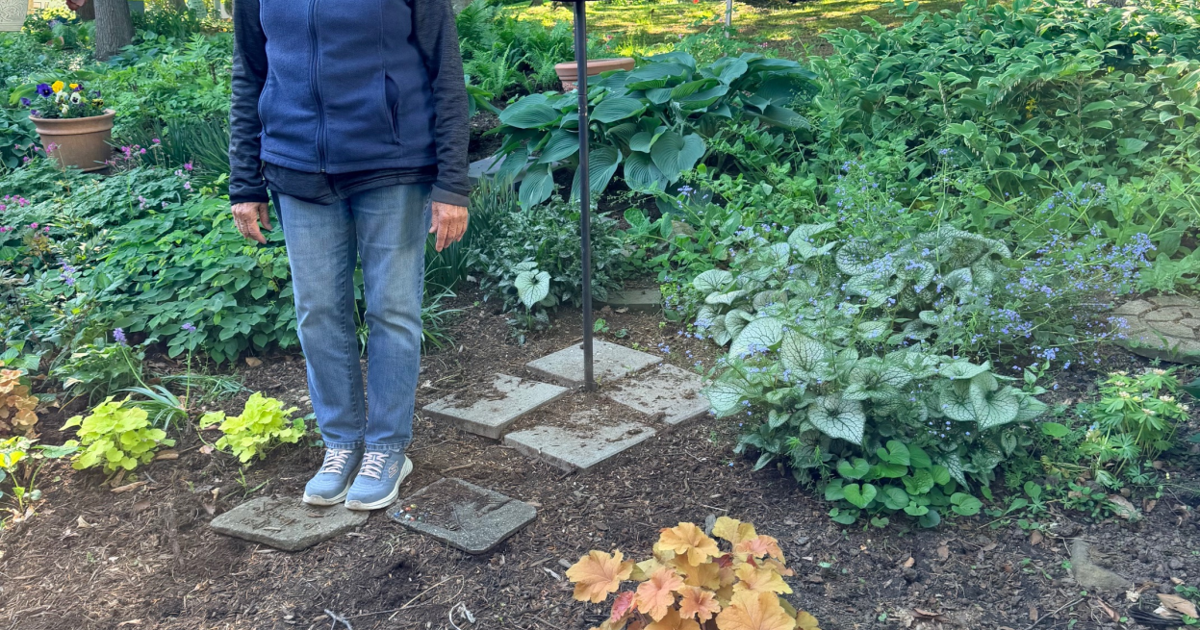
It was a parched, steep hillside, with a grove of native American beech trees creating deep and dappled shade. Erosion was significant, with the landscaper’s mulch washing away with each rain. It was also the backyard for several neighbors in an East Hempfield condominium complex.
By all accounts, the shady dry soil was a seemingly impossible place for a garden.
But Joy Temple Ray, 72, was determined to create a soothing space behind her patio to enjoy her coffee while protecting the trees and helping wildlife. Ray, who started the project 22 years ago by planting a couple of hostas, is now enjoying the fruits of her labor as the space blooms with Virginia bluebells, hellebores, ferns, various violets, heuchera, Solomon’s seal and other shade-loving plants beneath a grove of American beech trees. It’s become a backyard oasis for Ray and her neighbors.
Ray’s friend Jane Kintzi, a volunteer master gardener with Penn State Extension, was a helpful sounding board over the years. Kintzi is quick to say that Ray did all “the research and hands-on work.”
“It’s a trial-and-error and long-term friendship project,” Kintzi says of Ray’s garden.
MASTER GARDENERS
If you are stumped about what to plant in shady areas of your yard, there are many resources available to guide you. Jane Kintzi, a volunteer master gardener at Penn State Extension, says gardeners can call their hotline at 717-394-6851 or email plant, soil, and insect questions to LancasterMG@psu.edu. Residents can get a soil test kit for $10.
![Look inside the Lancaster Twp. greenhouses growing award-winning orchids [photos]](data:image/png;base64,iVBORw0KGgoAAAANSUhEUgAAAAEAAAABCAQAAAC1HAwCAAAAC0lEQVR42mP8Xw8AAoMBgDTD2qgAAAAASUVORK5CYII=)
Making friends
Over two decades ago, Ray made her first foray into gardening in the space by planting three hostas to stabilize the dry, shallow soil.
Ray says she shared the “how and why” with the HOA shortly after planting the hostas to help stop the runoff. They granted permission of planting in the common area as long as she maintained the plants and paid for them. “Don’t go crazy — we’re not paying you for it,” she recalls them saying. She followed up with the HOA a couple years later before adding more plants, securing permission again.
Kintzi says Ray also befriended the landscapers who were “pulling things up” and spreading mulch. Ray explained to them what she was doing with the space and asked them to leave the mulch in a pile for her to carefully spread around the nascent plants. As the greenery flourished over the seasons, Kintzi says Ray approached her neighbors who share the shaded erosion gully.
“Neighbors welcomed her efforts with ‘extra plants,’ ”
Kintzi says. “Getting to know the landscapers and the neighbors was helpful” to the project.
Five years after planting them, Ray says she felt good that those initial big, blue hostas were doing really well and looking healthy.
“They have continued to thrive and it makes me smile every year when I see their leaf sprouts pop up,” Ray says.
Information is power
Ray read up on beech trees and consulted an arborist at Longwood Gardens. She learned that the dense canopy, made up of millions of tiny leaves, requires plenty of water. She says the trees have deep tap roots as well as roots close to the surface to slurp up that rainfall. There is a chemical in the beech tree roots that deters other plants from growing underneath them and competing for water, which she had to work with.
Colorful coral bells in the East Hempfield garden of Joy Temple Ray.
KARYL CARMIGNANI
Ray says she scours books and magazines for ideas, and seeks out experts — like her friend Kintzi — for tips. She also observes botanical gardens and natural woodlands like Shenks Ferry Wildflower Preserve to see what grows together. She says this garden is a mixture of native and non-native plants — and plants that would survive beneath the beech trees.
The area had significant runnels from erosion, so a priority was finding a way to slow the flow and channel the water away from homes. She discovered the efficacy of dry riverbed rock in “Garden Gate” magazine. She asked the home owner association if they could get the stones. She says they were skeptical initially, but provided the materials and helped Ray and her neighbors lay it down.
The hillside required additional organic material—which she and her gardener friends added—and plants to stabilize it. She built little tiers for some plantings.
“Soil is most important” for plants to flourish, says Kintzi. She says that in Ray’s space, she couldn’t use deep rooted plants and still protect the beech trees; adding compost and organic material solved that.
Ray says it’s important to add plants that will work with the environment, topography and seasonality of the space.
“This is going to be happenstance what likes to be together and what doesn’t,” Ray adds about her early efforts.
Kintzi agrees, saying there was a great deal of experimenting over the years. She says it’s important to read the tags on plants for its mature size, light requirements, water needs, and spreading/reseeding tendencies.
“You’re not going to get bubble gum petunias growing in the shade no matter how much you like them,” she says.
Ray says the perennials are more about color and texture in the leaves in the shade than flashy blooms. She fills pots with colorful annuals like pansies, fuchsias, impatiens and begonias for added pizazz.
Ray says it is a learning process to understand exactly where a plant does best. For instance, she planted a red columbine at the top of the garden in hard shade, but it faltered. Moving it a few feet lower into dappled shade, it took off.
Another milestone occurred about five years ago when Ray was “elated to see the Virginia bluebells looking robust and starting to spread on their own, as did the variegated Solomon’s seal.”
Kintzi adds that “learning to layer” enhances a garden. Like Virginia bluebells next to hostas —when the bluebells fade, the hosta leaves are springing to life.
“There’s not a lot of summer bloomers in the shade,” Kintzi says. “Use leaves for color and texture.”
Patience, grasshopper
Ray says patience is key to a successful garden. It took 10 years for those Virginia bluebells to establish themselves.
For most perennials, “I have a three-to-five-year thing in my head, as that’s how long it takes for them to decide it’s happy there.”
She says it’s important to think about your plantings, even for a small space.
“Find your style,” Ray says. “Do you want neat clumps or a hodgepodge garden?”
Ray tries to keep a bit of space around the plants, as well a natural walkway to get the hose to the plants during the dry times. The garden has stretched into the backyards of other residents, which she consulted with. Ray says the neighbors are “happy with anything I do” in the landscape.
Ray’s efforts — and patience — have transformed the space into a wildlife corridor, with squirrels and other animals feasting on the beech tree nuts. The animals have cover and feel safe, she says. One time, a turkey sauntered past as she ate her dinner on her patio.
Deer walk through, nibbling as they go. “That’s just part of it,” Ray says. But they don’t like thick-leaved hostas. “I just wish they would eat more weeds.”
“Don’t spray [for weeds and insects] if you want wildlife,” Kintzi adds. “That’s just mean.”
During dry spells, Ray waters every third day in the morning (“never mid-day”), letting a sprinkler soak the ground for 20-30 minutes. She says the trees seem to like it, too.
She says gardeners should be willing to accept the unexpected, as well, like a group of bright yellow daisies popping up among the bluebells and Solomon’s seal.
“I never expected to do all this,” she says. “I was just happy the bluebells came back up.”
Managing the garden has changed over the years.
“Ten years ago, I was just hoping things would live,” Ray says. “Now I know what comes up and have to decide how much to cull to keep the vision of the garden.” She says those surplus specimens go to her friends.
The journey has enabled Ray to “garden to her aesthetics as well as to the beech trees’ health,” Kintzi says.
Growing this garden into a thriving micro-habitat has been a learning experience for Ray.
“You have to be very patient,” Ray says. “Nature does what nature does.”
TIPS FOR SHADE GARDENERS
— Look at your site for an entire year to determine its sun-shade time. Note nearby deciduous trees, background trees and buildings that may impact the area.
— Consider your water source. Trees will need thorough watering for the first 3 to 5 years: will you use a bucket or hose?
— Read tags on plants carefully and obey directions. Lancaster is currently a 7a zone.
— Spring ephemerals like trillium, foamflowers and bluebells will eventually spread.
— Let the colorful, textured leaves do the talking after bloom time: hostas, coleus, pulmonaria (lungwort), brunnera. Ferns of all kinds are colorful fillers.
— Explore botanical gardens, wildlands, and garden centers for inspiration. “Bringing Nature Home” by Doug Tallamy is a helpful resource for integrating native species.
Comments are closed.