
 6 min readEasy to maneuver around landscaping and treesEnough runtime to cover a full acreProduces an outstanding cut even in thick grass
Yards in the quarter acre to half acre range fall in that gray area when it comes to investing in a riding mower. While riding mowers can save time over a walk-behind mower, the difficulties of navigating around trees and landscaping with a lawn tractor often make them impractical for the average suburban yard. Ryobi’s new battery-powered R1 riding mower is an exception. With its 30-inch deck and short wheelbase, it’s one of the most compact electric riding mowers we’ve seen.
I spent three weeks testing it on my own quarter acre yard and found that it makes the cut when it comes to mowing in tighter confines. In spite of some issues navigating uneven terrain, it’s nimble enough to maneuver around trees and flower beds in smaller yards. Its dual blades, powered by an 80-volt system that uses three brushless motors, leave an outstanding cut even when the grass is high and thick. The R1 also packs enough runtime to mow up to an acre on a single charge. In the end, I found that the Ryobi R1 offers what we look for when upgrading from a walk-behind mower to a riding mower—tangible time savings.
Sized for Smaller Properties
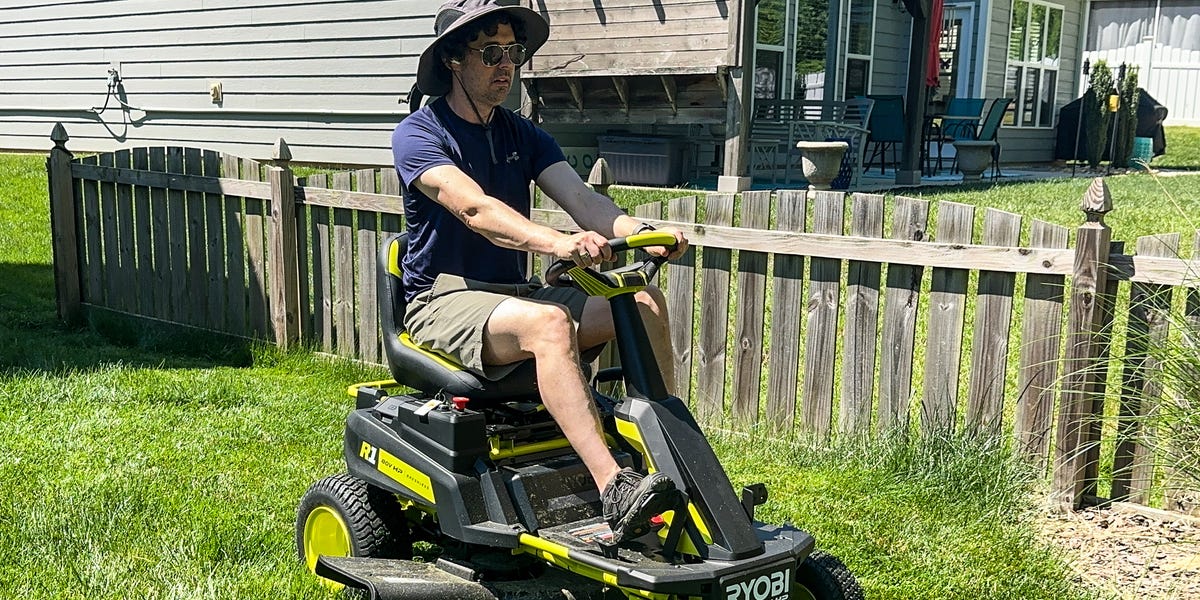
With its fence, various landscaped beds, a fire pit, and trees, my yard proved to be a good test for the R1’s maneuverability. A short wheelbase gives the R1 a tight turning radius. Even though my front yard is small, I was able to guide it around a curving walk and along a landscaped bed that borders the front of my house without having to back up or make multiple passes to avoid missing spots.
The larger backyard required less maneuvering for the R1, so I was able to pick up speed and didn’t have to spend as much time maneuvering around obstacles or making turns. This is where I was really able to shave time off my lawn mowing chore. With its 30-inch deck, which is far wider than the 19-inch deck on my push mower and a faster pace, I simply cut more grass with each pass. A job that typically takes me about 45 minutes to an hour is reduced to just 20 minutes. I could probably trim a few more minutes off that time after logging more hours on the R1.
As with any riding mower, the R1 does have its limitations. One of the banks on the side of my house has a 20-degree max slope that’s not safe for lawn tractors, so I had to go back over a few strips of grass with a push mower to finish the job. I also found I couldn’t get quite as close to trees and shrubs with lower branches as I can with a push mower. This meant that I had to go back with a string trimmer or push mower to hit these areas. While this is certainly a drawback, it’s not one specific to the Ryobi R1 riding mower. The inability to mow slopes or get tight to fences and landscaping is a problem you’ll face with any lawn tractor.
Great Handling On Flat Terrain
The R1 is fun and easy to drive. It uses a foot pedal that acts as an accelerator, making it easy and natural to regulate speed for anyone who has ever driven a car or golf cart. The left pedal functions as a brake. A second pedal just in front of the gas pedal puts the R1 in reverse.
The R1 excels on flat ground with a smooth, comfortable ride. Where I ran into problems was on uneven terrain. Since the R1 uses an open differential on its rear drive wheels, the wheel with the least resistance gets the most power. Thus, if one of the rear wheels comes off the ground while driving over uneven areas, it spins while the wheel that is still on the ground gets no power, leaving you stuck. This happened to me on several occasions while navigating some uneven ground in my yard. I found myself having to shift my weight to get traction on the spinning drive wheel. On a few occasions I had to get out and push to get the mower going again.
 Anthony Carrick
Riding around on the R1
 Anthony Carrick
Foot pedal controls for the drive system
I also found some inconsistencies with acceleration on small inclines. While the 80-volt system makes the R1 quite peppy, the torque it puts out can be a little jerky. On a couple of occasions, the R1 stalled on a mild incline, prompting me to apply more gas. This caused the mower to jerk forward suddenly, at one point causing me to pop a wheelie while moving up a small incline in my front yard.
My yard is relatively flat, so these issues are fixable by changing my mowing pattern, but they could present a problem on yards with a lot of uneven terrain to navigate.
An Excellent Cut
The Ryobi R1 uses three brushless motors that give it, according to Ryobi, the equivalent of a 16-horsepower engine, so I had high expectations for its cut quality. I made my first mow with the R1 in what I would judge to be unfair conditions for testing. I had let my lawn go for several weeks in the prime spring grass growing season, so it was tall, thick, and generally overdue for a cut.
Despite these conditions, the R1’s double blades had no problem handling it, even with the mulch kit in place. It produced an even, beautiful cut while mulching those clippings into tiny pieces with no noticeable clumping. My second go around with the R1 was with the grass a normal height for cutting and was just as impressive a cut, with clippings cut so fine that they weren’t visible on the lawn.
Great Battery Life
The R1 uses a single removable 80-volt battery, which Ryobi says can handle up to a half acre. There’s also a spot for a second battery, which Ryobi claims doubles runtime to enough for a full acre. The R1’s LED control panel, which is located to the right of the seat, shows the percentage of battery charge remaining. This was handy for gauging my runtime while mowing.
I completed my first mow with more than 40 percent of the battery remaining, which is in line with Ryobi’s estimates. This was impressive given the length of the grass and the fact that I was learning how to use the mower. I also took it for a spin up and down my quiet neighborhood road just for kicks on that first test run. The second time mowing I was more efficient, and that showed with battery life as I finished with about 55 percent of the battery remaining.
 Anthony Carrick
Ryobi R1 control panel
I was less thrilled with the R1’s recharge time. The 80v battery should take about 1.5 to two hours to charge; however, it took me a full four hours to charge from 0 to 100 percent. To be fair, I’m not sure if this was an issue with the charger or with the electrical outlet in my garage as I couldn’t find any reports of lengthy recharge times amid user reviews. The Ryobi charger plugs into a standard outlet and mounts to the wall, similar to an electric vehicle charger. Since the charger plugs into a port on the side of the mower, there’s no need to remove the battery from its dock.
The Verdict
With its $3,000 price tag, the R1 is an investment, but so is any riding mower. It’s actually one of the most affordable battery-powered riding mowers we’ve seen. It has enough runtime to handle a 1/2-acre yard and can easily bump up to a full acre with the addition of a second battery, which retails for about $700. With its three brushless motors, it’s capable of moving surprisingly fast. Those motors also do an excellent job of powering its dual blades, making a clean cut even in tall, thick grass.
Its small size and maneuverability make it ideal for smaller yards or those yards that have a lot of trees and landscaping to maneuver around. As I found during testing, uneven terrain does present challenges for the R1. If one rear wheel ends up off the ground, it’s essentially stuck. Inclines can also cause the mower to jerk forward. These qualities limit the R1 to yards that are mostly flat. But if you are looking to reduce your runtime from a push mower or just looking to get off your feet but not hire out your mowing, this is well worth considering.
Shop the Ryobi R1 Riding Mower
Other Lawn Mowers We Recommend
Best Overall
 Ego Power+ Power+ 21-Inch Select Cut XP Electric Lawn Mower
Now 40% Off
EGO’s user-friendly controls, X-shaped blade that produces an outstanding cut, and a long runtime are the main reasons why it tops our list of the best battery-powered lawn mowers.
Best Value
 40V HP 21-Inch Lawn Mower
This affordably priced battery-powered self-propelled mower’s features and design make it one of the easiest mowers to use. We loved its smooth handling and intuitive controls, all of which are centrally located right on the handle.
Best Electric Lawn Tractor
 Ego Power+ T6 Electric Riding Lawn Mower
Now 9% Off
With a 42-inch deck and six 56-volt batteries, this mower can handle up to 1.5 acres. It’s one of the quietest mowers we’ve tested, and it boasts excellent cut quality with variable speeds that make it easy to control.

Tony Carrick is a full-time freelance writer who specializes in technology, home improvement, DIY, home security, and outdoor recreation. He’s tested and written about everything from home security systems to power tools to gas grills. His product guides, how-to articles, and feature stories can be found in such publications as Bob Vila, Angi, U.S. News and World Report, Field & Stream, Futurism, and Switchful. When Tony isn’t writing, he can be found working on his latest home improvement effort at his home in North Carolina.

Colin Aylesworth attended Binghamton University and is a Deputy Editor with the Gear team at Popular Mechanics and Runner’s World, where he has been since 2022. Prior to joining Hearst Magazines, he worked for 11 years at U.S. News and World Report on the autos team.
His personal pursuits fit in well with the work he does for PM and RW. Aylesworth was on his college’s club rowing team and has maintained a routine running habit through most of his adult life as a means of getting exercise and spending time outdoors. Running creates a hearty appetite, which brings us to Popular Mechanics. That publication’s expertise in the area of grilling is relatable to Aylesworth, who is an adherent to charcoal grilling. In fact, he’s been primarily using the same Weber charcoal kettle he bought on Craigslist in 2012.
Aylesworth also has experience in the lawn mower industry. Not only has he been mowing his and neighbor’s lawns during adolescence, one of his more recent endeavors is a side gig of repairing and restoring gas lawn mowers given up by their previous owners. Since joining PM, he has gotten more involved with the publication’s mower testing efforts and especially enjoys testing out new electric and zero turn mowers.
Comments are closed.