
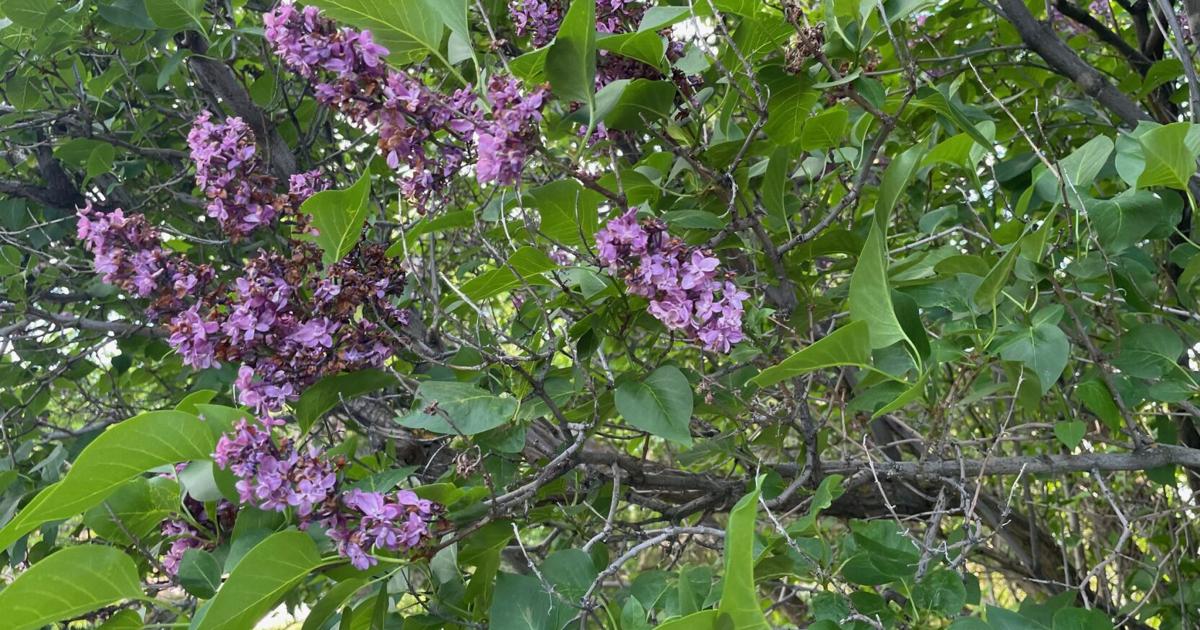
Every gardener has a list of plants they wish they could grow but can’t because of Yakima’s freezing winters. I count it a blessing that lilacs are not on my list. Lilacs are plants for colder climates, requiring a period of cold-initiated dormancy to trigger flowering — something chilly Zones 4-7 can offer.
On April walks through my neighborhood, I enjoy their sweet fragrance on nearly every block I pass. For me, spring smells just like lilacs.
Lilacs are members of the Syringa genus, which includes 12 species of flowering plants in the olive family, native to Russia and Poland. These deciduous shrubs were introduced to America in the mid-17th century by French settlers and have since become part of our horticultural history.
In 1767, Thomas Jefferson recorded his method of planting lilacs in his “Garden Book.” In 1785, George Washington noted in his journal that he had transplanted existing lilacs in his garden. The oldest living lilacs in North America may be those at the Governor Wentworth estate in Portsmouth, New Hampshire, believed to have been planted around 1750.
Over the next century, lilacs were planted in gardens across America. In 1906, two lilacs were planted on Second Avenue in Spokane, by one of the city’s early founders. Six years later, John Duncan obtained 128 lilac cultivars from Rochester, New York, and began planting what would become the lilac garden in Manito Park.
In the 1930s, Spokane began promoting itself as the Lilac City and launched a festival that has been going strong since 1938.
Rochester, New York, is home to North America’s largest lilac collection, with more than 1,200 bushes and over 500 varieties displayed in Highland Park. Each May, about 500,000 visitors attend the Lilac Festival.
Closer to home, you can visit the Hulda Klager Lilac Gardens in Woodland, Washington.
Syringa vulgaris, the common lilac, is the most popular species and includes hundreds of varieties that differ in color, size, flower type and fragrance. The spectacular floral display arrives in late spring, when masses of small flowers are packed into dense pyramidal or conical clusters.
Blooms last only about two weeks, but their fragrance and beauty make the effort worthwhile. Trust me — if you have room, plant a lilac. Their blooming period can be extended by choosing several varieties that flower at different times.
Sign up for our Daily Headlines newsletter — delivered to your inbox every morning at 7 a.m.
Thanks! You’re all set.
Watch your inbox for Daily Headlines.
Lilacs grow best in full sun and well-drained soil. Plants grown in partial sun or shade will not flower well. Shrubs may take three to four years to establish, but once established, they can live for centuries. My home is 102 years old, and lilacs planted when the house was first built continue to bloom with little care.
Lilacs require well-drained soil high in organic matter, with a neutral to slightly alkaline pH — which sounds like Yakima to me. They do not like “wet feet,” or areas where water pools after heavy rainfall. Yakima gardeners win again on that count.
You only get one chance to get your lilac off to a good start, and these plants can live for a century or more. Dig a planting hole two to three times the width of the root ball, but no deeper than its height. Backfill with native soil — don’t add amendments.
Air circulation is also critical to help prevent powdery mildew, so allow proper spacing if you’re planting more than one lilac.
Lilacs bloom best on healthy new growth rather than old stems. To ensure abundant flowering, cut off all spent blossoms each year and prune the flowering stem back to a set of leaves, preventing seed formation. Don’t wait too long — next year’s buds begin forming in summer.
Pruning in winter removes those buds and eliminates the following spring’s blooms. It is always appropriate, however, to remove dead, damaged or diseased branches.
When neglected, lilacs can reach 15 to 18 feet in height, with leaves and blossoms only at the top of the branches. Tall, leggy, poorly flowering plants call for renewal pruning. Remove about one-third of the oldest stems at ground level each year for three years. This encourages vigorous new growth from the base.
By the end of that period, the plant should be fully rejuvenated, with blossoms once more at nose level, where they can be appreciated.
Tough as lilacs are, they do need ample water while establishing. They thrive in moist but well-draining soil and are fairly drought-tolerant once established.
To make cut lilacs last longer, harvest them early in the morning when one-half to three-quarters of the flower buds are open. Remove the leaves to reduce moisture loss, and split or smash the bottom 2 inches of the woody stems. Place them immediately in fresh water. Kept out of direct sunlight, they can last three to four days.
Comments are closed.