
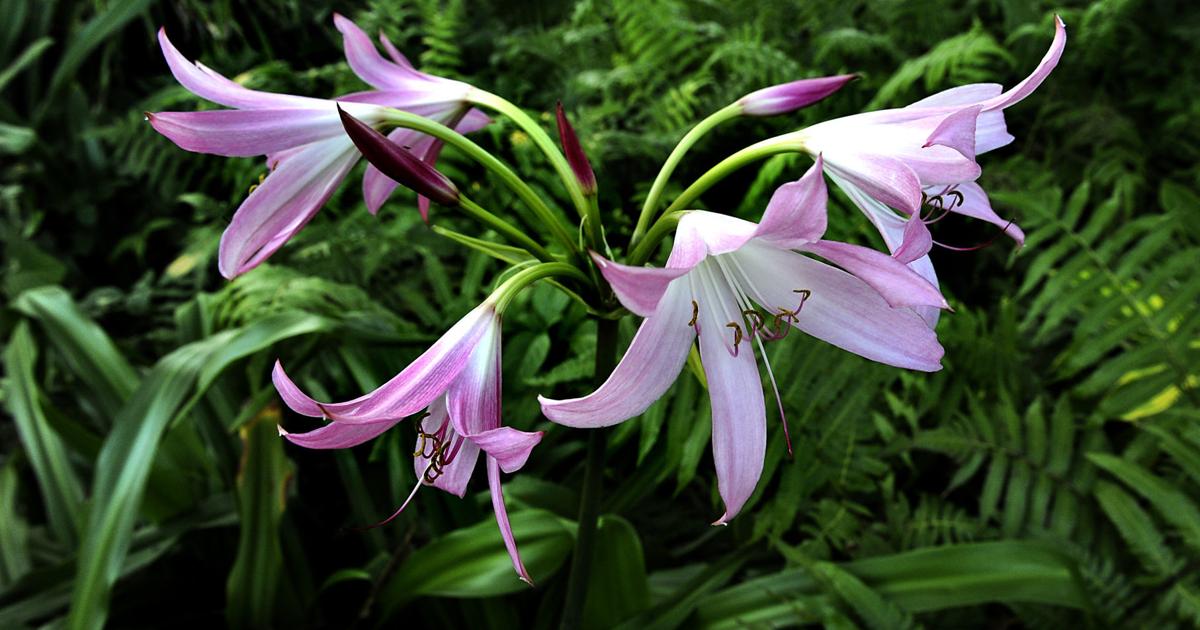
For a summer full of beautiful flowers and lush foliage, consider adding summer bulbs to your gardens. Summer bulbs bloom roughly from May through September.
Most summer flowering bulbs are native to tropical and subtropical climates and will reliably bloom here for many years. They make colorful additions to summer flower gardens and landscapes, and now is a great time to plant them.
In common usage, the term “bulb” is used for any fleshy below-ground structure produced by a plant, including bulbs, tubers, corms, rhizomes and tuberous roots. Although generally not critical, it is sometimes important to know that these structures do differ significantly from one another and can influence how the plant is cultivated and propagated.
Because they are such a large and diverse group of plants, summer bulbs will thrive in a wide variety of growing conditions in your landscape. Indeed, no matter what situation you have, there are almost always a few kinds of bulbs that will grow there.
Most summer bulbs prefer good drainage, although calla, canna, crinum, spider lily (Hymenocallis) and some gingers are a few exceptions. Full to part sun (six hours or more of direct sun) is important to most of these plants for healthy growth and flowering. But many, such as achimenes, caladium, gingers and bletilla, do fine in shadier spots.
Summer bulbs typically have a dormancy period in winter when the foliage dies off and the bulbs rest. A few bulbs are normally evergreen, such as agapanthus and some gingers, but they will go dormant if the winter is cold enough and several hard freezes occur.
As bulbs enter dormancy, growth stops and the foliage will become yellow, then brown. At that time, the foliage may be trimmed back to the ground. Be sure to place markers where the dormant bulbs are located. Sometimes it’s hard to remember exactly where they are when nothing shows above ground, and you can accidentally dig into them with a shovel if you’re not careful.
Avoid removing healthy, green foliage. It is the leaves that manufacture the food, which is stored in the bulb. If you frequently remove healthy foliage, you will reduce the plant’s ability to create food, weaken the bulb, lower the vigor of the plant and reduce flowering.
When planting summer flowering bulbs, dig generous amounts of organic matter, such as compost, aged manure or soil conditioner, into the area before you plant your bulbs. The application of a general-purpose granular fertilizer once or twice during active growth from March to August is sufficient for most summer bulbs.
Seed pods will sometimes form after a summer bulb has bloomed. Unless you want to try growing the plant from seeds, allowing the seed pods to develop is a waste of energy for the plant.
Growing most summer bulbs from seed is not especially difficult, but it requires patience as most will not bloom until they are at least 2 or 3 years old. Generally, I recommend that you remove the old flower spikes or developing seed pods as soon as you notice them.
Rather than planting seeds, propagate spring flowering bulbs by dividing the clumps when they are dormant or just waking up in early spring. Some bulbs, like crocosmia, do best divided every year or two while others, like agapanthus, prefer to be left alone.
There are many outstanding summer bulbs for our area. One of the best known and popular is the caladium, which is grown for its colorful foliage rather than flowers.
You can buy caladium tubers now and plant them directly into the garden. You may also plant pre-sprouted tubers that are available at many local nurseries. Unless you need growth immediately, the unsprouted tubers are generally a better buy.
Tubers left in the ground from last year should be up and growing by now if they made it through the winter. Caladium foliage is present from April through October, and the colorful, bold leaves combine very well with other shade-loving plants.
Gingers are a natural for south Louisiana landscapes and grow well in partially shaded conditions. They grow from rhizomes. Because they are native to the tropics, ornamental gingers thrive in our hot, humid summers. Despite their tropical origins, however, many gingers are completely root hardy here and make excellent permanent additions to your landscape.
The plants we call gingers include many genera, with many different sizes, growth habits and shapes of flowers. Low-growing gingers such as kaempferia and globba make great ground covers, while larger gingers reaching 5 to 10 feet such as costus, alpinia and hedychium, can be used for accent, screens or background plants.
My favorite true lily that grows well here is the Formosa lily, Lilium formosanum. Looking for all the world like a giant Easter lily (a close relative), the Formosa lily blooms in late summer in July and August. The large white trumpet flowers occur in a cluster at the top of plants 4 to 7 feet tall. It thrives in our heat and humidity.
This is just a taste of the many outstanding summer flowering bulbs for our area. They are generally reliable, long-lived and easy to grow. I recommend you dive in and have fun. The following lists will help you get started.
Summer bulbs for full sun to part sun: agapanthus, belamcanda, calla, canna, crinum, crocosmia, dieters, garlic chives (Allium tuberosum), gladiolus, gloriosa lily, habranthus, Tropical Giant spider lily (Hymenocallis caribaea), lilies (Formosa, Asiatic), lycoris, oxalis, tigridia, society garlic (Tulbaghia), zephyranthes.
Summer bulbs for part shade to shade: achimenes, alpinia, arisaema, bletilla, caladium, calla, costus, curcuma, globba, hedychium, hymenocallis, kaempferia, neomarica, oxalis.
Comments are closed.