

Horsetail has spent centuries adapting to different climates, weather conditions and soil types, and expert gardener Peter Dowdall warns that the usual methods of weed removal simply don’t work for it
Liam McInerney Content Editor
04:30, 09 May 2026

Image of invasive field horsetail weed in garden(Image: Getty)
Nobody enjoys dealing with a weed infestation in their garden, and there is one plant in particular that is virtually impossible to eliminate.
The horsetail weed has spent centuries adapting to various climates, weather conditions and soil types, meaning the usual methods of weed removal simply don’t cut it. That’s according to expert gardener Peter Dowdall, who has shared his top tips for tackling horsetail.
He told us it was one of the oldest and “most frustrating plants in Irish gardens” and that it behaves like something that “simply refuses to die”.
“I am asked about it constantly,” Peter, also known as The Irish Gardener, continued. “Every spring and summer, gardeners get in touch with the same question: ‘How do I get rid of it for good?’ The honest answer is simple – you probably do not.”
Speaking about the most common mistake people make at this time of year, he revealed: “That is where most people go wrong. The instinct is to fight it. People dig it out, spray it, pour boiling water on it, or try repeated treatments in the hopes it disappears.”
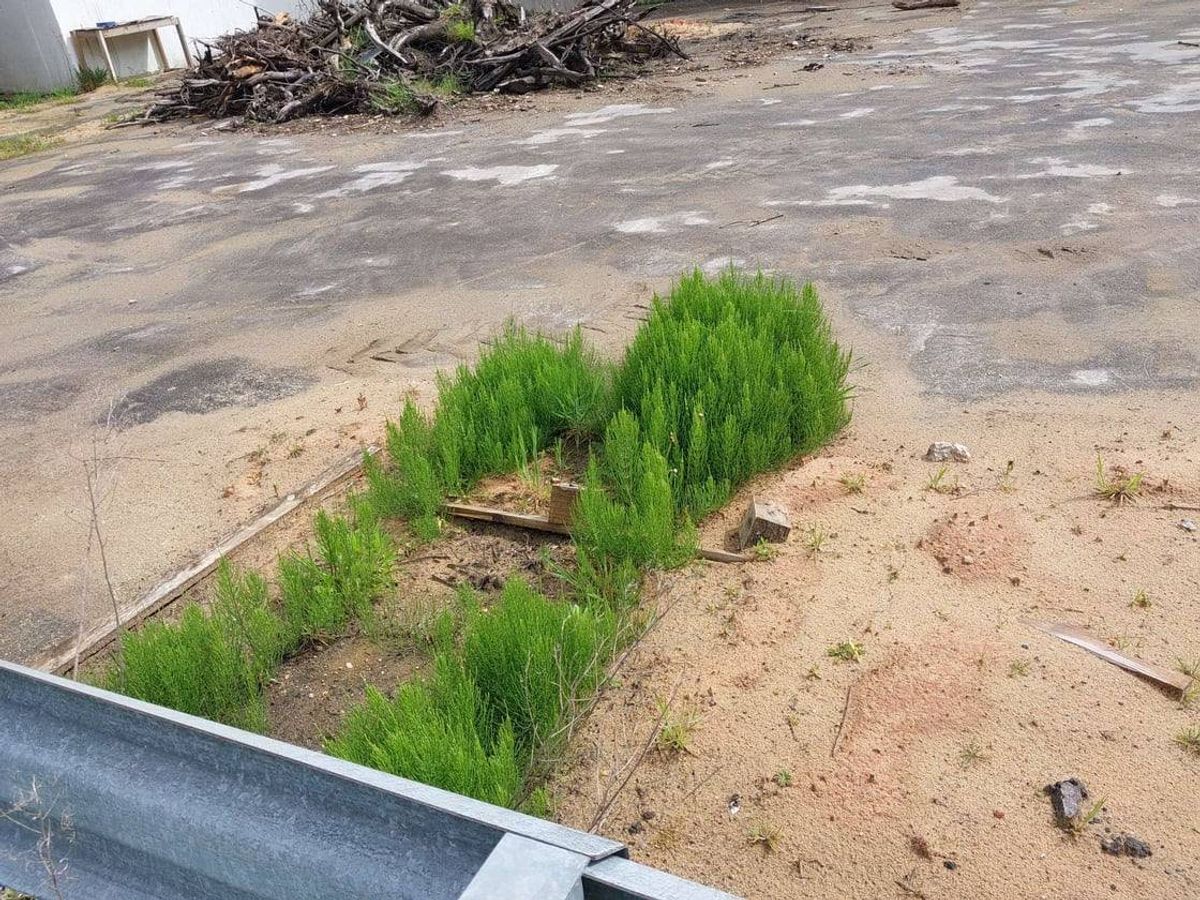
Horsetail growing through cracks in the concrete on an old army barracks site (Image: Japanese Knotweed Ltd)
However, horsetail is unlike most garden weeds, boasting a deep and extensive root system that stretches far beneath the surface, where even the tiniest fragments left behind can regenerate.
According to Peter, the more aggressively you attempt to remove it, the greater the chance you’ll end up spreading it further. He also remarked that it was “interesting” that gardeners were offering a variety of contrasting answers regarding horsetail, yet he maintained that there was no “simple single solution”, despite this being something many of us would rather not hear.
Nonetheless, offering his own perspective, he said: “Some swear by digging it out. Others suggest repeated cutting. Some recommend chemical treatments. But a growing number of people, myself included, take a completely different view and suggest learning to live with it, or even working around it in planting schemes.
“Horsetail thrives in poor, compacted soil with low fertility. Its presence is often a signal rather than just a nuisance. It is telling you something about the conditions in your garden.

Field horsetail sprouting(Image: Catherine McQueen via Getty Images)
“Improving the soil is the long-term solution. This means increasing organic matter, improving structure, and encouraging stronger planting that can compete naturally. Over time, as conditions improve, horsetail becomes less dominant.
“In the short term, repeated cutting or pulling can help weaken it, but it needs to be done consistently. One-off efforts rarely make a difference.”
Yet Peter believes one crucial point is frequently overlooked – people dismissing horsetail as merely a troublesome weed. He argued it was a “remarkable” plant in its own right.
He went on to explain how, throughout history, it has been utilised for a wide variety of purposes, including once being used to polish metal and wood owing to its high silica content. Some gardeners still produce a form of plant feed or spray from it, as they believe it helps to fortify other plants.
Others maintain it can be utilised in herbal remedies and can be brewed into teas or infusions for health benefits.
However, Peter warned: “It is important to say that these uses are widely discussed but should be approached with caution, particularly without proper knowledge or guidance.”
The expert noted that not everyone views horsetail as something that must be eradicated at all costs, explaining how some gardeners incorporate it into a planting scheme, which can prove far less of a struggle than waging an endless battle against it.
Summing up his thoughts on the matter, Peter, who has worked on Irish gardens for over 30 years, concluded: “There is also something quietly fascinating about it. A plant that has survived for millions of years, adapting through enormous environmental change, is always going to be resilient.
“So if you are battling horsetail this year, you are not alone. But instead of asking how to kill it, it is often more useful to ask what it is telling you, and how you might work with the conditions that allowed it to take hold.”
For more practical garden advice, see Peter Dowdall’s Garden Q&A
Comments are closed.