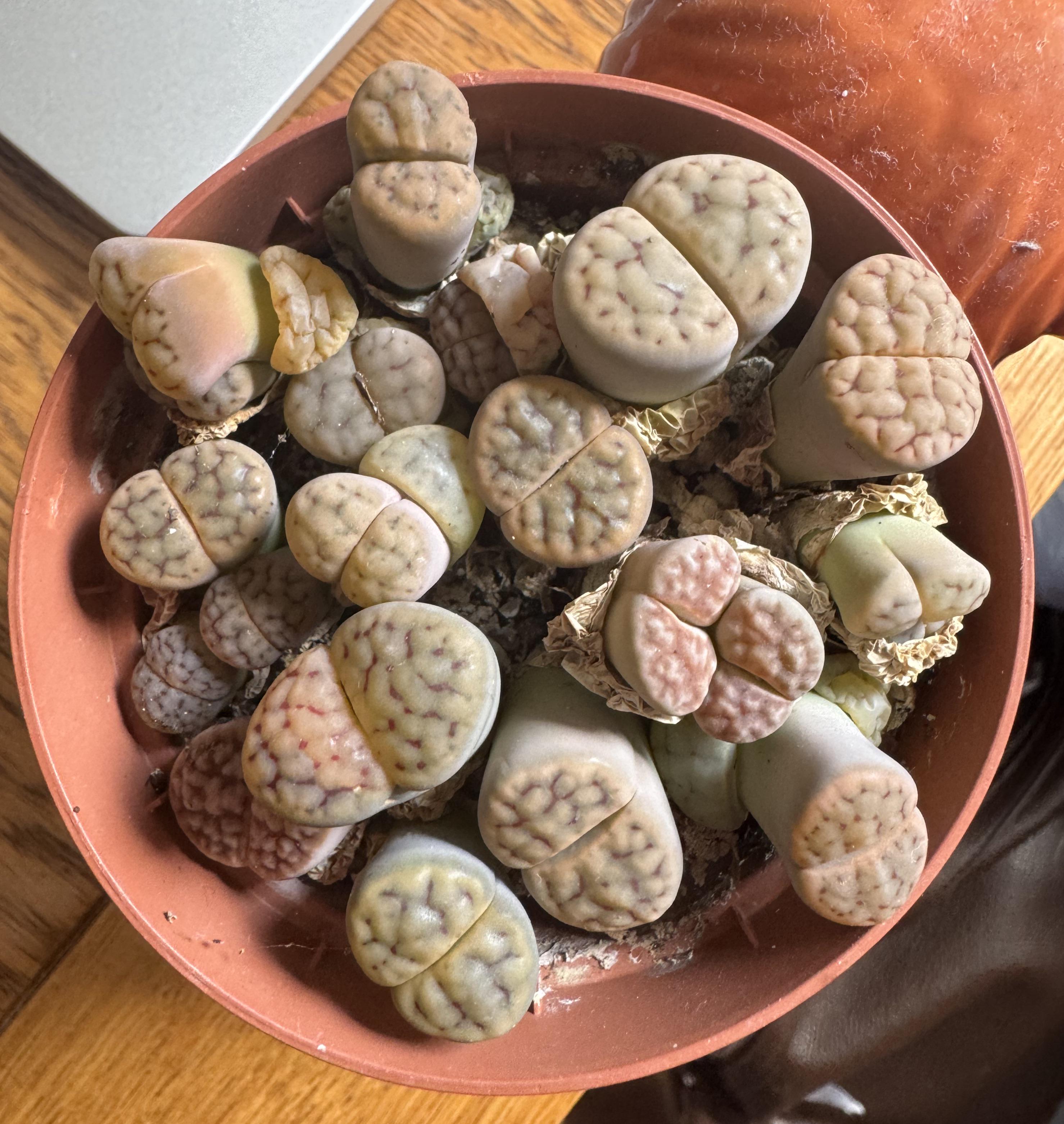
Never cared for these funky little plants before, got these from a garden centre, any advice for a newbie?
Should these be split? They seem quite tightly packed?
by Peanutbuttersaur

Never cared for these funky little plants before, got these from a garden centre, any advice for a newbie?
Should these be split? They seem quite tightly packed?
by Peanutbuttersaur
3 Comments
Welcome to the world of lithops!
That’s a wonderful group. My suggestion is to separate and repot to a very gritty mix. If you group any together make sure they are at the same stage of splitting.
Split these up into different pots. They’re at different stages of growth and if you keep them all in one pot, when you water the ones that need watering, you’ll kill the ones that don’t.
Be sure to use a mix that’s majority grit, like 70:30 or even 80:20.
If you’re not sure, err on the side of not watering.
Give them a fuck ton of light if indoors (beware of sunburn and excess heat if outdoors, NEVER let them get rained on) because some are looking etiolated (unhealthily tall to reach for light). They also need dark night time coupled with colder temperatures (10-22°C or 50-75°F) for gaseous exchange to work properly.
Also, while you’re repotting, check the bases for any super mushy (like a sack of water with no structural integrity), notably translucent rot. There’s no known way to save a lithops when that happens so just leave it somewhere else so that it doesn’t spread to the rest. During the first 2 months (but sometimes just the first few weeks) after getting new lithops that have been under horrible conditions and likely overwatered, some (or even most) of the lithops may have this happen spontaneously even if you do everything correctly. It can be stressful but just make sure to confirm that you’re doing everything right and do your best with the survivors.
You can wash the old substrate off the roots while repotting (do NOT break off the entire tap root, that is basically a death sentence), but in any case, do not put them immediately into new substrate after unpotting, leave them in air and wait at least a few days (I go at least 5 to be safe) for any broken roots to heal themselves (to minimize rot). You can leave healthy lithops in air after removing their roots for maybe 3 weeks without problems, then put them into the correct pots and mixes (do NOT use moist substrate, keep the substrate completely DRY when putting them in, only start watering at least a week after they’re put in to minimize chances of rot). If any of the lithops start to rot, they’ll suddenly shrivel up within a few days maximum when left in air. Healthy ones will stay almost the same in appearance.
Make sure grit size is 0.5-3mm for the roots to have sufficient coverage, don’t use sand, try to get pumice of that size. Depending on the humidity where they grow, you can go up to 100% grit and they’ll be fine. Try to get unglazed clay/terracotta pots for quick drying if you don’t live in very arid conditions, because here in 65-90% humidity, even 100% grit (mostly pumice) will not dry beyond the surface layer many days after watering once and can easily cause rot issues. Your lithops can wait sitting bare-root in a dry place for you to get the right soil mix for them, so absolutely prioritize getting that.
As long as the tap roots and lithops are held in stable position, I actually recommend getting the base of the lithops to be in as little contact with any water-absorbing substrate/soil (including pumice) as possible (especially when watering) especially if you live in more humid conditions, because healthier ones can support themselves just fine and the bases are the areas most prone to rot (the tops can look completely fine while this happens). Especially if in contact with moisture for long.