
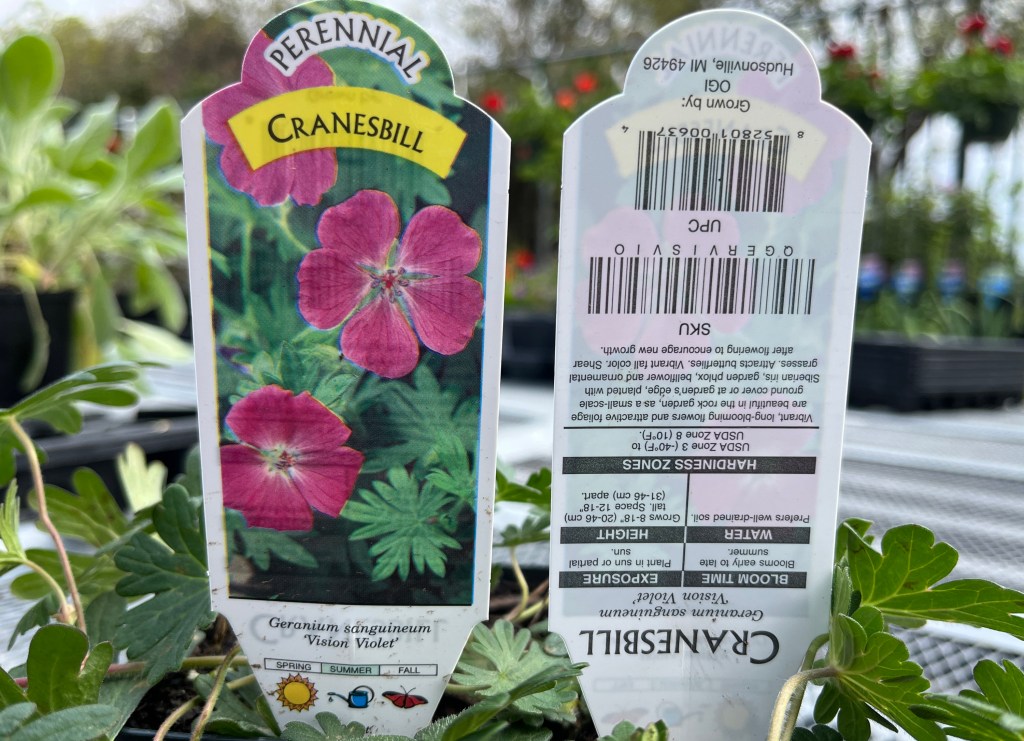
Before you fall for a gorgeous blooming perennial at the garden center or a hot-deal tree at the big-box store, stop and read the label.
“It’s an essential step in plant shopping,” said Sharon Yiesla, plant knowledge specialist in the Plant Clinic at The Morton Arboretum in Lisle. “It will keep you from wasting money and making avoidable errors.”
The label makes it possible to compare the plant’s needs to the conditions in your garden, such as the amount of sun it is likely to get. “If you know your garden’s conditions, the label can tell you whether the plant is likely to work for you,” she said. The label also will remind you how to care for the plant when you get it home.
Never buy a plant without a label. “It’s the only way to be sure of what you’re getting,” Yiesla said.
Some labels offer a lot more information that others, but here are some basic things to look for—before you spend money on a plant.
Plant names: The label should include both the common name and the botanical name. The botanical name, which is more precise and reliable, is key to finding more information about the plant.
Light needs: The plant’s light requirements may be given in words or symbols, such as circles or suns or moons. If symbols are used, a full sun or white circle usually indicates that the plant needs full sun, meaning six to eight hours of direct sunlight a day; a moon or black circle indicates full shade, meaning it can handle a site with two to four hours of sun a day; and a half sun (or half black/half white circle) indicates part sun or part shade, which generally means about four hours of full sun a day. If the label combines icons — for example, a white circle and a half-white/half-black circle — it means the plant can handle a range of conditions from full sun to part shade.
Hardiness zone: The zone number tells you how much winter cold the plant is likely to survive, expressed as a zone number from the USDA plant hardiness map. (Find the map at planthardiness.ars.usda.gov.) Much of the Chicago region is still Zone 5, but most of Cook and Will counties, as well as eastern parts of Lake and DuPage counties, are now in Zone 6.
You’ll be safe buying plants that are hardy in Zone 5 or the colder Zones 4 and 3. Often the label will show a range, such as “Zones 5-9.” If it shows a single number, that is the coldest zone in which the plant is hardy. For example, if it says “Zone 3,” that means the plant is also hardy in the less cold zones 4, 5 and 6.
Mature size: A plant for sale will usually be young, with a lot of growing to do. Read the label to find out how tall and wide it will eventually grow to be, so you can tell if you really have space for it. This is especially critical information if you are shopping for long-lived trees or shrubs, because it’s hard to visualize how big they can get over a period of years. Some labels only give a height, usually after 10 years. But don’t forget that that plants also grow wider as they get taller. Sometimes the mature width is expressed as spacing, such as “space 12 inches apart.”
The label is important, but it won’t tell you everything about a plant. For example, most labels won’t tell you what kind of soil a plant needs; only some plants can handle the dense, alkaline clay soil common in the Chicago area.
That’s why you need the botanical name on the label. “Use that name to search for more care information on your phone,” Yiesla said. “If you search by the common name you can easily get confused, because many common names can apply to more than one plant.”
For tree and plant advice, contact the Plant Clinic at The Morton Arboretum (630-719-2424, mortonarb.org/plant-clinic, or plantclinic@mortonarb.org). Beth Botts is a staff writer at the Arboretum.
Comments are closed.