
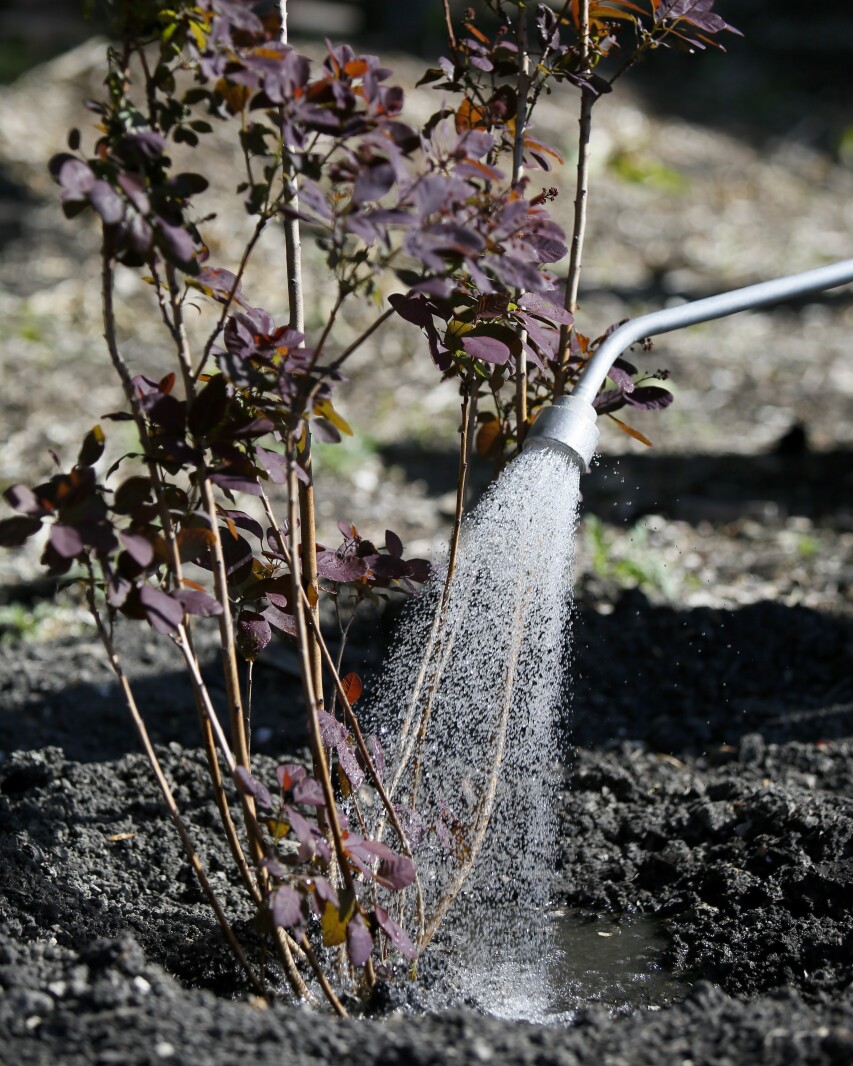
In a previous column, there was discussion about watering newly planted trees.
There is a product on the market called Treegator bags. They can be used to provide a slow delivery of water over the root balls of establishing trees and shrubs.
The bag holds about 14 gallons of water and releases a slow trickle of water over five to nine hours. This will apply water directly over the root zone.

You need to be sure to keep the backfill soil in the planting hole moist. This encourages the roots to expand beyond the root ball into the backfill soil.
Tree roots grow approximately 18 inches per year in our part of the country so expand the watering area accordingly.
Create a water reservoir by making a circular mound of soil 3 to 4 inches high around the plant at the edge of the root zone. Use a slow trickle of water to fill the reservoir to allow water to slowly infiltrate into and around the root zone
(Information about Treegator bags was supplied by Brandon Miller, Extension specialist; Laura Irish-Hanson, Extension educator; and Kathy Zuzek.)
Spring is the second-best season for patching your lawn. Consider adding flowering plants, such as Dutch white clover, to your lawn. It fixes nitrogen and adds more nectar and pollen to your garden.
There are several wildflowers that are fun to have in your flower bed. Some of them include Dutchman’s breeches, wild Canadian ginger (in my garden the ants have moved seed from one side of the house to the other), Jack-in-the-pulpit, mayflower, Solomon’s seal, trillium and violet. Violet can take over an area if you let it.
Have you ever heard of “wool pellets”? I hadn’t until recently. To make these pellets, the wool is shredded and then compressed into cylinders, smaller than the size of a dime — right off the sheep.
By mixing the pellets into the soil of a potted plant or in a garden, it has been said gardeners can water 25 to 30 percent less. The pellets can hold three times their weight in water This is a certified organic product, and as it breaks down, it releases nitrogen and other nutrients.
A Utah State University Extension study showed it gives plants a nitrogen punch of 9% to 14% compared to 1% to 2% from compost or 4.5% with chicken manure. It also increases soil porosity as it disintegrates.
South Dakota State University Extension says studies have shown 58% to 69% larger tomatoes when fertilized with wool compared to no fertilizer.
The University of Minnesota did a study which showed that wool can be an effective mulch for growing strawberries when combined with a cover crop of canola.
A wool mulch works well in vegetable gardens. It is biodegradable – it can take anywhere from three months to two years to break down. Other universities have been testing it as well.
It has been recommended that one tablespoon in the root zone for a single plant is enough. A half cup is ample for a gallon of soil in a pot and one pound of pellets covers a 30-square-foot garden. An added benefit is an outlet for farmers to sell the wool which doesn’t have much market value these days.
This product is made by Ewe and Me Wool Company in Eau Claire, Wisconsin. It is called Woolly Belly Pellets.

Master Gardener Sue Morris has been writing a column since 1991 for Kandiyohi County newspapers. Morris has been certified through the University of Minnesota as a gardening and horticulture expert since 1983. She lives in Kandiyohi County.
Comments are closed.