
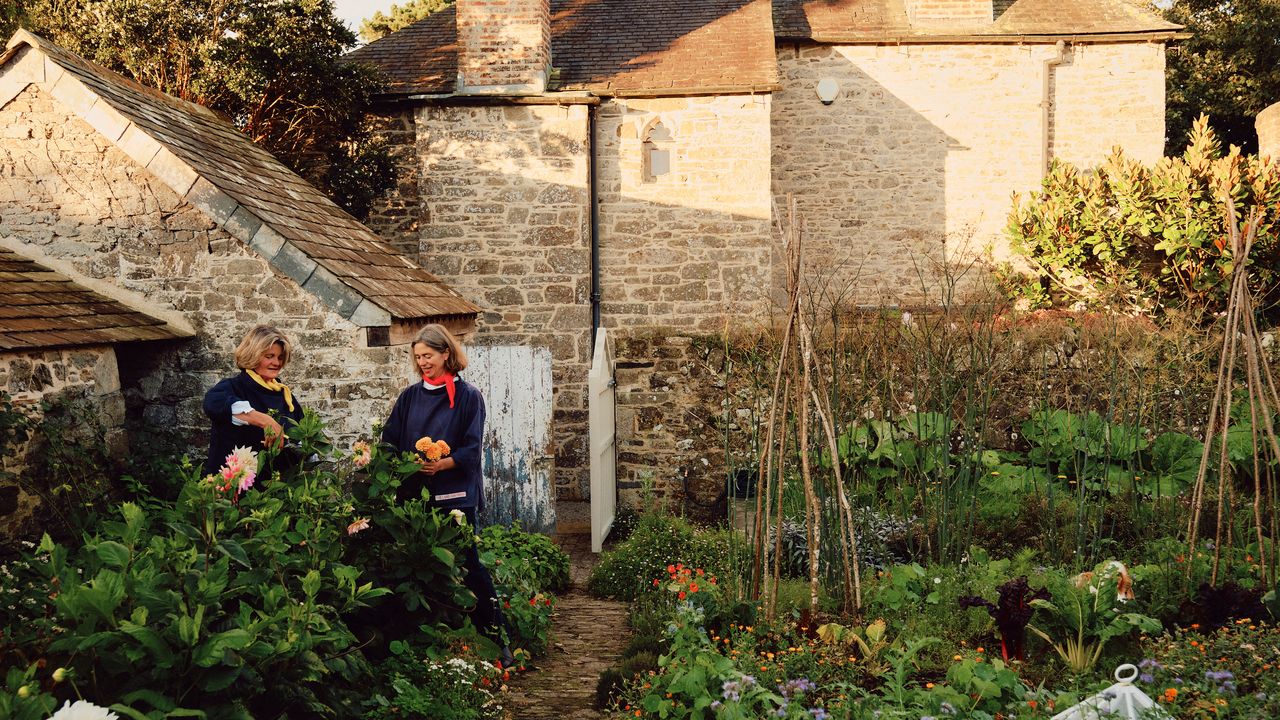
Henrietta’s ebullient planting might seem artlessly natural, as if it’s happened entirely on its own, but the skill is judging the tipping point and maintaining the balance between wildness and control, attention and neglect: ‘It’s always a dance with nature, but getting the soil humming and full of life was the priority.’
A particular challenge was the creation of the productive garden on what had been a hard, compacted pony paddock. The composts, natural fertilisers (nutrient-rich soil brews made from comfrey and nettles) and a regime of broad forking to aerate the soil have all played a part. Repeated sowings of green manures (buckwheat, phacelia and mustard) have been the way forward in recent years. ‘These manures feed the soil while aerating it with their roots, at the same time as suppressing weeds. We rarely go out without a handful of seeds in our pockets to chuck on bare corners – they do all the work for us,’ adds Bridget.
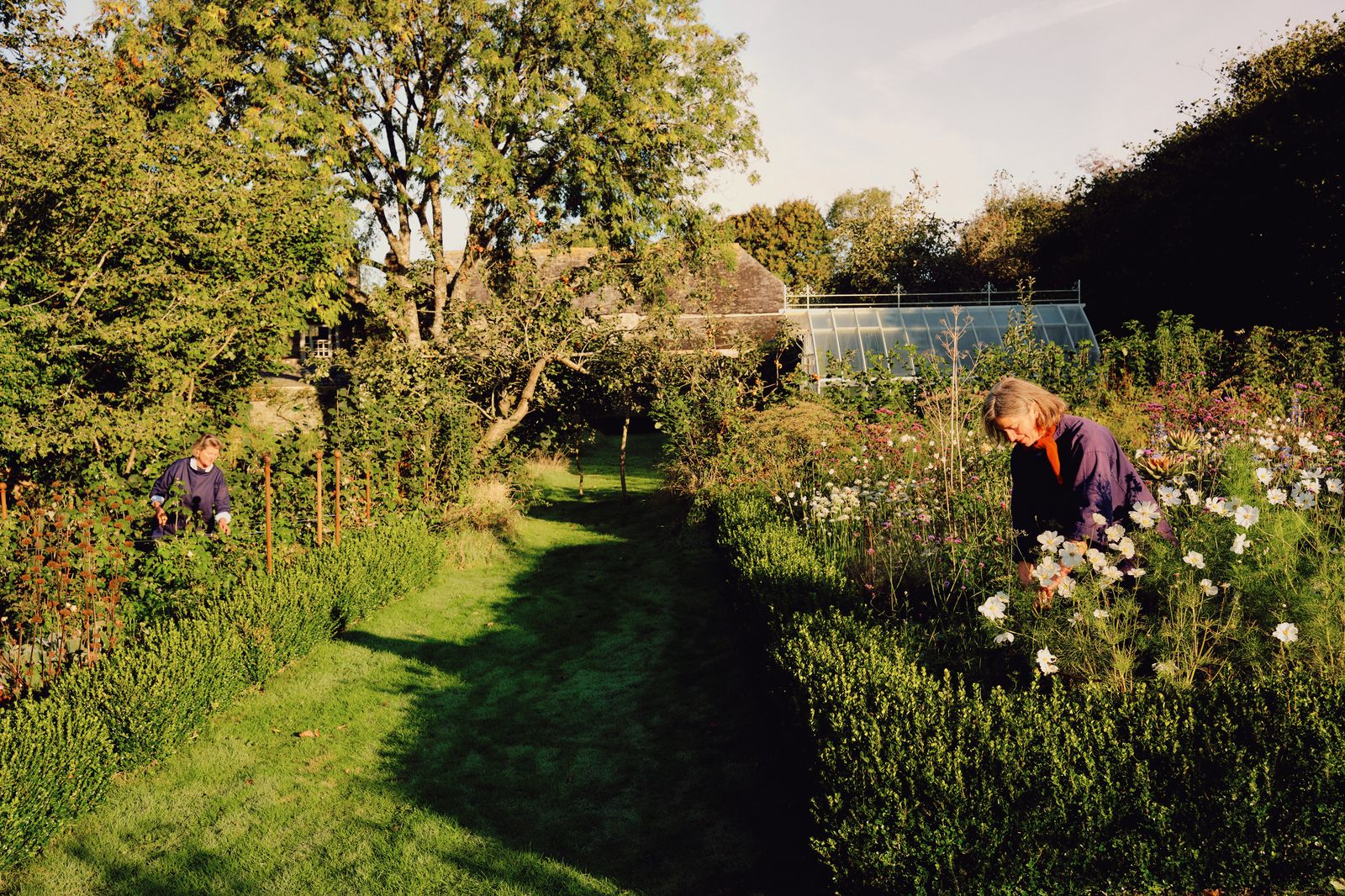
Picking Cosmos bipinnatus ‘Purity’ in the cutting garden.
Dean Hearne
Now bursting with life and health, and full of worms, the beds erupt each spring with a joyful productive mix of flowers, fruit and vegetables, grown together in four large box-edged beds. Favourites for cutting include Rosa ‘Royal Jubilee’ and R. ‘The Lark Ascending’, Paeonia ‘Coral Charm’, sweet peas from the hazel wigwams and, later, masses of luxuriant dahlias. Nepeta ‘Six Hills Giant’ is planted under the gooseberries to hide the fruit from the birds, though Henrietta is keen to stress that a third of what she grows goes back to nature. The birds get the teasels and rosehips (species roses such as Rosa ‘Amy Robsart’, R. ‘Dupontii’, and R. ‘Stanwell Perpetual’ are grown in the long grass). Nettles are allowed to romp through the adjacent laid hedge, and valerian and comfrey are given plenty of valuable growing space, as they’re crucial for the natural fertilisers.
Recently, by complete chance, Henrietta came across a copy of William Carnsew of Bokelly’s diary from the late 1500s, which charts the yearly rhythms of life on the farm. He writes of his garden, of planting trees, of growing hops and quinces, and he goes on to describe making ‘sandridges of dung’ and of taking ‘the shelly sand’ from nearby beaches for spreading on his soil. How pleased he would be that the tradition of resilient husbandry at Bokelly continues to flourish to this day.
The Land Gardeners: thelandgardeners.com
Comments are closed.