
The notion that home gardening can be treated as a blanket remedy for Sri Lanka’s deepening agricultural crisis is fundamentally misplaced, Senior Professor of Crop Science at the University of Peradeniya, Buddhi Marambe has warned.
Delivering the keynote address at the Science Forum on Food Security held at the National Science Foundation (NSF) on 29 April 2026, Prof. Marambe cautioned that while home gardens have an important role, they cannot substitute systemic solutions required to address structural weaknesses in the country’s food production sector.
Speaking at the forum, held under the theme, ‘Facing Agriculture Crisis – Home Gardening as a Tool’, Prof. Marambe said Sri Lanka’s food security challenges were increasingly shaped by shrinking agricultural land per capita, climate volatility and rising input costs.
He noted that global agricultural land per person had fallen sharply from about 1.45 hectares in 1961 to 0.6 hectares in 2023, while in Asia it had declined to 0.35 hectares. In Sri Lanka, he said, the figure had dropped further from 0.17 hectares to just 0.13 hectares over the same period, underscoring severe land constraints.
Against this backdrop, Prof Marambe said home gardening could not be expected to compensate for the loss of large-scale production systems such as paddy cultivation, which depended on wetlands that could not be replicated in residential spaces.
He also pointed to the growing impact of extreme weather events, citing Cyclone Ditwah (2025), which brought record 24-hour rainfall of 375 mm in parts of the country and caused extensive damage to paddy and other field crops. Climate-related losses in paddy production were estimated at 35.4 per cent, with policy-related disruptions accounting for a further 34.1 per cent.
Several districts, including Anuradhapura, Polonnaruwa and Batticaloa, recorded damage to over 20,000 hectares of cultivated land, he noted, warning that such shocks are becoming more frequent and unpredictable.
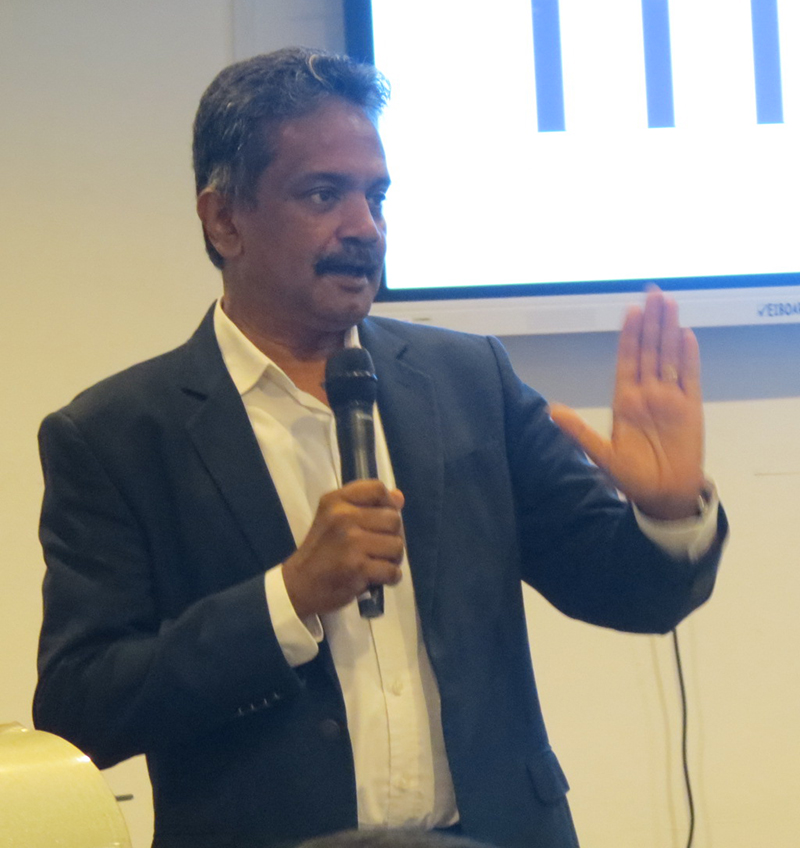
Prof. Marambe speaking at the science forum
Prof. Marambe highlighted economic pressures on agriculture, particularly the volatility in fertiliser prices. Citing global market data, he said urea prices had peaked at nearly USD 750 per tonne in early 2026 before easing marginally, placing additional strain on farmers.
Referring to the COVID-19 pandemic experience, he cautioned against unstructured promotion of home gardening, noting that during lockdowns many households had turned to cultivating crops such as ginger and turmeric, eventually leading to market gluts that disrupted livelihoods of commercial producers.
“Different crises require different solutions,” he said, arguing that home gardening should not be seen as a universal production substitute but rather as a targeted intervention.
He stressed that the most practical and sustainable role of home gardening lay in addressing household nutrition rather than bulk food production. At a time when rising food prices were contributing to nutritional decline, he said, home gardens should be reoriented towards improving dietary diversity.
“Even small-scale interventions such as keeping a few hens for eggs to obtain daily protein requirement or cultivating leafy vegetables in limited space can significantly strengthen household nutrition security,” he said.
Prof. Marambe advocated a shift towards “nutrition-focused home gardening”, integrating crops and small livestock within urban and rural homesteads. He also pointed to successful models of urban farming, community gardens in Colombo flats, and school gardening initiatives supported by development partners.
He said such systems, if properly structured, could play a meaningful role in cushioning vulnerable populations against food price shocks while improving dietary outcomes.
However, he reiterated that home gardening must be viewed as one component within a broader agricultural strategy rather than a standalone solution to Sri Lanka’s food security challenges.
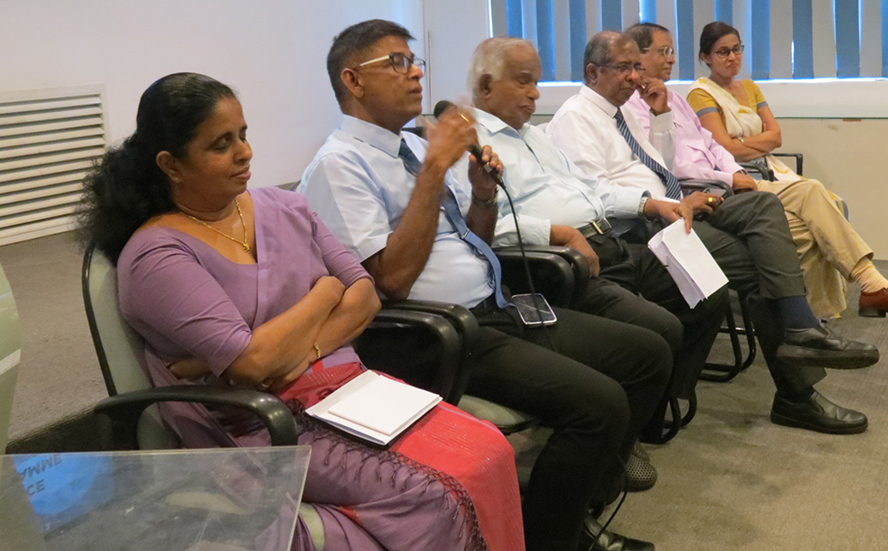
The forum, organised by the Media and Event Management Division of NSF under the purview of the Ministry of Science and Technology, brought together leading experts in food science including Emeritus Professor K. K. D. S. Ranaweera, Prof. Renuka Silva and Dr Hiranya Jayawickrema, alongside representatives from print, electronic and social media.
Comments are closed.