
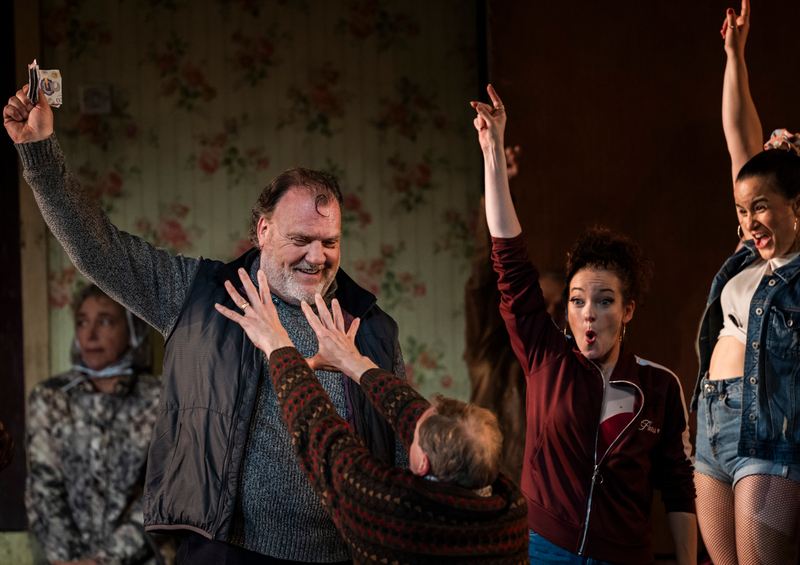
Peter Grimes was the first twentieth century English opera to enter the international repertoire and hold its place there. This emphatic success showed its composer, Benjamin Britten, to be the most gifted English opera composer since Henry Purcell, and the work’s eager acceptance by foreign opera houses confirmed that judgement. Featuring powerful and hugely evocative music, Britten’s opera paints a vivid picture of a local community’s descent into suspicion, gossip and mob mentality in the face of a tragedy.
What really happened with Grimes’s earlier missing apprentice? This is where the opera starts, and as the townspeople’s mistrust grows, Grimes spirals downwards, with devastating consequences for the new apprentice and himself personally.
There are three layers: in the foreground Grimes, in the middle ground the villagers, and in the background the sea. Grimes is a visionary, a dreamer in a society that cannot tolerate such people, and he illustrates a conflict between the individual and society, reflecting the fact that Britten and and his partner Peter Pears, who first sang the title character, were pacifists during World War 2, and homosexuals in a society that treated it as illegal.
First performed just after the end of the War at Sadler’s Wells in London, it was the first of Britten’s operas to be hailed by both the public and critics as an unqualified success. Indeed its box-office takings matched or exceeded those for both La Bohéme and Madame Butterfly, which were being staged concurrently by the Sadlers Wells Opera Company, later to become the ENO. As part of the standard repertoire, the opera remains widely performed internationally. The four Sea Interludes, consisting of the first, third, fifth and second interludes from the opera, were published separately and are frequently performed as an orchestral suite.
The story is based on the Reverend George Crabbe’s 1810 narrative poem The Borough, but Britten and his librettist, Montagu Slater, transformed the straightforwardly cruel character of Grimes into a more complex, ambiguous figure. Britten’s Grimes is an outcast fisherman in an isolated Suffolk fishing town. He’s a victim of fate and society, but the darker aspects in his character are retained, and the audience is left to judge him. Meanwhile, the self-righteous attitudes of the townsfolk are embodied in the laudanum addict Mrs Sedley, and the prosaic common sense of the retired merchant seaman, Captain Balstrode.
At the Royal Opera House, the large cast is headed by Allan Clayton as an exceptionally well-nuanced and well sung Grimes, with Swedish soprano Maria Bengtsson as a strong Ellen Orford, the widow who hopes to tame and integrate him into society. She it is who volunteers to collect his new apprentice from the workhouse, a boy who in this production falls accidentally from the cliff. This may not be Grimes’s fault but his casual brutality and determination to go after a huge catch on a Sunday fuels the boy’s evident terror and exhaustion.
Bryn Terfel made an engaging Captain Balstrode, and Catherine Wyn-Rogers sang very well as Auntie, the local pub landlady whose “nieces” could have looked sexier earlier on, though they did manage mini-skirts in Act 3. But that was the choice of Deborah Warner’s rather flat production, which tried too hard to update the setting to a more present-day style of yobbos and skinheads. The dance moves they exhibited seemed unnecessary, and the idea of having the former dead apprentice floating above the stage more than once was a distraction, particularly in the final moments.
The music however was exceptional, and under the baton of music director Jakub Hrusa I heard wonderful nuances. It is a truly remarkable score. The cast rose to the challenge with Christine Rice a very fine Mrs Sedley, and other supporting roles were well performed with Clive Bayley as Swallow the magistrate, Jacques Imbrailo as Ned Keene the apothecary, John Graham-Hall as Bob Boles the irritating Methodist, Barnaby Rea as Hobson the Carter, and James Gilchrist as the local Rector. Overall a first rate performance, marred only by a second rate production.
A Message from TheArticle
We are the only publication that’s committed to covering every angle. We have an important contribution to make, one that’s needed now more than ever, and we need your help to continue publishing throughout these hard economic times. So please, make a donation.
Comments are closed.