
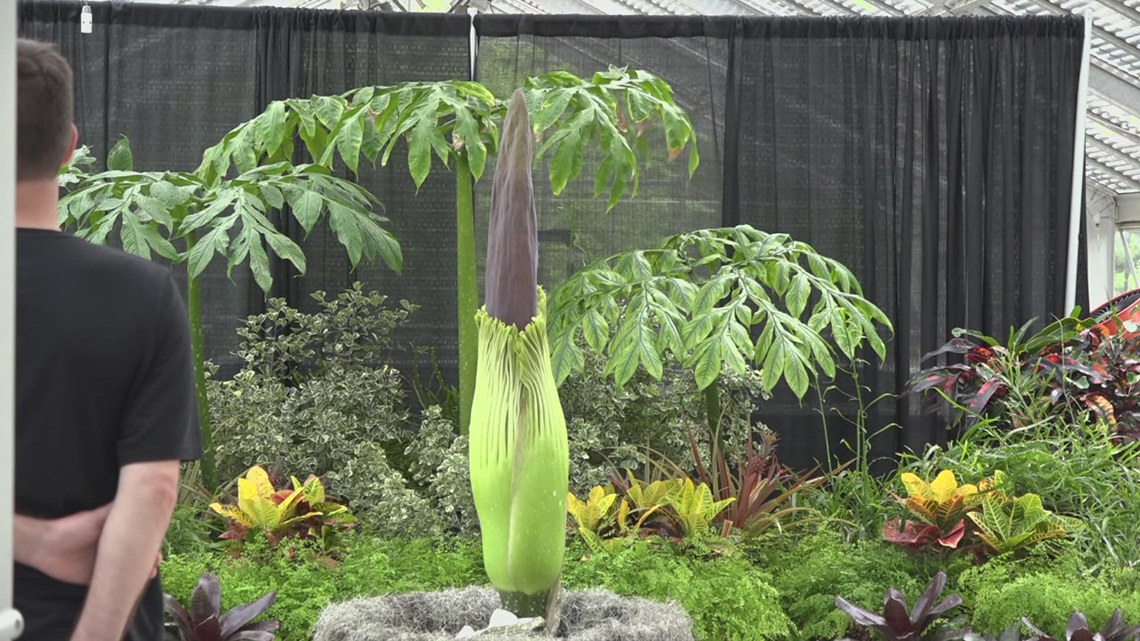
A rare corpse flower named Elenore could bloom within days at Shangri La Gardens in Orange, drawing crowds eager to smell the unusual plant.
ORANGE, Texas — A towering plant known for smelling like rotting flesh is drawing visitors from across Southeast Texas as it prepares to bloom for only the second time in more than a decade at Shangri La Botanical Gardens and Nature Center.
The corpse flower, named “Elenore,” could bloom within days at the Orange garden, where staff members have spent years monitoring its growth. Once the plant fully opens, the bloom may last only two to four days before it begins to wilt.
“It’s very fast for a plant, and all that energy that’s being spent on the flower, it doesn’t last long,” said Jennifer Buckner, Director of Horticultural Operations at Shangri La Botanical Gardens. “Once it’s fully bloomed, within two to four days, it starts to go down and start to wilt. So you gotta act fast if you want to come see it.”
The bloom marks the first time since 2013 that a corpse flower has flowered at Shangri La. Elenore is an offshoot of “Lenore,” the garden’s previous corpse flower, which staff lost during Hurricane Harvey.
“Our last bloom 13 years ago was Lenore,” said Angie Mason, Executive Director of Shangri La Botanical Gardens. “This is an offset of Lenore, a baby of Lenore, and we lost Lenore in Hurricane Harvey. So it’s kind of a rebirth of life.”
Over the last month, Elenore has grown rapidly — shooting from roughly five inches tall to nearly five feet.
The corpse flower, scientifically known as Amorphophallus titanum, is native to the tropical forests of Sumatra, Indonesia, and is considered endangered. Fewer than 1,000 are estimated to remain in the wild, according to the International Union for Conservation of Nature.
The plant gets its nickname from the odor it produces once it blooms. The smell, often compared to decomposing meat, attracts flies and carrion beetles that pollinate the flower.
“It attracts flies and carrion beetles as its pollinator,” Buckner said. “So it’s going to smell like rotten meat.”
Buckner said the flower’s central spike, called the spadix, can heat up to about 98 degrees to help spread the odor farther and attract more pollinators.
Despite — or perhaps because of — the smell, visitors have continued to flock to the gardens ahead of the bloom.
“We have some people who come every spring for our really big azalea bloom, and then we have people who couldn’t care less about the azaleas, and they want to see this stinky plant,” Mason said.
For some visitors, the rare bloom carries a deeper meaning.
“We’re here today with a bunch of us old hands to see this beautiful plant that only blooms once every 10 years,” said Jon Flowers, a Nederland resident visiting the gardens. “We may not be here in another 10 years.”
Shangri La Botanical Gardens extended its hours through Thursday, remaining open until 7 p.m. as staff wait for Elenore to fully bloom.
Comments are closed.