
I don’t profess to be an expert at gardening.
When I first moved from a condo to a home with a yard a few years ago, I didn’t know the difference between an annual and a perennial.
I had difficulty discerning a plant from a weed (although I’ve since come to understand it’s in the eye of the beholder).
I was just so happy to have a lawn, I didn’t care mine had as much moss, clover, violets, dandelions and wild strawberry as grass.
After a lot of trial and error, observation, talking with neighbours and research, I’ve picked up a few pointers and gardening has become a new passion.
But I’ve also come to question whether some common practices employed to nurture our shrubs and flowers are in tune with nature, like raking up and bagging every last fallen leaf, or spraying the lawn so it looks like a putting green.
According to the real experts, biologists and environmental groups, a lot of our gardening habits are actually hurting nature, especially pollinators, like the at-risk monarch butterfly.
Butterflies, bees, birds, bats, beetles and other bugs are essential to fertilizing plants, including much of the fruits and vegetables we eat. But their populations are sharply declining, which could put us all in peril if crops fail and the food supply is jeopardized.
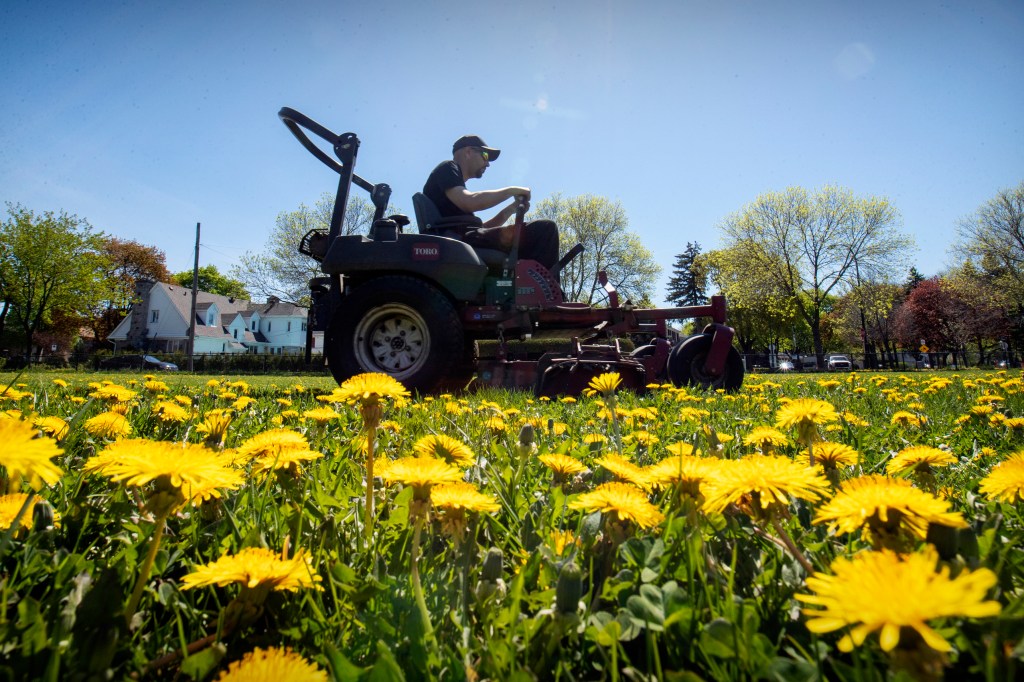
In spring, gardeners are literally throwing pollinators hiding in old leaves in the trash, killing them with the blades of lawnmowers or depriving them of the food they need to thrive.
Initiatives like No Mow May, which started in Britain, and Défi Pissenlits, which originated in Quebec, have sought to get gardeners to rethink this approach.
No Mow May, as the name suggests, is essentially delaying mowing for a month to allow pollinators to feed on the dandelions and other plants that sprout among the grass — often their first nourishment after a long winter. It’s a simple conservation challenge that any household can join. Montreal and municipalities such as Westmount and Notre-Dame-de-l’Île-Perrot participate in parks and other green spaces on their territory.
Défi Pissenlits is similar, except it only lasts until the dandelions go to seed. Cities like Dollard-des-Ormeaux and Laval and Montreal boroughs like Lachine and Outremont take part.
What could be easier for supporting bees and butterflies than literally watching the grass grow?
But it’s also a bit simplistic if everyone just revs up their mowers and goes back to destroying pollinator habitat come June.
For this reason, Bee City Canada (which designated Montreal a member in 2021) is of two minds about catchy campaigns like No Mow May.
On the one hand, it has raised important awareness about how our actions undermine biodiversity, and can be extremely effective when municipalities sign on. On the other, it may overshadow some of the more significant measures we should be taking to make our gardens more ecologically resilient, such as planting native species and being mindful of the needs of pollinators year-round.
“At Bee City Canada, we see No Mow May as a step in the right direction, and not a destination,” the organization states. “The concept can act as a gateway to learning about the actions that can be taken to support pollinators and ecosystems.”
So, what are some of the things we can do to garden more sustainably, beyond No Mow May?
Besides incorporating more native plants into our beds, Bee City Canada advocates planting flowers with different blooming schedules to provide sustenance from spring to fall, and including varieties that serve as hosts for particular species, like milkweed for monarchs. It also recommends leaving bare soil patches, branches and stalks for nesting. And it counsels against using pesticides that are harmful to bees.
The Canadian Wildlife Federation suggests reducing mown areas, reducing mowing frequency, reconsidering the time of day you mow, mowing higher and mowing slower to preserve habitat for monarchs and other pollinators.
Many of these concepts are being put in motion on a large scale through Montreal’s 2022-27 pollinator strategy. It is critical the city continue to lead in its parks, natural spaces, gardens and sidewalk landscaping.
For the average gardener, continuing to learn about best practices is a valuable contribution to sustainability efforts. Fortunately, there are resources to offer tips, like Espace pour la vie and Nature Action Québec.
Perhaps we also need to re-examine our notions of beauty.
Although perfectly manicured lawns are a status symbol for some, they are little more than a sterile monoculture that does nothing to support biodiversity.
And some of what we consider weeds and hack out are life-sustaining nourishment for small critters. The asters, goldenrod and sumac that spontaneously sprout on the edges of parks, ditches, vacant lots, rail lines and highways late in the summer awe me as much as the flowers I plant myself.
Gardening has taught me many important life lessons: patience, faith, humility, gratitude and wonder. But it has also made me realize my little patch of yard is one piece of a much greater ecosystem that also needs care and attention.
ahanes@postmedia.com
Editor’s Picks

I started at The Montreal Gazette in 2000 as an intern. Since then I have covered the National Assembly and courts, worked on the assignment desk and written editorials, before debuting as city columnist in 2017.
Comments are closed.