
Researchers at the University of Hawaii are leading nearly 100 projects backed by more than $33.5 million in funding to combat invasive species across the islands, underscoring the growing urgency to protect Hawai‘i’s fragile ecosystems, agriculture and public health.
According to a university press release, 98 active, grant-funded projects are underway, targeting some of the state’s most pressing threats — from rapid ohia death to invasive mosquitoes that spread avian malaria, as well as destructive crop pests, invasive ants and beetles, and non-native plants and animals that degrade forests and watersheds.
The projects are supported by 44 federal awards totaling $21.05 million and 54 non-federal awards totaling $12.49 million. Research is led primarily by teams at University of Hawaii at Manoa and University of Hawaii at Hilo, in collaboration with state and national partners.
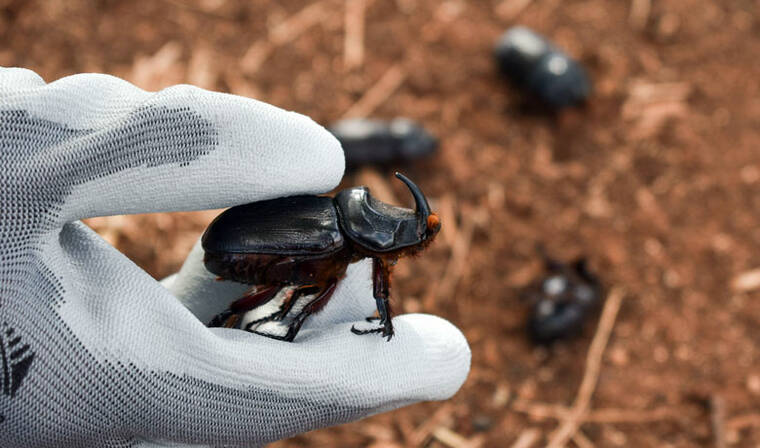
“These awards reflect the trust that agencies have in UH to protect Hawaii’s people, environment and economy,” UH Interim Vice President for Research and Innovation Chad Walton said in a statement. “You can see the damage coconut rhinoceros beetles leave behind, or how native birds are being wiped out by multiple invasive threats. Our UH teams are conducting research to develop practical solutions that protect both our environment and our communities.”
Several of the largest projects focus on protecting native forest birds, particularly endangered honeycreepers, by reducing populations of invasive mosquitoes that transmit avian malaria. One $5.34 million project targets mosquito suppression in key forest bird habitats in East Maui, while another $1.39 million effort aims to protect endangered birds on Kauai.
Researchers are also deploying satellite imagery and remote sensing tools to monitor forest health and detect invasive plants early — when eradication is more feasible and less costly. A $2.25 million project led by UH Hilo integrates satellite and meteorological data to track ecosystem changes.
On the agricultural front, scientists are developing molecular diagnostic tools that use DNA to rapidly identify pests such as fruit flies, moths and plant pathogens. These efforts aim to safeguard local food production and reduce economic losses for farmers.
Other projects include fencing and removal programs to keep invasive animals out of sensitive habitats, and testing new pest control strategies designed to reduce reliance on conventional insecticides.
Major funded initiatives include:
• $5.34 million: Suppression of non-native mosquitoes in East Maui forest bird habitats
• $2.56 million: Fencing to protect unique park ecosystems in UH Manoa
• $2.25 million: Satellite- based forest health monitoring in UH Hilo
• $1.39 million: Protection of endangered birds on Kauai in UH Manoa
• $1.36 million: Preventing spread of coconut rhinoceros beetles statewide
• $789,777: Research on Phytophthora palmivora to protect crops
• $651,084: Mosquito biology research to suppress avian malaria on Kauai
• $600,580: Control methods for invasive plants in Hawai‘i Volcanoes National Park
• $200,000: Outreach and treatment for little fire ant infestations
• $34,500: Initial studies on coffee berry borer control
Collectively, the projects aim to protect drinking water sources, preserve native forests and biodiversity, and support Hawaii’s agricultural resilience, which are priorities that researchers say are increasingly at risk due to the state’s geographic isolation and susceptibility to invasive species introductions.
With native species found nowhere else on Earth, university officials say the stakes remain high.
Comments are closed.