
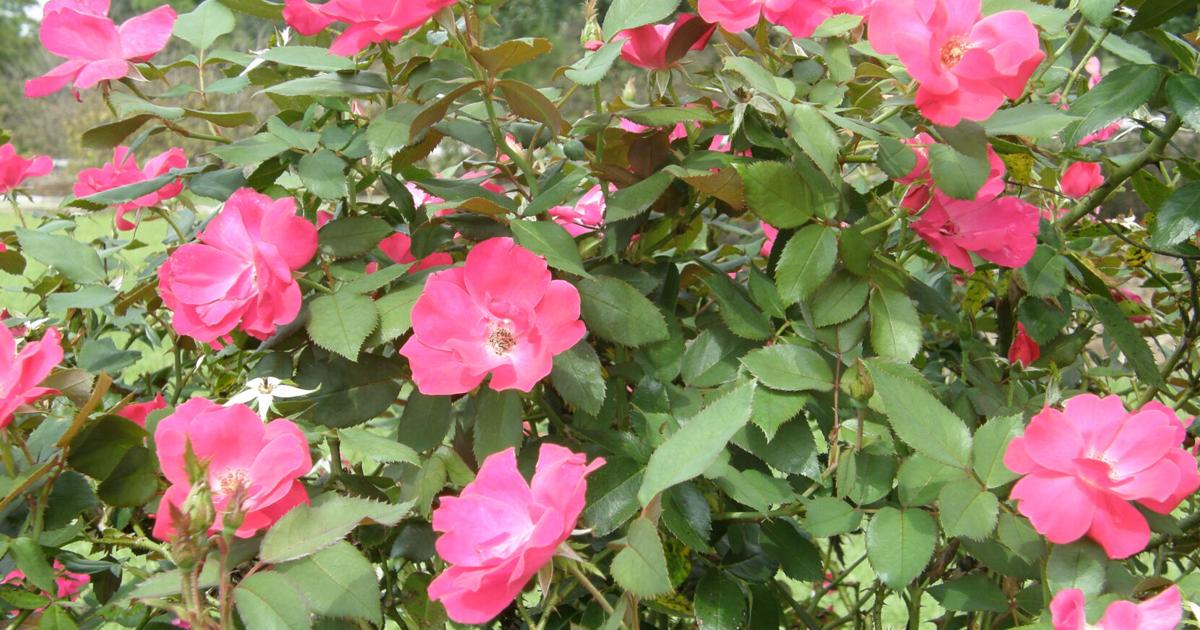
Does Triple 13 fertilizer cause black spot disease in roses? My Knock Out roses were really nice before I fertilized. Now they are stricken heavily with the disease. — Lee
Black spot symptoms are caused by a fungal infection, and the occurrence of this disease is not related to applying fertilizer or the type of fertilizer you use. Roses infected with black spot develop numerous black spots on their leaves, which then turn yellow and drop off. Heavily infected plants may lose most of their leaves, but the disease is not life-threatening.
The black spot fungus needs wet leaves to infect the plant (the spores must land on a wet leaf for infection to occur). So black spot infections are encouraged by rainy weather or wetting the foliage when irrigating. The outbreak you are seeing may be related to recent rains.
Knock Out roses are resistant to black spot but will occasionally experience infections (they are not immune). The plants are resilient, however, and will recuperate without treatment. After the infection runs its course, the bushes will send out new growth and recover.

Knock Out roses, in general, are quite resistant (but not immune) to black spot disease.
STAFF FILE PHOTO
Do be sure to rake up and dispose of the infected leaves as the plant sheds them. The fungus persists on the dropped leaves and can serve as a source of infection for future outbreaks.
If you decide you would like to treat your roses to minimize future black spot outbreaks and keep the plants looking more attractive, there are numerous products labeled to control black spot on roses at nurseries and garden centers.
You must repeatedly apply the fungicide through the summer until November for effective black spot control. You cannot treat as needed. The roses must stay on a regular schedule of treatment following directions on the label of the product you are using.
Can you recommend a weed killer for zoysia grass that is safe for my puppy? — Bruce
MSM Turf or Celsius would be good choices for weed control in your zoysia lawn.
Lawn weed killers are considered safe to use on home lawns following label directions. It is understood that home lawns treated with weed killers will be used by pets, children and families in outdoor activities.
The labeling of these products for use on home lawns takes this into account, and, again, they are considered safe by the Environmental Protection Agency.
That said, if you decide you are not comfortable using a weed killer on your lawn out of concern for your dog, that’s not unreasonable.
GARDEN TIPS
A Cloudless Sulphur moth flies through the Butterfly Walk at City Park’s Botanical Garden, The walk is filled with butterfly friendly flora. Common species seen here include the Monarch, Viceroy and Eastern Giant Swallowtail. The garden is open daily 10am-4:30 pm except Monday New Orleans, Thursday, June 19, 2025. (Staff photo by John McCusker, The Times-Picayune | NOLA.com)
STAFF PHOTO BY JOHN MCCUSKER
WELCOME BUTTERFLIES: Pentas, lantana, verbena, zinnia, salvias (many different species and cultivars), coneflower, black-eyed Susan, milkweed and buddleia are excellent flowering plants to attract butterflies into your garden this summer. These plants also provide colorful flowers throughout the summer. Do not use any insecticides (even organic) on plants grown for butterflies.
WHAT TO PLANT: May is a transitional month for Louisiana gardeners. The intense heat of the hot season arrives in May with daytime highs reaching the 90s and nighttime lows staying in the 70s. Although the ideal planting season for planting hardy trees and shrubs is past, many heat tolerant vegetables, bedding plants, summer bulbs and tropicals can be planted now.
Pots of flowers bloom on a porch. Remove mineral stains on terra cotta pots by soaking empty pots overnight in a solution of one part vinegar to four parts water.
POT SCRUBBERS: Terra cotta pots are beautiful. But as time goes by, water evaporating from the sides and rim can leave behind unattractive mineral salt residues. Remove these by soaking empty pots overnight in a solution of one part vinegar to four parts water. The residues should come off with a stiff brush.
Hibiscus-like flowers appear before okra pods emerge.
LSU AgCENTER PHOTO BY OLIVIA McCLURE
HOT TIPS: Vegetables planted in May must be able to take the extreme heat of summer. Excellent hot weather vegetables that can be planted this month include amaranth, cantaloupe, cucuzza, cushaw, eggplant (especially the narrow Japanese types), Malabar spinach, edamame (edible soybean), peanuts, pumpkin, Southern peas, hot peppers, heat tolerant tomato varieties, luffa gourd, mirliton, okra, sweet potato, watermelon and yardlong beans.
Comments are closed.