
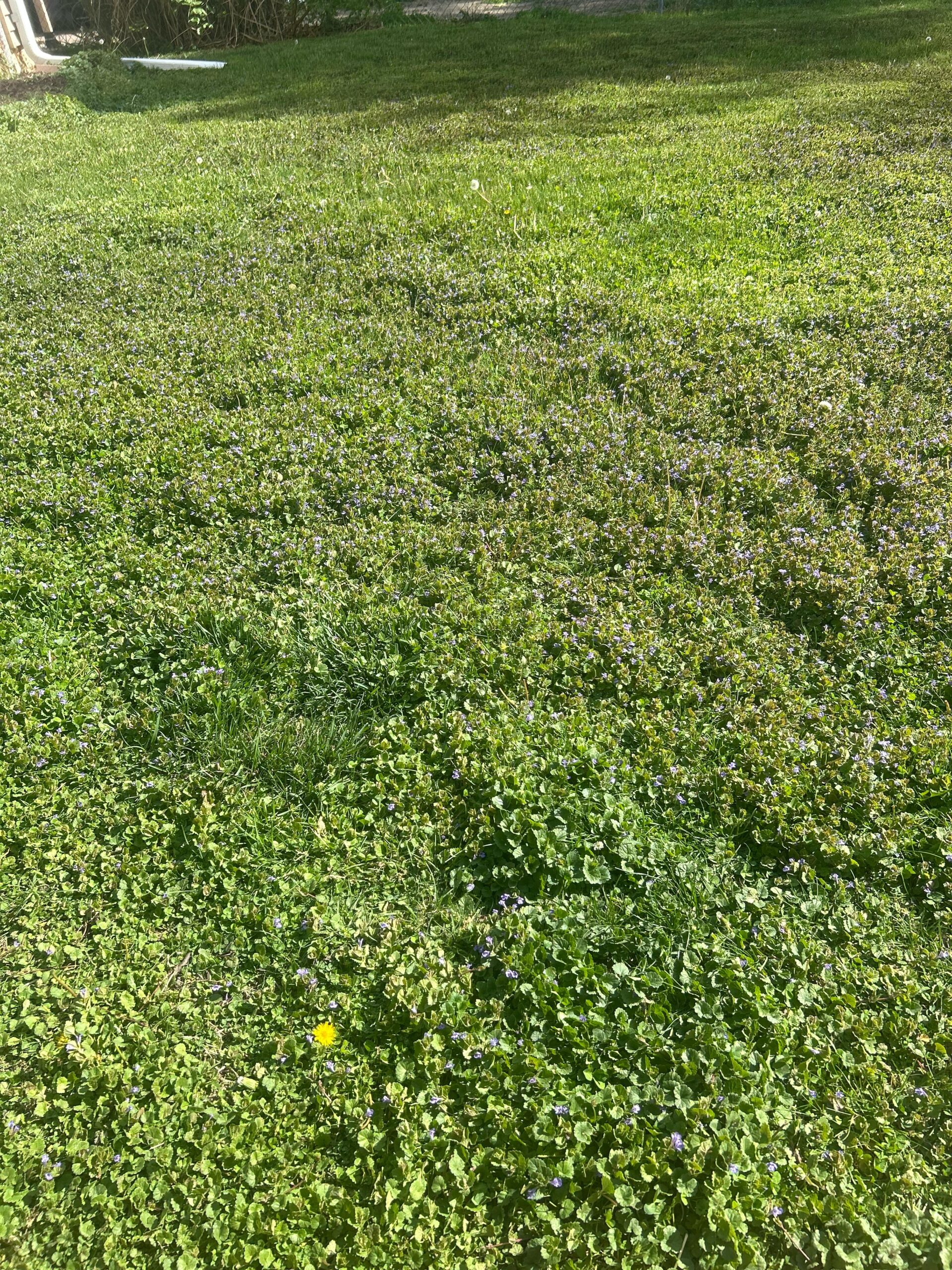

My wife and I just bought a house a couple of weeks ago. We have lots of these purple flowers/clovers that cover most of our backyard. All of my family and friends recommend spraying the lawn with weedstop to kill all of the weeds and other plants so that we can have grass. However, I’ve noticed plenty of bees that visit our yard and I feel awful that I might kill them by doing so. Any recommendations how to safely manage my lawn? In a perfect would, I would like to get rid of these without eradicating the bees that visit our lawn. Thanks!
by MatterAppropriate574
21 Comments
That’s [Creeping Charlie](https://www.google.com/search?gs_ssp=eJzj4tTP1TcwqjCvLDdgdGDwEkguSk0tyMxLV0jOSCzKyUwFAJFsCfA&q=creeping+charlie&oq=creep&gs_lcrp=EgZjaHJvbWUqDQgCEC4YgwEYsQMYgAQyBggAEEUYOTINCAEQLhiDARixAxiABDINCAIQLhiDARixAxiABDINCAMQLhiDARixAxiABDINCAQQLhiDARixAxiABDIKCAUQLhixAxiABDIGCAYQRRg8MgYIBxBFGDzSAQgzOTUwajBqN6gCALACAA&sourceid=chrome&ie=UTF-8). An Invasive.
What’s your state and region? It can help people give better advice about what you should actually be planting instead of creeping Charlie.
Don’t listen to them. Someone put a lot of effort into that clover and violet lawn to help the bees. I’ve also found a new plant called self-heal that’s supposed to be evergreen and create tiny little flowers I’m going to add to my yard.
If more people had lawns like yours we’d have better insect populations.
It’s just phobias driven from marketing. I had the same responses back in ’09 when I ditched my home phone or more recently when I’ve adopted EVs, geothermal and solar. New is scary–but it’s awesome and the data speaks for itself.
When I zoom in to see the leaves, you have creeping Charlie, dandelion, crab grass, and clover. There are native clovers, but that’s not what you have. All the things pictured are not native.
Creeping Charlie is invasive. Planting native will help support bees and other wildlife. Invasive plants destroy habitats.
I’m not advocating for spraying your whole yard to turn around and plant turf grass. But I would remove at least the Charlie to the extent possible and add a native plant garden.
Creeping Charlie does pull up easily, but it’s so aggressive that it’ll take years get rid of it all manually. I’m 8 years in at my house and still pulling it, but it’s much more manageable now.
The first step is **always** identify the plant.
That is creeping charlie which is a non-native invasive weed. They’re actually horrible for bees not only by being non-native but not all their flowers even have nectar in them which wastes bee’s energy.
If you want to help the bees, then reduce your lawn space and plant natives. Use [ChipDrop](https://getchipdrop.com/) to get free woodchips to help out.
Are you looking to remove part of your lawn and establish a native plant garden? Because that is what this sub is for. If you’re looking to eradicate the creeping charlie so you can have a typical lawn with non-native turf grass this isn’t the right subreddit.
I see some [Native Violets](https://www.google.com/search?q=native+violets&sca_esv=347ef560d6344a36&sxsrf=ANbL-n7SWsuLsNeiREcX5T53RFrbUcPjNg%3A1777845856897&ei=YMb3aYC-NqbsptQP8ZSF8Qk&biw=384&bih=692&oq=native+violets&gs_lp=EhNtb2JpbGUtZ3dzLXdpei1zZXJwIg5uYXRpdmUgdmlvbGV0czIFEC4YgAQyBRAAGIAEMggQABiABBjJAzIFEAAYgAQyBRAAGIAEMgUQABiABDIFEAAYgAQyBRAAGIAESIxeUJc1WKlWcAV4AZABAJgBgAKgAcYOqgEGMC4xMy4xuAEDyAEA-AEBmAIToALsEagCMcICChAuGMAGGCcY6gLCAgoQIxjABhgnGOoCwgIQECMY8AUYwAYYJxjqAhieBsICEBAjGPAFGMAGGCcYyQIY6gLCAhAQLhjABhjHARgnGOoCGK8BwgIOEAAYtAIY6gIY2wXYAQHCAg0QIxjBBhgnGOoC2AEBwgIQEAAYAxi0AhjqAhiPAdgBAcICEBAuGAMYtAIY6gIYjwHYAQHCAgoQABiwAxjWBBhHwgINEAAYgAQYsAMYQxiKBcICExAuGIAEGLADGEMYyAMYigXYAQHCAgQQIxgnwgIKECMYgAQYJxiKBcICChAuGIAEGEMYigXCAgsQLhiABBixAxiDAcICDhAAGIAEGLEDGIMBGIoFwgIKEAAYgAQYQxiKBcICEBAuGIAEGLEDGEMYgwEYigXCAhAQLhiABBgUGMcBGIcCGK8BwgIOEC4YgAQYsQMY0QMYxwHCAgsQABiABBixAxiDAcICCBAAGIAEGLEDwgIIEC4YgAQY5QSYA0fxBfoeEk0rilvgiAYBkAYQugYECAEYF5IHBjUuMTMuMaAHs3SyBwYwLjEzLjG4B4gQwgcIMy0xNC4yLjPIB54DgAgA&sclient=mobile-gws-wiz-serp) in addition to creeping charlie.
It’s green, not poisonous, and easy to mow. I don’t see the problem as it is.
Right now, this is better than turfgrass, which supports zero bees. There’s nothing wrong with leaving it as is, it mows short and stays green. If you are unbothered by it, it’s fine. I have a pretty substantial native plant garden and i’ve still left a lot of my yard like this so my kids can play on it.
Yes, that is ground ivy aka creeping charlie. It spreads very fast and is invasive. As invasives go, however, it is not high on my priority list, precisely because it mows short and eradication would take vastly more manual labor and/or herbicide than I am willing to do or use. I pull it out of my garden beds and that’s about it.
This is a native plants sub. The focus here is returning our landscapes to plants that are native and support local ecosystems. If you like this idea – You can map the plants there and see what is native/not to your sub region. There are techniques ( sheet mulching ) that can help you to get rid of the invasives and replace with natives. You might also learn about the bees. As an example if you are in the Americas – honeybees are considered a non native/invasive. Domestic bees can be supported w native plants. Looking at the size of your property it’ll be a multi year effort.
But …if you are interested in a non native typical suburban lawn monoculture ( ie turf grass) that’s sterile and supports no wildlife and want to get into a perpetual cycle of spraying expensive carcinogens to maintain it and keep it green – head on over to r/ lawncare. Plenty of people there will gladly help you fulfill that destiny.
Congrats on new house- good luck!
I would personally keep that over turfgrass, which is really a sterile waste of space, especially if you spray to keep it that sterile! I would start pulling up some lawn and replace with some fabulous native plants that will support a plethora of different bees!
Creeping Charles. I ran an experiment and pulled half of my lawn manually and the other half i treated with triclopyr.
I loathe the idea of chemically treating my lawn.
The area i treated is back to normal, with wild violets filling gaps (background of bermuda, crab grass, clover, and dandelions).
The hand pulled area grew a whole bunch of charlie back, and I damaged the soil in the mean time by raking at it and leaving bare sections, which the charlie seems to like.
I’m way up in 3b country. I saw a bee today in my back yard. It’s a beautiful day here today in northern Minnesota.
When I bought this property it was covered with creeping Charlie, about 75%. After 5 years of fighting it, and had to resort to chemical in some places. But I have painstakingly manually pulled close to hundreds more of wheel barrow loads. I hate it.
I can tell you what has worked for me is the chemical, I didn’t want to use, but had to, BUT, BUT, what was really effective was using a dethatcher in the spring and fall. Get rid of that mat, that creeping Charlie loves to wind its way through. it hold the moisture at the surface. And the dethatcher pulls up so much creeping Charlie. Also, I aerate the lawn with aerator every spring and fall.
Genuinely, my lawn is now only 15-20% creeping Charlie.
Also, I keep reseeding my lawn with a slow grow/ no mow seed package that has deeper roots and needs less watering. My lawn is probably 50% mix of slow grow with the crappy corporate bags of seed that was used before I bought the place.
Creeping Charlie. I had a ton of it in my yard, and it chokes out everything. Luckily, it’s easy to rip up by hand. You’ll get the technique down in no time! Just start in one area and work on getting it under control, then start on a new area, but still keep up the first area. You will get there! You may have bare dirt under the creeper – cover with wood chips/mulch. This is only my second year, so I’m filling it in with native plants and shrubs as I go.
Simple. Swap it out with yarrow and wild violets. Pull what you can then hit it with a sod cutter. Bees will appreciate.
As for getting rid of the weeds in a bee friendly way from most labor to least:
* Card board or a tarp until fall, then aerate and seed grass
* Till the area, take it, till in organic matter, rake up more roots. Let it bake a few days, rake some more, than water and seed
Please remember that native bees need a little dirt to build underground nests. And the dried plant stalks need to stand for 2 years. The first one for the mom to find it and lay eggs in them. The second for the young to hatch. I have a corner of the yard where I stand the dried stalks up against the fence. That way it doesn’t look terrible for the neighbors but it’s still available to the bugs.
I hope you get lots of good advise and love the work you are doing.
I’m curious about where you live, OP, because this looks just like my lawn right now.
Nothing I see in your lawn right now is incompatible with having a typical suburban lawn, all of those plants take to mowing at a reasonable height just fine, and will stay green all summer where I live (even in droughts – mostly thanks to the creeping charlie).
The “worst” thing is the dandelions, but that’s because the stalks (after the puff balls are spent) are aggressively ugly. You can manage that by being aggressive about mowing after they flower.
Don’t use herbicides. The best way to combat lawn weeds like this is with denser turfgrass. You’re out of the best window for over seeding (early fall or early spring is best).
Enjoy your new place. Don’t put too much stock in the advice people will give you on how to have a perfectly manicured lawn, because who even wants that?
Get rid of it whatever way you have to. Bees need more than pollen/nectar to survive, so if you actually want to do some good you should create a bed (however large or small you can manage) with year round native vegetation that provides food and shelter for all kinds of specialist creatures for their entire lifecycles.
We’re not talking honeybees here. We don’t need more of those. You want the stem-dwelling, dirt-digging, leaf-chopping stuff, and creeping charlie doesn’t do much for those.
If you need lawn, do lawn. It’s not really possible to so both in the same spot.
Cardboard for a few weeks, then 1-2 weeks off. Then put it back on. So on and so forth. But once you kill it, Don’t do the entire thing a lawn.
Carve out some spaces for native gardens and the bees/birds/butterflies will love you.
And don’t rake up leaves. Then you’ll have fireflies next year.
And mow high as you can tolerate. 4inch or higher then the violets will spread. And you will have happier soil.
I don’t see your location. If you are in the US, the plants in your photo are not native. Then again, if the bees you see are honey bees, they are not native to the US either. So there’s that.