
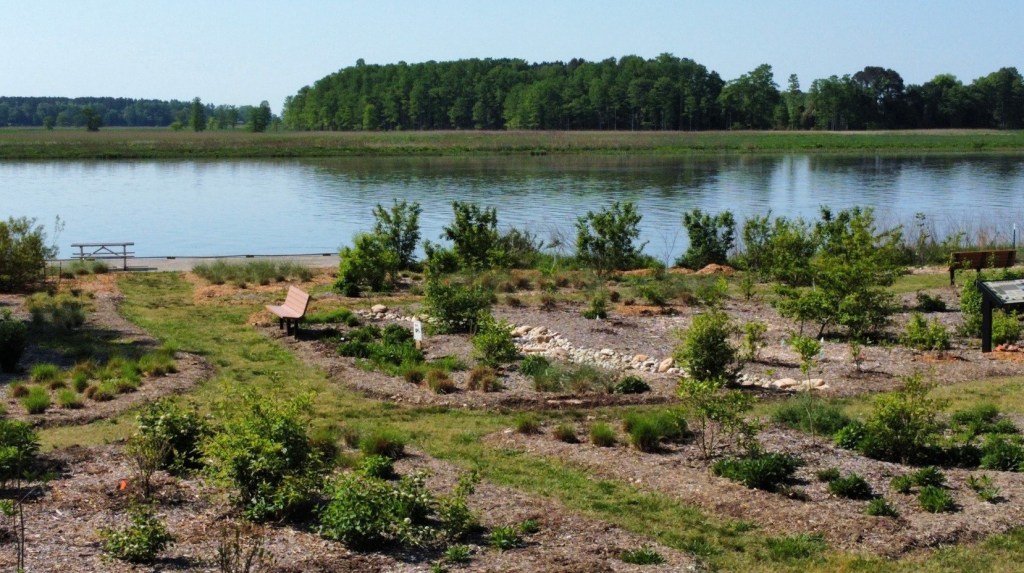
JAMES CITY — Many homeowners in eastern Virginia know the frustration of trying to maintain property that’s soggy or prone to erosion. Now there’s an opportunity to learn firsthand some natural approaches to tackling tricky terrain.
The James City County Williamsburg Master Gardener Association and the Historic Rivers Chapter of the Virginia Master Naturalists are jointly sponsoring a demonstration garden at James City County’s Brickyard Landing that provides living examples of species and landscape design that provide benefits both for local ecosystems and the landowners who tend them.
Brickyard Landing is a 119-acre county-owned property and public boat ramp on the Chickahominy River near the James City County community of Toano. The county acquired the property in 2020 and has a plan to transform the mostly undeveloped space over the next several years. But while county officials navigate the glacial pace of securing funds to improve Brickyard, the gardeners and naturalists have stepped in to implement their own grant-funded enhancements.
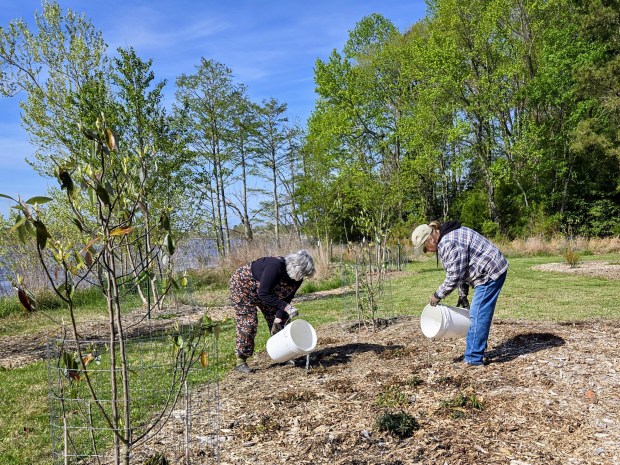 Judy Kinshaw-Ellis, left, a co-lead of the demonstration garden, waters plants. (Ben Swenson/For The Virginia Gazette)
The master gardener and master naturalist groups are distinct volunteer organizations that promote common goals, with the former focusing on horticultural awareness and education and the latter concentrating on projects that benefit natural areas and resources.
Judy Kinshaw-Ellis, co-lead of the demonstration garden, said the organizations began planting at Brickyard in November 2023 and the pace and volume of plantings has accelerated since then. The garden, which sits in the riparian zone between the shoreline and upland terrain, is divided into several sections.
Among the different areas are a pollinator friendly wildflower patch, a more formal stand of trees and ground-dwelling plants that thrive under their canopy, a plot of native grasses, and a native meadow that the Virginia Department of Forestry conducted a prescribed burn on in February.
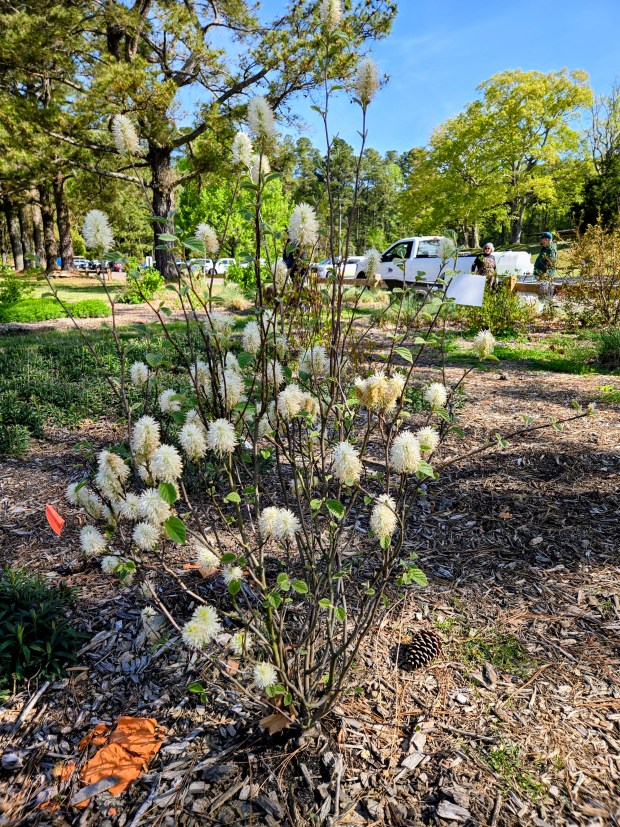 Fothergilla is one of many plants at the demonstration garden that can benefit the ecosystem while providing a blush of flowers. (Ben Swenson/For The Virginia Gazette)
The common denominator among nearly all the species is that they are native and can help control runoff, erosion and standing water, said Donna Benson, also a co-lead of the project. The plants additionally attract beneficial insects, birds and other animals, increasing biodiversity.
The garden includes some common native plant species, such as river birch, dogwood and black-eyed Susans, but also lesser-known standouts, including Virginia sweetspire, coral bells and sweetbay magnolia.
The demonstration garden accomplishes several goals, Kinshaw-Ellis said. The plants are ideal for areas that are often damp or sit at the edge of a shoreline. In addition to helping stabilize the soil, they provide an array of options for landowners to plant on their own property.
The project is helping to secure the shoreline at Brickyard, according to Sarah O’Reilly, who oversees natural and cultural resources for James City County.
“It’s also provided an opportunity to really get more intentionally involved in our natural resource management within our parks and green spaces,” O’Reilly said, providing critical background knowledge for more meadow management, wildlife mapping and habitat creation on county-owned lands.
Benson said the demonstration garden, which occupies about 2 acres including the natural meadow, is meant to provide an array of options for landowners to consider. “People don’t have to take out their entire yard,” she said. “You can start slowly and maybe just plant a section or the edges.”
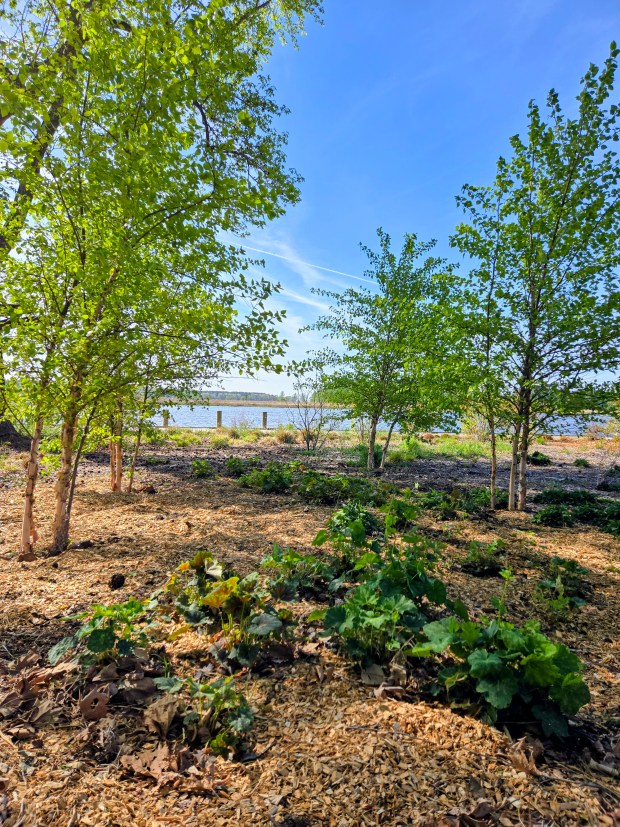 River birch and coral bells thrive at Brickyard Landing’s demonstration garden. (Ben Swenson/For The Virginia Gazette)
Native plants use less water than a traditional lawn, don’t require fertilizer and propagate themselves. “The beauty of native plants is that they don’t need a lot of care once they become established,” Benson said.
The demonstration garden is free of charge to explore, and the master gardeners and master naturalists occasionally offer guided tours. Volunteers typically meet at the garden on Monday and Thursday mornings to work in the garden.
Numerous organizations partnered with the county and volunteer organizations for the demonstration garden, providing grants, in-kind donations and other means of support. Among those were the Land & Water Conservation Fund, Coastal Resilience & Tree Fund, the Virginia Outdoors Foundation, the Colonial Soil and Water Conservation District, Stantec and Wetlands Watch.
Brickyard Landing provided the ideal location for this venture, O’Reilly said, and she hopes it can be replicated elsewhere. “It allowed us to turn highly manicured and mowed area to something more biodiverse and beneficial.”
To reach the master gardeners for more information, call 757-603-6067.
Ben Swenson, ben.swenson05@gmail.com
Comments are closed.