
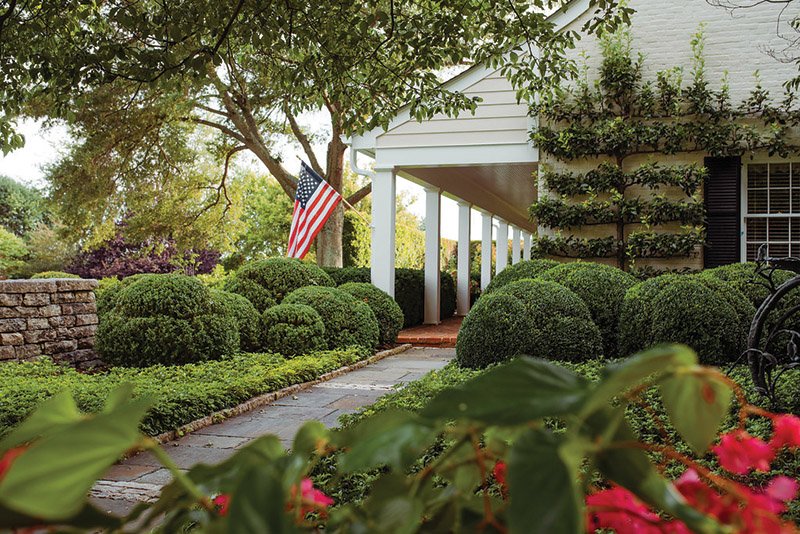
At the end of a bucolic Midway street, tucked in beside Midway Cemetery and overlooking Hurstland Farm, sits the home of Dottie Cordray and Chris Batts. The home — a beauty in its own right — is surrounded by just under an acre of gardens, masterfully designed by Joseph Hillenmeyer of Joseph Hillenmeyer Garden Design. Cordray, a cousin of Hillenmeyer’s father, was one of his first clients when she entrusted him with her property more than 20 years ago.
“I moved here 40 years ago,” said Cordray. “My sister actually designed this house. She and her husband built it and lived here with their four kids for 15 years. When they built a new house on their farm in Woodford County, she encouraged me to buy this house.”
At the time, Cordray was living in a tiny house in Lexington, with two big dogs and her first baby on the way, and it was an opportunity she welcomed. Though she had started a degree in horticulture before she got married and became a mother, that focus was put on the back burner during the early years of raising a family, and she left the garden alone during those early years.
“When my kids were old enough, I went back [to school], and that’s when I got really interested in starting the garden,” she explained.
With their family connections, it was natural that she would turn to the Hillenmeyers for help with the garden, but instead of working with one of the more established members of the family, Cordray took a chance on Joseph Hillenmeyer, who was just getting started designing gardens professionally.
“I had only been doing design work out of the garden center for about a year,” he said. “I really had no experience, but she took some chances with me right away. None of these projects have been small undertakings, and she put a lot of trust in me from the beginning.”
Cordray explained that when she bought the house, the landscape consisted of three big oak trees, a holly, a dogwood, and a cherry tree that had been struck by lightning.
“That was about it,” she said.
With the intention of making the entryway more inviting, she and Hillenmeyer started with a courtyard to the right of the home, creating the first of what now numbers eight separate garden spaces. Intersected by the driveway, the entry courtyard is visually delineated from a larger parking area by free-standing low limestone walls. Stone benches were built into the walls in an adaptation that nods to the tradition of the stile: steps that allow the passage of people over a fence while keeping animals contained. The area is anchored by a fountain created from a large river marble millstone perched atop a limestone base, which Cordray said has become quite the attraction for the birds.
“They come from all over the neighborhood and take turns, standing on top or walking underneath and using it like a shower,” she said.
Hillenmeyer said that aside from marking the entrance to the property, the Courtyard Garden is a significant focal point because of its visibility from the kitchen window.
“It’s what you see when you’re standing at the kitchen sink or prepping at the counter,” he said. “The intention was for it to be a tranquil area.”
Moving counterclockwise around the house, the entry courtyard leads into the Woodland Garden. Reminiscent of a path through shady woods, this area is shaded by the Japanese maple “Seiryu” cultivar and is filled with special flowering plants such as Japanese Sacred Lily, uncommon varieties of liriope and Solomon’s Seal, and a native euonymus that carries the common name Hearts-a-Burstin’.
“This area is a riot of color in the spring, with yellow celandine poppies, bluebells, trillium, twinleaf plants, blood root and bleeding heart, as well as other natives,” Cordray said.
From the Woodland Garden, visitors enter a second courtyard. Marked by a low brick wall and small fountain in one corner, limelight hydrangeas and hedges surround a small square lawn, which connects via stone path to the Circular Garden. This more manicured, traditional garden, features low hedges that encircle a round lawn with a Grecian-style planter resting on a stone pillar in the center. A small nook set off the entry path is home to a stone statue of a woman holding flowers, which holds a special place in both Cordray’s and Hillenmeyer’s heart, as it once belonged to Cordray’s grandparents – Hillenmeyer’s great-grandparents.
“This is, for me, a special part of the garden,” Hillenmeyer said.
Adjacent to the Circular Garden is a space the family refers to as the Tent Lawn. A flat lawn delineated by a low stone border and visually separated from the adjoining properties by boxwoods and hydrangeas, the area is sized perfectly for a tent and a dance floor, and it has seen its share of weddings and celebrations. The Tent Lawn moves visitors from the right side of the house into a larger area behind the house, opening views to Cordray’s greenhouse and attached cutting garden, where native plants attract scores of butterflies and other pollinators.
From there, the tent lawn transitions into the sunset garden, with two rows of sycamores that draw visitors to a small seating area. Hillenmeyer calls it the Sunset Garden because the trees perfectly frame the view as the sun goes down.
Coming around to the left side of the house brings you to the most recent design, which takes advantage of a larger area available between the house and the property line.
“There are constraints on the right side and behind the house because of the tightness of the space, but those constraints disappear as we move over here,” Hillenmeyer explained. “Because we had more freedom, I wanted to bring in some curvilinear lines. I call it the Serpentine Garden.”
With a stone path that twists through curved hedges surrounded by flowering and native plants, visitors feel as if they are walking through a miniature labyrinth. The path deposits you at the edge of the front lawn next to the Water Oak Garden: a collection of ground-covering plants and flowers surrounding a large water oak.
“We started about 21 years ago, and the last major project was completed about 12 years ago, so we spent more than a decade building this,” Cordray said. “But it’s never really finished.”
Hillenmeyer points to the Woodland Garden as a prime example of how things change.
“Things we planted 21 years ago have gotten much bigger and are competing for a lot more water, so the understory plantings that survive will change dramatically over a 21-year period,” he explained. “We redid the Woodland Garden eight years ago, and the whole plant palette changed. Squirrels and other animals have dug things up, and we’ve had some mild drought that has killed things off. As conditions change, Dottie gives us the freedom to come back in and revamp sections of the garden.”
The project has been special to both Hillenmeyer and Cordray due to the layers that tie both of them to the property.
“Her sister built the property, and the handful of trees that were here when I started designing for this property were planted by my dad or grandfather, 50 years ago,” Hillenmeyer said. “I have a few projects that I have worked on where I’ve overlapped with grandfather or great-uncle or my dad and those projects are always special.”
With so many individual spaces, it would be easy for them to feel disjointed in less talented hands. Hillenmeyer, however, never loses sight of through-lines, using them as a means to tie the spaces together.
“You’ll see repetition of details throughout the property, like the triple banding of the limestone that repeats, or blue stone that is used throughout the garden in different patterns,” he explained. “It provides some cohesion to the garden.”
Hillenmeyer also makes sure to take advantage of the home’s unique location.
“The [adjacent] horse farm and the cemetery provide a lot of borrowed landscape,” he said. “It makes the property feel even larger than it is.”
Cordray has been happy to let Hillenmeyer experiment and take chances with her garden, and it has paid off.
“This house is the best decision I’ve ever made,” she said. “I absolutely love it here. It’s my haven.”
Comments are closed.