
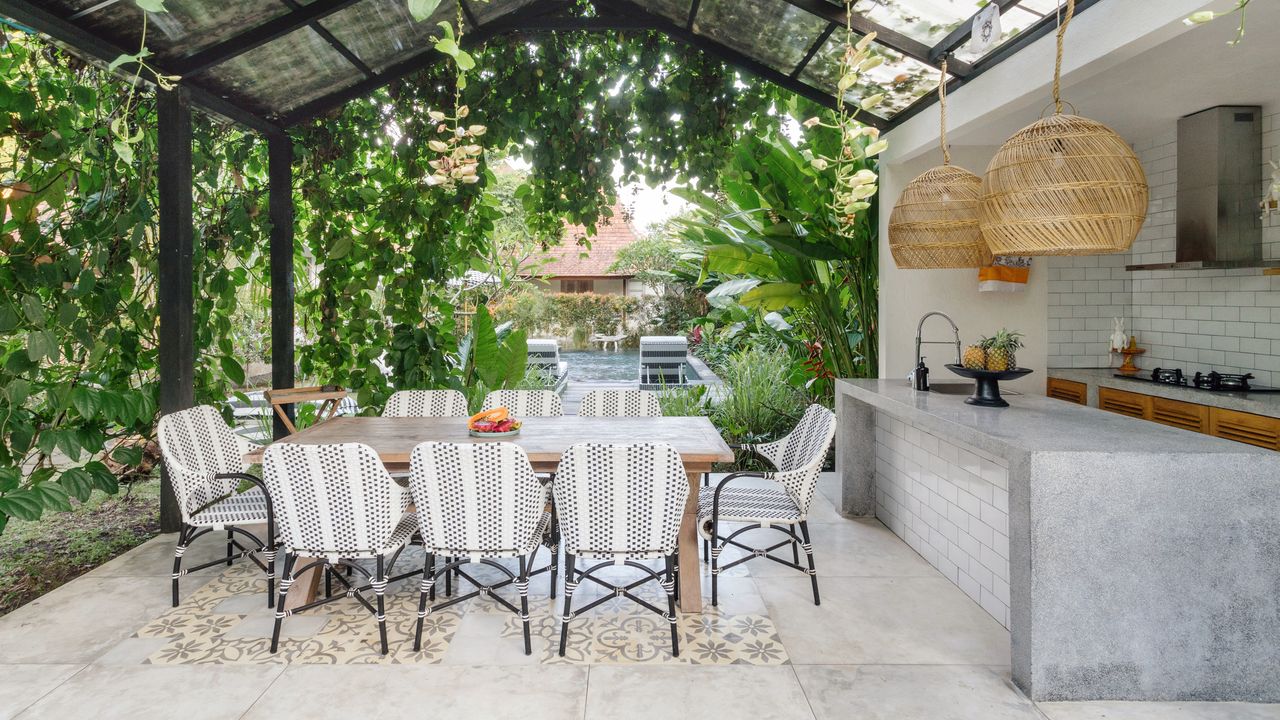
A well-lit backyard should feature layered lighting that’s strategically placed for ambiance and safety. Tricks like illuminating walkways and creating focal points accomplish both simultaneously, while clever DIYs like glowing orbs bring a dynamic design element to your landscape. Firepits and outdoor candles can even provide organic light without any electricity at all. The fewer light bulbs to replace the better, right?
According to Caroline Danielson, the director of showrooms at Ferguson Bath, Kitchen & Lighting Gallery, it’s also critical to consider light pollution when lighting your backyard. She cites information from the International Dark-Sky Association, a nonprofit that advocates for decreased use of excessive artificial light because it can disrupt ecosystems and wildlife and can cause harm to human health. Luckily, fixtures labeled “dark sky” and “good neighbor” can illuminate your backyard with limited light pollution. Your lighting system affects all the living things around you too.
“Using warmer lights and minimizing blue light emissions can help reduce the impact of your light pollution, as blue light brightens the night sky more than any other color of light,” Danielson explains. “Motion detector lights and timers are ideal dark-sky lighting solutions, as these lights only come on as needed. It’s also important that you shield outdoor fixtures so that the light shines exactly where it needs to: downward.”
Motion detectors and timers help conserve electricity, as do renewable solar-powered lights. Knopfler recommends solar path lights that charge in the sun and automatically turn on after dark, so you don’t have to remember to flip a switch. Solar lights can brighten your outdoor living space without making you feel like it’s just another burden on your electricity bill at the end of the month.
The best solar option for your space varies depending on the natural light it gets and which way your home faces, according to Jane. You can mix warmer and cooler tones and different light fixture styles to achieve your vision. Floodlights, LED lights, and garden lights all look different, so make sure you research what each one would actually look like in your space.
Comments are closed.