
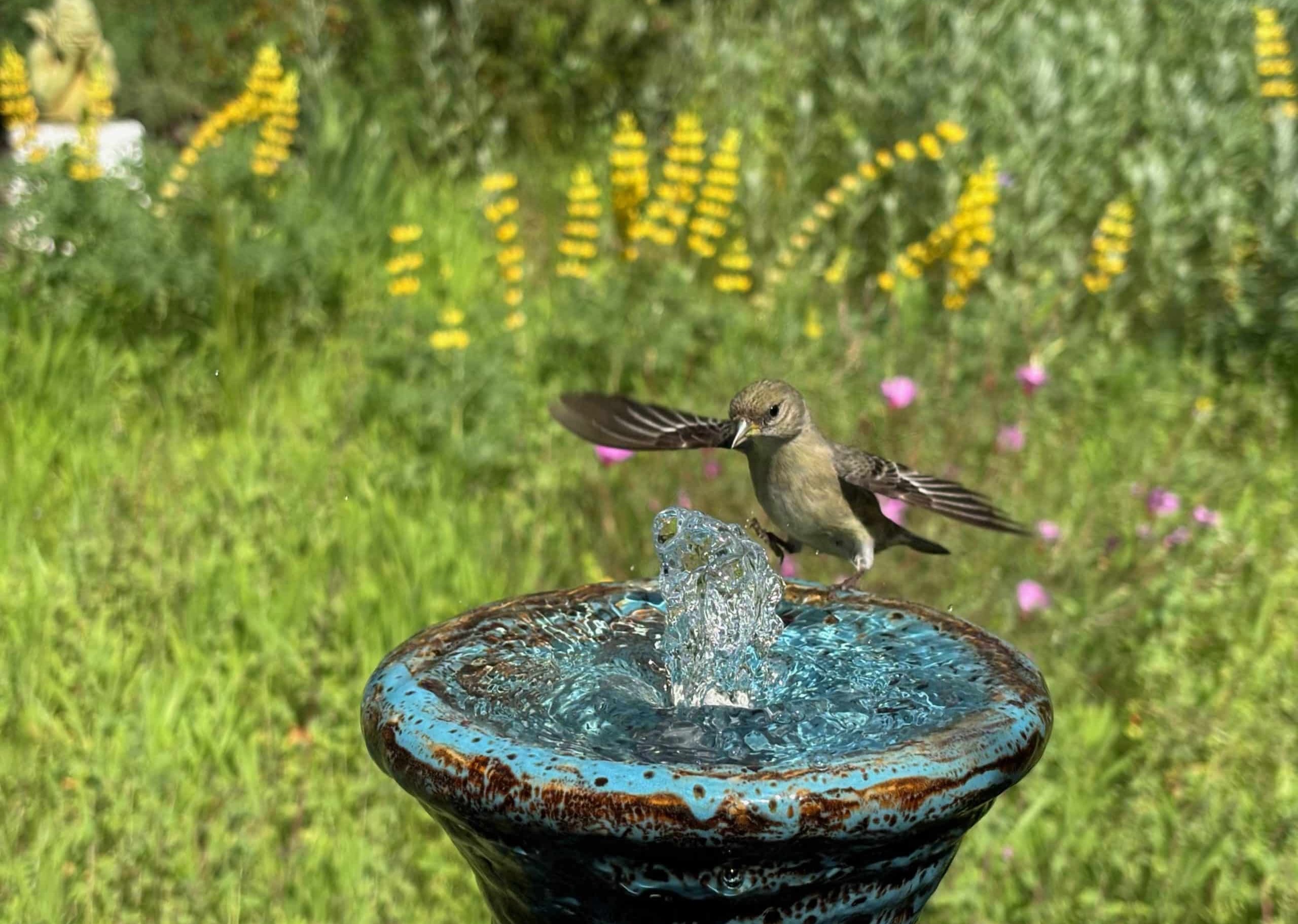
As you walk down the path leading to Tim Vendlinski’s backyard in Trestle Glen, he’s apt to pluck a leaf of white sage, a silvery shrub that sends up towering stalks of white flowers in late spring, and invite you to inhale its pungent, earthy smell. Farther along, he might encourage you to bury your face in the pitcher sage, whose sweet, delicious, layered scent might have been developed by a perfumerie. But the real star of his backyard lies beyond — his tiny native meadow of wild grasses and wildflowers, known as a pocket prairie.
The day The Oaklandside was there, the bright tangerine blooms of the California poppy had just begun to fade and several varieties of Clarkia were blanketing the space, with their pink and magenta blossoms rising above the purple needlegrass. Later in the summer, the flashy yellow of elegant tarweed will take over, attracting a riot of caterpillars and native bees.
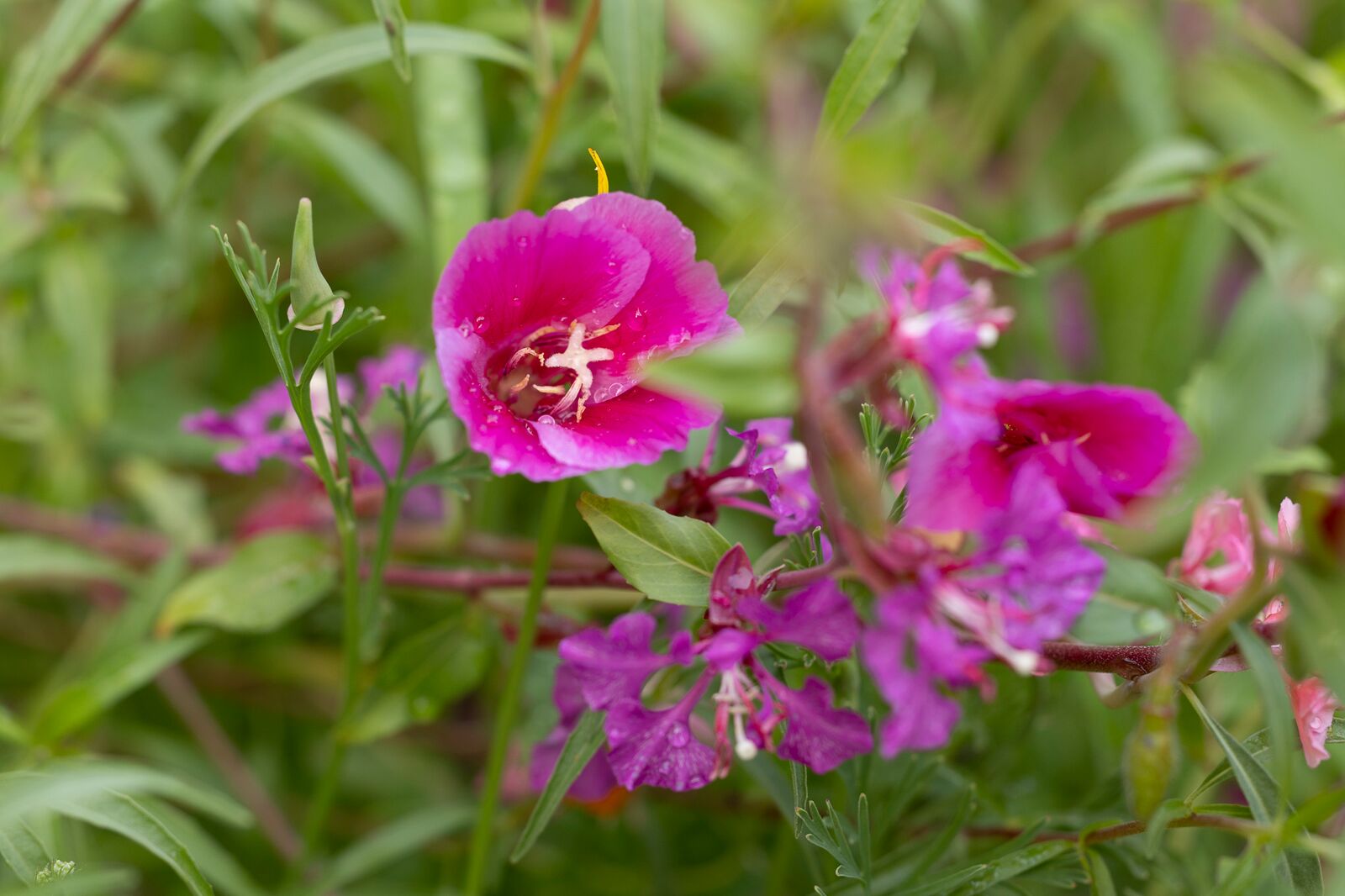 Several varieties of clarkia are in bloom in the pocket meadow in Vendlinski’s backyard on April 27, 2026. Credit: David M. Barreda for The Oaklandside
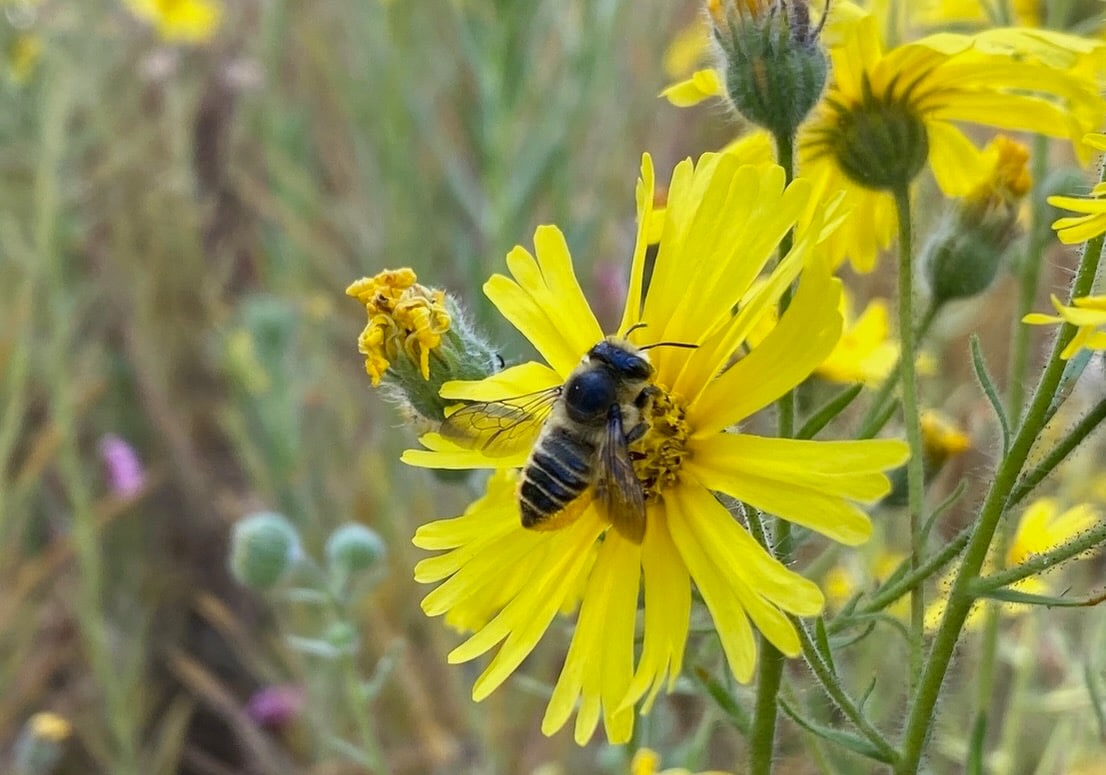 Later in the summer, a sea of tarweed blooms will attract native pollinators to Vendlinski’s backyard, including the Western leaf cutter bee seen in June 2024. Credit: May Chen
“We have our own daily super bloom in our backyard,” Vendlinski said. “And it benefits the birds that are grassland dependent.”
Tim’s backyard is one of 13 private Oakland native plant gardens — and a total of 70 gardens across the East Bay — that will be open to the public this weekend, May 2 and 3, 10 a.m. to 5 p.m., for the 22nd annual Bringing Back the Natives Garden Tour. Preregistration is required, but it’s free; Oakland, Berkeley, and other bayside cities are on view Saturday, May 2, while a smaller number of inland gardens, in places like Livermore and Walnut Creek, are on view Sunday, May 3.
Kathy Kramer, who organizes the tour, wants people to get inspired to transform their own yards, balconies, sidewalk strips, or neglected traffic circles.
“We need plants that provide habitat for our own local native species,” she told The Oaklandside. “If we want birds, we need caterpillars, and if we want caterpillars, we need our native plants. My goal is for birds to find enough food on my property to reproduce there. And if everybody found a part of their yard to plant natives, it would make a huge difference.”
Like many of the gardens on the tour, Vendlinski’s yard was a water-hungry lawn when he and his wife moved in more than a decade ago. As California’s drought deepened, he let the lawn dry to a brown crisp and then just ripped it out and began to plant California natives. Now he rarely waters unless he’s establishing new plants.
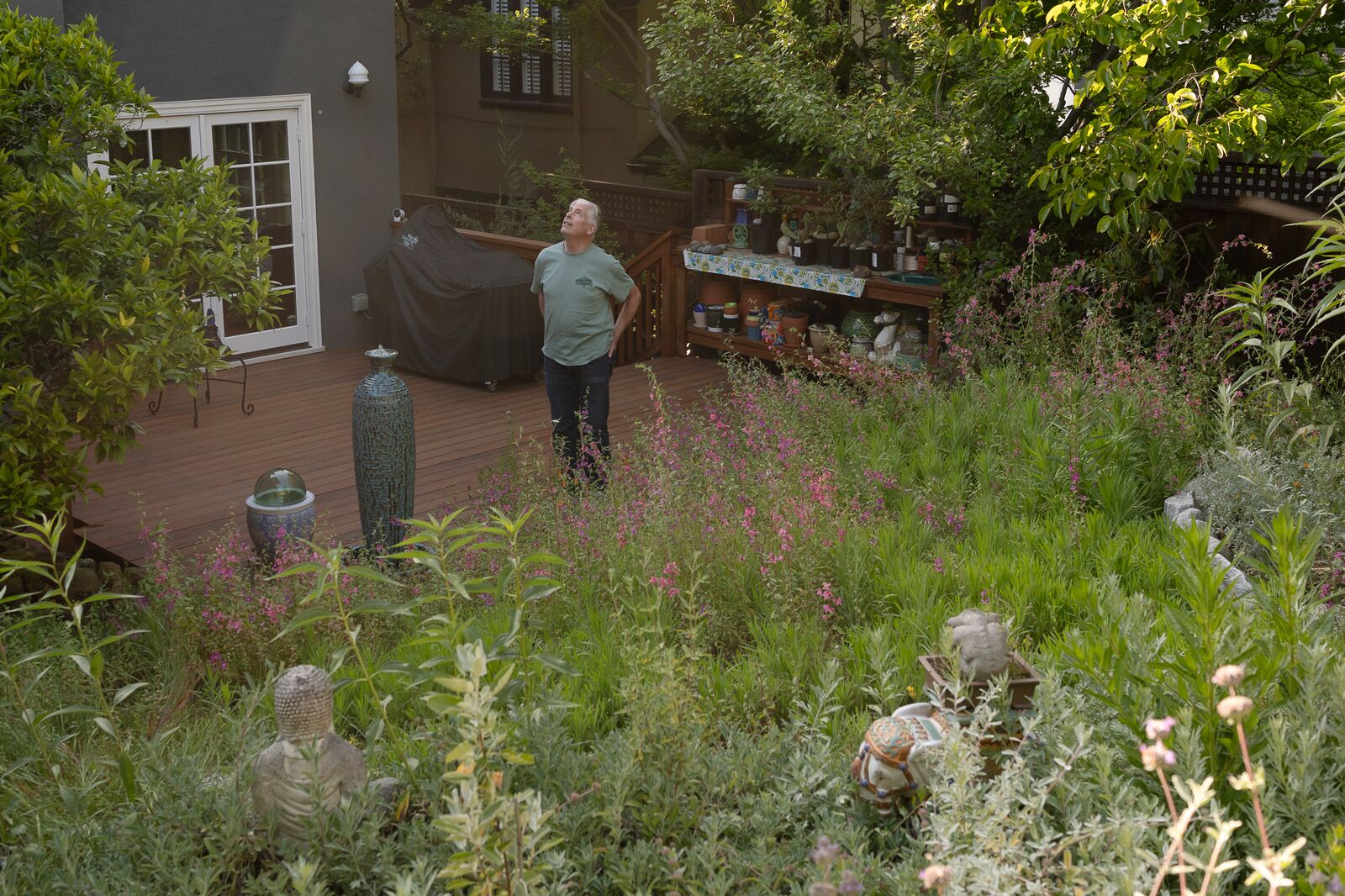 Vendlinski out in his backyard pocket prairie. Credit: David M. Barreda for The Oaklandside
Kramer, a longtime environmental educator, said the tour began informally, some three decades ago, with a group of friends who would get together and visit a native plant garden after work. When she first started planting with natives in the late 1980s and early 1990s, she said, people in the East Bay could only buy plants once a year at Merritt College when the local chapter of the Native Plant Society held its annual sale.
“People would line up for hours and then just snatch plants off of the shelves,” she said. There was one bible, Marjorie Schmidt’s “Growing California Native Plants,” but there weren’t landscape designers dedicated to California natives.
“Now all of those things are available,” she said. “Native plant nurseries, a great list of designers.”
Kramer’s yard, designed by Four Dimension Landscape Cooperative, is now home to 42 species of birds, including scrub jays and chickadees who nest there. She went on to plant a native garden at her son’s preschool in El Cerrito.
‘My garden of mistakes’
When Genie Barry, an educational therapist, first rented her home on Normandie Avenue in East Oakland in 2010, the small front yard was completely taken over by two Arbovitae, the fast-growing evergreens, pruned into a boxy hedge. Behind them, she recalled, everything was dead. She asked her landlord for permission to redo the garden and, inspired by the Bringing Back the Natives tour, began a journey characterized by experimentation.
“If I gave a talk as part of the tour,” she said, “it would be called, ‘My Garden of Mistakes.’”
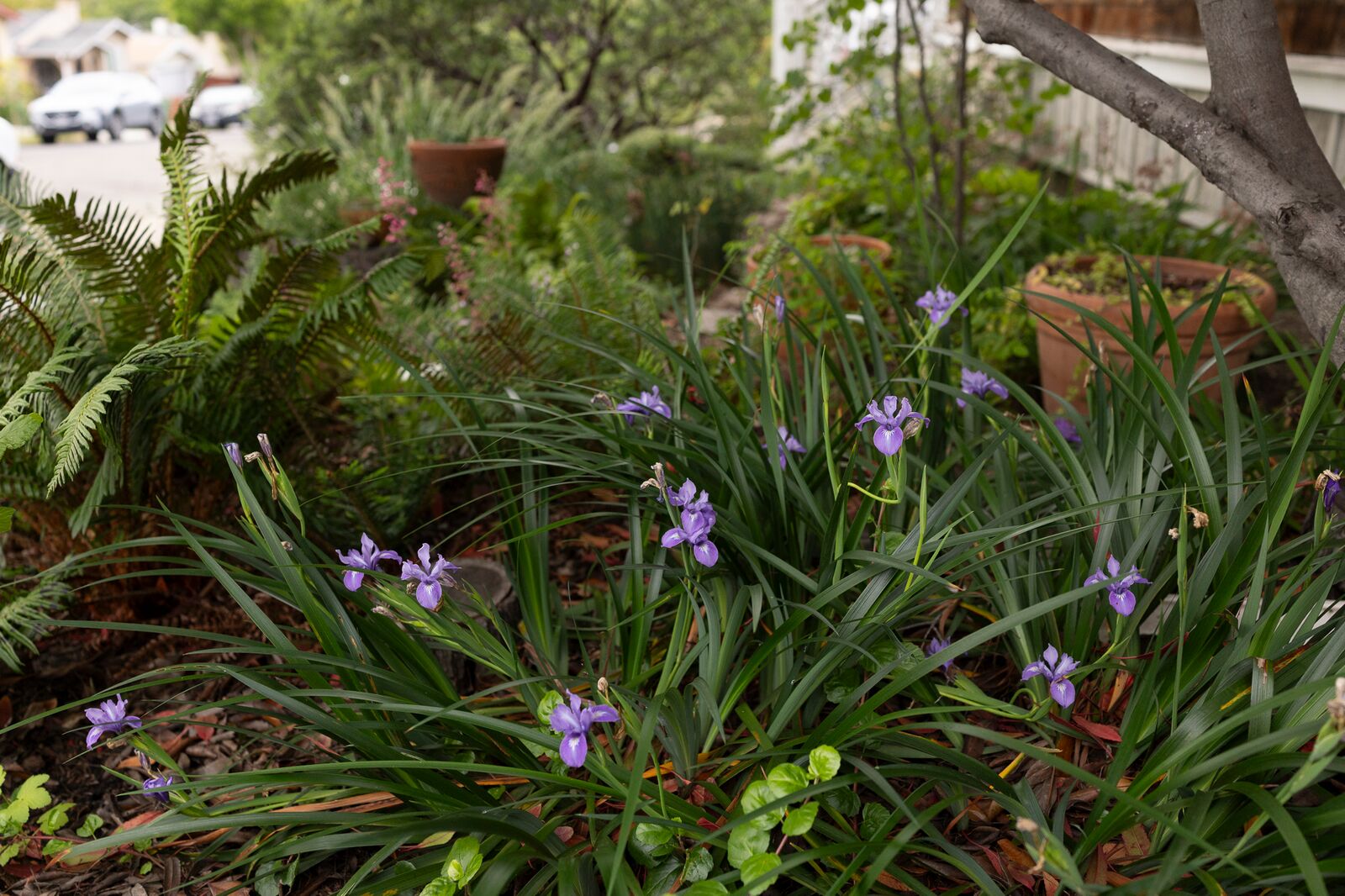 A patch of Douglas iris in a shady corner of Genie Barry’s front garden in East Oakland. Credit: David M. Barreda for The Oaklandside
She attended a talk along the way by landscape designer Kat Weiss — many gardens she designed are on the tour this year — called “Five easy design ideas to do your own front garden, using four rocks, one pot, and 21 plants” — and learned some basics, such as how to choose a focal point and some supporting cast members, how to use repetition, and the value of adding some “glitz” and some seasonal blooms. Then she took a design class at the Tilden Regional Parks Botanic Garden and planted over the course of two years.
“We were raising California kids, and they should have a sense of place,” she said. “They should know the shapes and smells and colors of California plants.”
A shady corner of her garden now features crevice alum root, with its floating pale pink flowers; the deep purple of Douglas iris; and fuchsia-flowered gooseberry, whose deep pink tubular flowers bob in the breeze just outside her kitchen window.
“We sit there in the mornings,” she said, “and watch the hummingbirds.”
 Barry’s blue gilia attracts a pollinator on April 27, 2026. Credit: David M. Barreda for The Oaklandside
 The deep purple blooms of blue-eyed grass and the cornflower blue of baby blue eyes in Barry’s backyard. Credit: David M. Barreda for The Oaklandside
Nearby, where there’s a bit more sun, some woolly blue curls attract native solitary bees. Two beautifully pruned manzanitas — yes, she prunes them herself — anchor the space as squat, gnarled sentinels, with their smooth, deep purple bark.
Along the side of the house are drifts of blue gilia, an annual with bright blue flower clusters that, she said, “reseeds like crazy.” In the backyard, more manzanitas and a desert olive, which she planted to shade her Southern-facing windows. “The bushtits just love it,” she said, “and the leaves turn gold in the fall and hang on for a long time.”
Before we left, she offered up a wild strawberry, tiny and tart, from a planter box near her back window.
Restoring a slope and a stream
While Vendlinski and Barry created their gardens themselves, a number of gardens on the tour were planned by landscape designers, with strategic plant choices and attractive hardscapes such as decks, pathways, and terraces. Gardens designed by Plantkind, in Oakland; Four Dimensions Landscape Cooperative, in Castro Valley and Martinez; Butterfly Effect Gardens, in Berkeley; and Pete Veilleux of East Bay Wilds, in Kensington and Hayward, are among those on the tour.
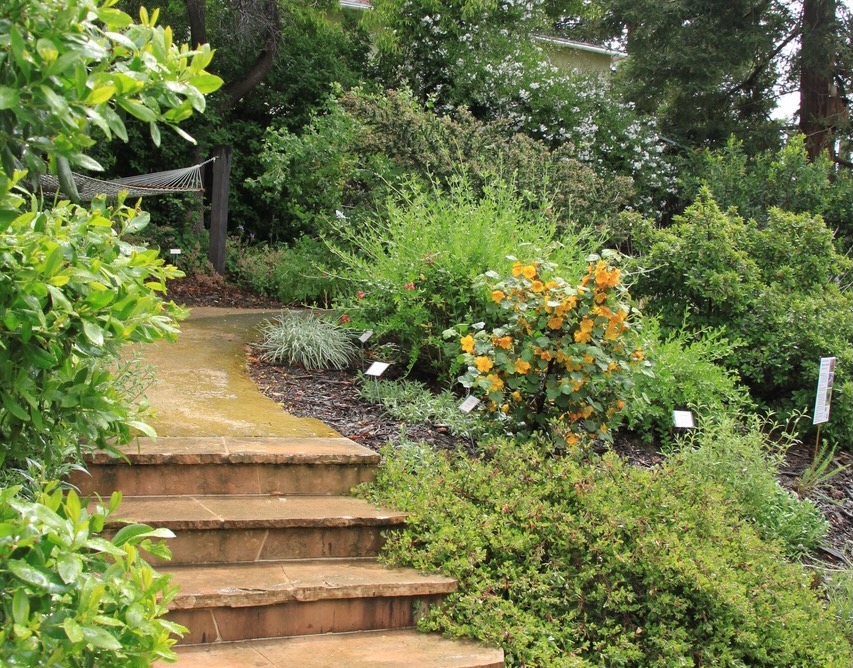 Susan and Bill Teefy’s garden in Castro Valley was designed by the Oakland-based Four Dimensions Landscape Cooperative. Credit: Courtesy of Bringing Back the Natives Garden Tour Credit: Kathy Kramer
One of the most extensive professionally managed gardens is Alan Harper and Carol Baird’s five acres in the Oakland Hills overlooking Anthony Chabot Regional Park. Designed originally by Roger Raiche, of the University of California Botanic Garden, it is now maintained by Kiah Dennerstein of Liminal Grounds. On a recent weekend, The Oaklandside visited the property, which you enter by going through a sculpted metal gate by Oakland artist Jaime Vaida and passing under the bows of an ancient live oak. Above the house, a narrow trail leads you through a native oak woodland, with a rich understory of wood fern, honeysuckle, false solomon seal, ocean spray, and man-root. Some of it Dennerstein planted; some of it emerged on its own as she and her crew fenced out the deer and repeatedly cleared out invasive species.
 The entrance to Alan Harper and Carol Baird’s five-acre native habitat in the Oakland Hills. Credit: Kathy Kramer
 A trail through Harper and Baird’s oak-bay woodland. Credit: Kathy Kramer
As we walk, we pass a mock orange in bloom, with its citrusy perfume, and a hummingbird sage, whose magenta flowers have attracted native bees.
Below the house, Harper and Dennerstein show us a slope that was cleared by a flash landslide in 2022, powerful enough to wipe out even large, established trees. They’ve been slowly restoring it with native grass seed, cow parsnip, and native nettles, all of which have happily established themselves as the gardeners have cleared out stretches of invasive poison hemlock.
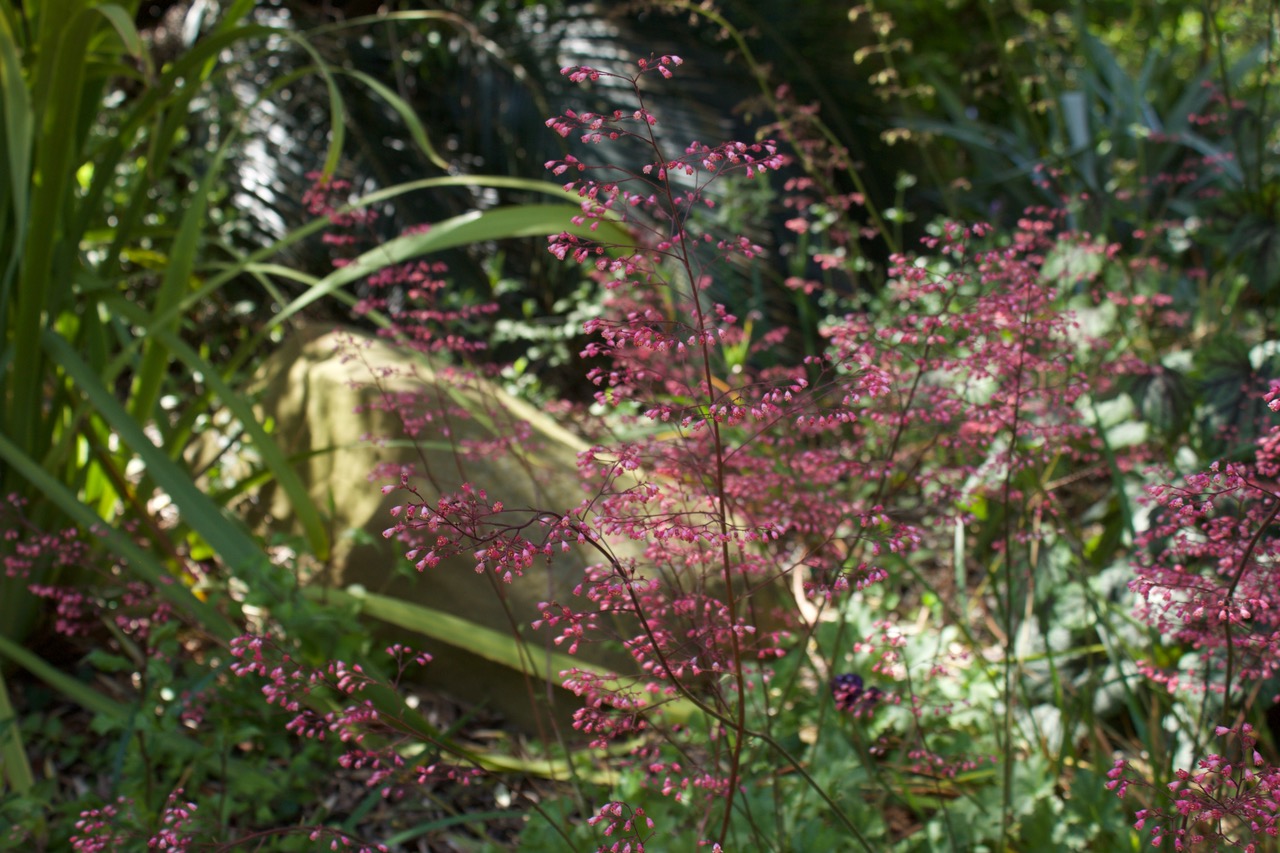 Coral bells in the understory. Credit: Kathy Kramer
 A detail from one of artist Jaime Vaida’s sculpted metal gates. Credit: Kathy Kramer
Farther down, they’re restoring a creek that had become a bare crevasse after the 2022 storms, an effort to reestablish shallow pools that were once nurseries for the California newt. They’re using a strategy called biomimicry, creating beaver dam analogs out of fallen branches to slow the course of the stream and collect silt and debris.
“For me, this work is a political project,” Dennerstein said of their efforts to restore the native landscape, “helping people fall back in love with what really matters.”
Guerrilla gardening
Few Oaklanders have five acres to experiment with, but Kramer emphasizes that even the smallest plots can help to form pollinator pathways that support native insects. Vendlinski, for example, adopted a traffic circle near his home that is now home to a mature California buckeye, mounding manzanitas, sage, and fuchsia.
“I’m a long-term guerrilla gardener,” he told The Oaklandside, “an adopter of abandoned landscapes.”
Some years ago, through Oakland’s “Adopt-a-Spot” program, Vendlinski, who is an environmental scientist by training, took on a large traffic triangle strewn with abandoned television sets where Park Boulevard intersects with Kingsley Street and Excelsior Avenue, where he planted three live oaks he grew from seedlings.
Now, he said, deer rest there at night.
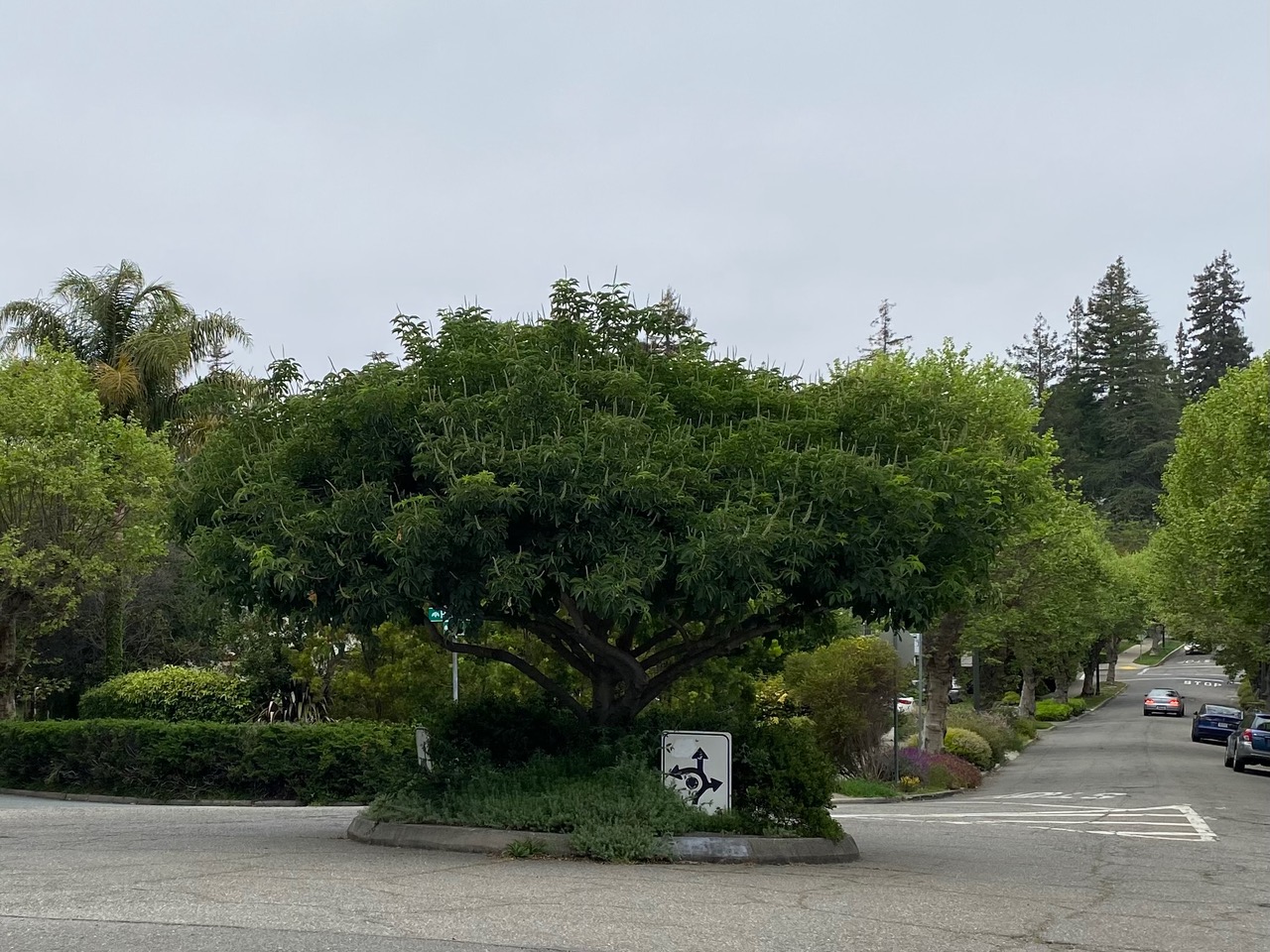 A mature California buckeye that Vendlinski planted years ago in a traffic circle near his home in Trestle Glen. Credit: Kathy Kramer
“*” indicates required fields
Comments are closed.