
Call it the scars of a beer bottle broken across the face of storied Black Oakland, severing the twin nerves of prosperity and progress. The freeway system that slashes through this city—from South Berkeley through Temescal to Downtown—was never meant to aid Oakland. The Oakland of the 1960s was a city on her mid-20th-century path, blazing toward the capable, futuristic metropolis that all her manufacturing, wartime industry and technological innovation had primed her for.
Starting from its very inception, the freeway system in Oakland was designed to direct resources above and away from the city, not through it.
It’s the last Sunday in September 2025, and the sky has started to fall in that overcast, secretive Bay Area mix of mist and drizzle—a weather phenomenon best coined here as “mizzle.” At the end of the block, a heavy-duty green cab truck is parked, presumably idling between runs from the Oakland dump. A Black school bus sits nearby, fitted with solar panels on the roof—a nice build.
The sidewalk is impeded by vegetation and feral fruit trees spilling out from carefully curated plots caught somewhere between purposeful manicuring and radical neglect. This community treats street corners like thrift shops, and residents leave gently used things out for one another: a North Face backpack, a bicycle tire, a barely used pair of leather gloves in front of one of the houses.
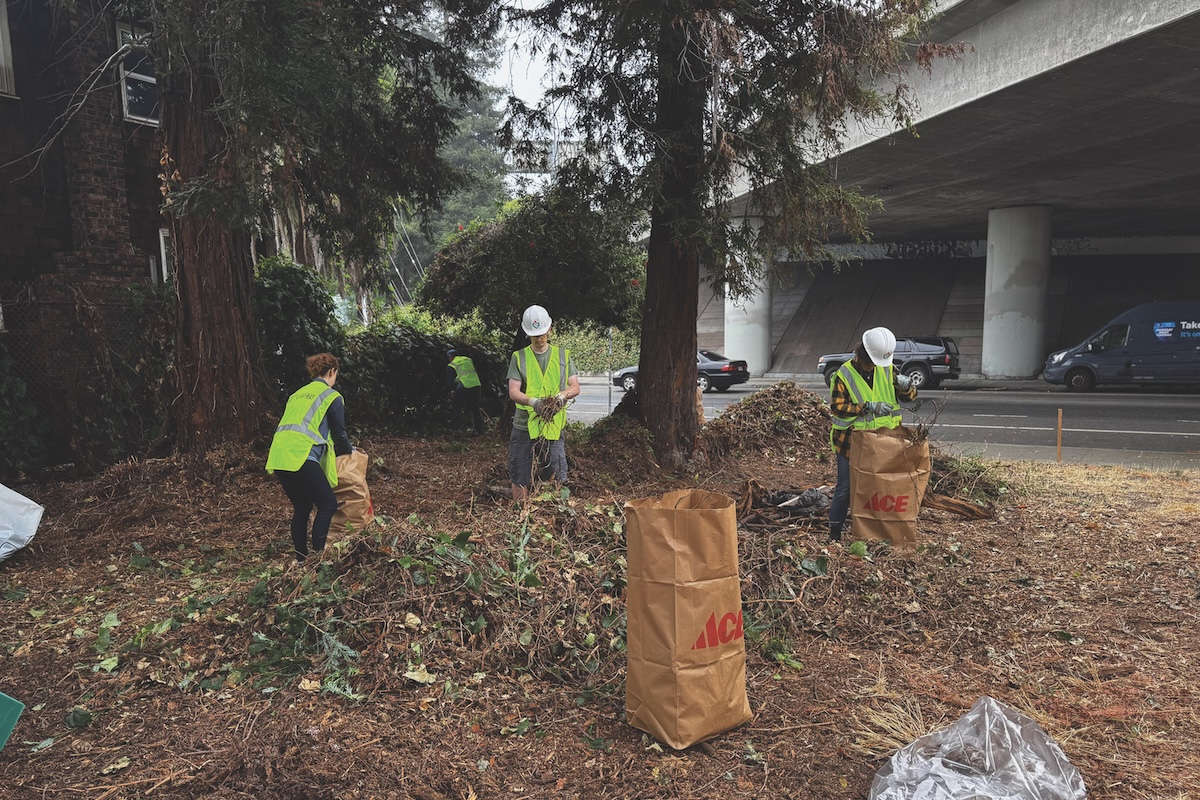
At 606 54th St., where the corner meets Shattuck, Karen West packs a large brown paper ACE garden trash bag that nearly matches her in height. Recently retired from Children’s Hospital in July, she found her way here through the Temescal Street Fair, where she met the garden committee and followed up on their calls for volunteers.
“I like being outside, and I like gardening,” she says. She knows that as a community resident she will have pride in the finished space, and thinks that people will enjoy “driving by it and seeing the park.” Karen loves the idea of a pollinator garden filled with California natives and a play area for kids.
The idea didn’t originate from a planning document or a city committee. It emerged after Caltrans rejected the concept of the garden producing food. So the community pivoted, and in that pivot found something better. The vision came from someone familiar with the land: Khaled Almaghafi, a beekeeper and owner of Bee Healthy Honey Shop at 2950 Telegraph Ave., who lives next door to the vacant corner lot.
Living with the overgrown, ivy-strangled parcel, Almaghafi saw not blight but potential—specifically, the native flowering habitat that sustains the bees he has built his livelihood around. His vision of a pollinator corridor in the heart of Temescal gave the project its ecological soul, connecting the community’s radical political inheritance to the most intimate workings of the natural world: the quiet, essential labor of bees moving from flower to flower, sustaining life without asking permission.
Jack Porter, North Oakland community organizer and Merritt landscape architecture student, is in his element this morning. A hardhat perched atop his salt-and-pepper curly natural mane, his smile is wide and welcoming—illuminating, slashing through the mizzle.
In the shadow of the neighborhood where one of the country’s foremost radical political parties once organized, a pollinator garden is being planted. Radical, because this is a re-matriation of land taken from the community through eminent domain to build a freeway meant to break the back of the Black community and break the heart of radical Black organizing.
It’s reductive to claim that this garden’s sole purpose is to address blight. Furthermore, it’s incendiary because it fuels the national media’s negative portrayal of Oakland. The land this garden occupies was only able to be taken because a careless and intentional report labeled the area as blighted. Words like “blight” hold particular power in Oakland.
On the northeast corner of 54th and Shattuck sits a former residential lot owned by Caltrans— “only because they have one of their freeway columns on the corner,” Porter notes. “We’re here today because we have a permit from Caltrans, and we are taking over this site, installing a 100% native pollinator garden. Today we are removing ivy and the redwood suckers from the base of the redwood grove at the northern part of the lot. The ivy is an invasive species. It’s choking out the redwoods. And really, we want to provide a nice play area for kids to be under the trees.”
For Porter, the planting carries additional meaning—a reversal of deliberate disinvestment. “In the ’70s and into the ’80s, law enforcement across the country removed a lot of trees in predominantly Black and poor neighborhoods as a way for police helicopters to better find suspects,” he says. The practice, documented by National Geographic, stripped urban canopy from the communities that needed it most. “You see a lot of empty tree wells all over neighborhoods, broken sidewalks where trees used to be, and all I see are opportunities to provide people with shade. Opportunities to cool the city and make it a more livable place,” he adds.
This land has a long memory. The Grove-Shafter corridor—Route 24—was never supposed to run through Oakland at all. The original plan traced a path through Berkeley, along Ashby Avenue, threading through a city with the political will to push back. When planners encountered that resistance, they turned south and found Oakland—more welcoming, they decided, which is a polite way of saying less protected. The Federal Housing Administration’s own underwriting manual stated plainly that highways were “effective in protecting a neighborhood and the locations within it from inharmonious racial groups.”
The freeway wasn’t incidental. It was a weapon—a concrete wall purpose-built to quarantine a community as it organized, connected and ignited. The Congress for the New Urbanism has named I-980 among the top 10 “Freeways Without Futures,” noting the damage fell “disproportionately in minority communities.” Disproportionately. That word is doing enormous work. It means Black. It means intentional.
The building at 5605 Grove—today It’s All Good bakery on Martin Luther King Jr. Way—was once the headquarters of the Afro-American Association, the reading group that pioneered Black Nationalist philosophy on the West Coast and directly influenced the founding of the Black Panther Party. That history informs the concept of this re-matriated garden. This land is not meant for exploitation. It is intended for people to rest, enjoy and play in—a place for children to explore, for early morning meditation, for watching bees work a row of California natives in the quiet light.
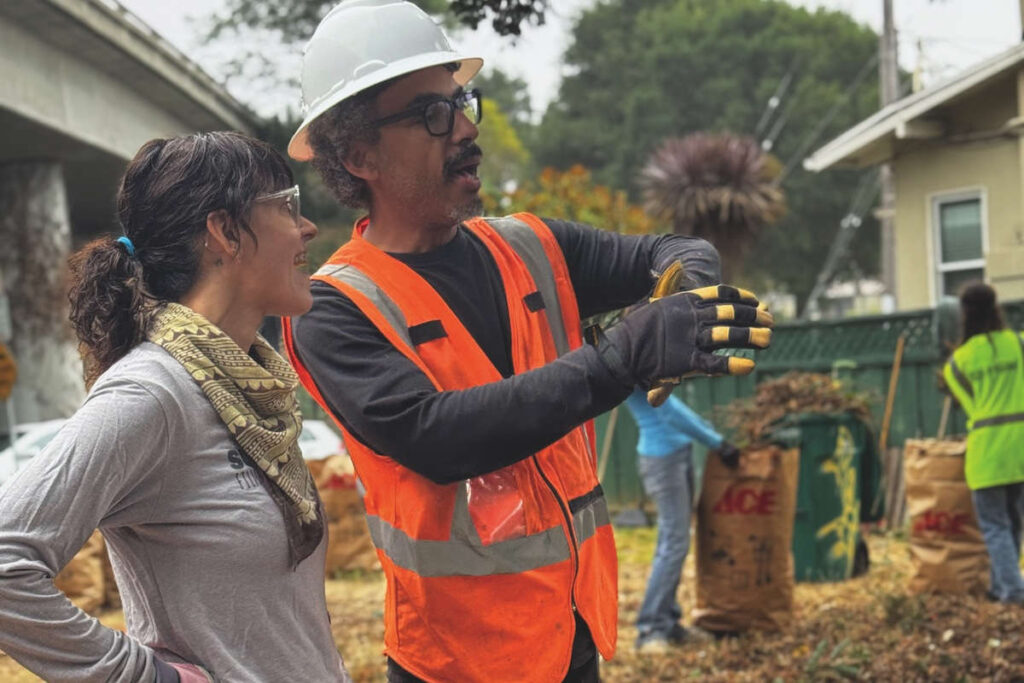 BEE INSPIRED The community pivoted to a pollinator garden after Caltrans rejected the concept of the garden producing food. Pictured: Rivkah Meadow (left) and Jack Porter.
Rivkah Meadow, a 15-year neighborhood resident, puts it plainly from behind a pair of pruning shears: “There’s just no better way to connect with community and root into the land than volunteering with neighbors and knowing each other. We keep each other safe, especially with all what’s going on right now in our politics. It feels just even more important to weave together locally and help protect our land and soil and protect each other.”
Porter knows the truth that romantics prefer to ignore: This work is never finished. The ivy will come back. It comes back every year, reliable as the mizzle, indifferent to how thoroughly it was pulled the season before. He calls it what it is—not a defeat, but a calendar. The annual ivy-pulling will be “a great opportunity for folks to come together and get a little bit of work in.” Not a single heroic morning, but a standing date between a neighborhood and its land.
Rob Selna, co-director of Sidewalk Trees and Gardens—fiscal sponsor and Caltrans liaison—came to this work through his background as a land-use and real estate lawyer. Their first project at 43rd and Dover built a 2,500-square-foot edible garden that has thrived for a decade. “We decided we needed to do even more things in the city,” Selna says, “because there was such a need.”
The community has raised $30,000 of the $40,000 needed, with the garden being laid out by Oscito, a Bay Area landscape design firm. Planting began the weekend of March 28. Volunteers and donations are always welcome.
For Porter, the mission is personal and political in the same breath. “It’s a lot about third spaces, about communal spaces, about re-matriation of the commons that the colonial capitalist project has robbed from people—not just here in modern U.S.A., but people all over the world. And yeah, we’ve got to fight that.”
In the shadow of a freeway built to break a community, a pollinator garden is being planted. The first order of business is pulling ivy—invasive, persistent, quietly strangling everything it touches. Redlining spread the same way. So did the freeway. Patient, creeping, dressed up as progress.
But here is what the planners never modeled: ivy comes back. And so does this community. They cut it down. It returns. They pave it over. It returns. Resistance propagates—its roots run deeper than anything built to contain it. Oakland wears her scars as testament. And sometimes, it starts with a beekeeper looking at a patch of choked earth and seeing, instead, a field of flowers.
To learn more, visit 54thandshattuckgarden.org and treesngardens.org.
Comments are closed.