
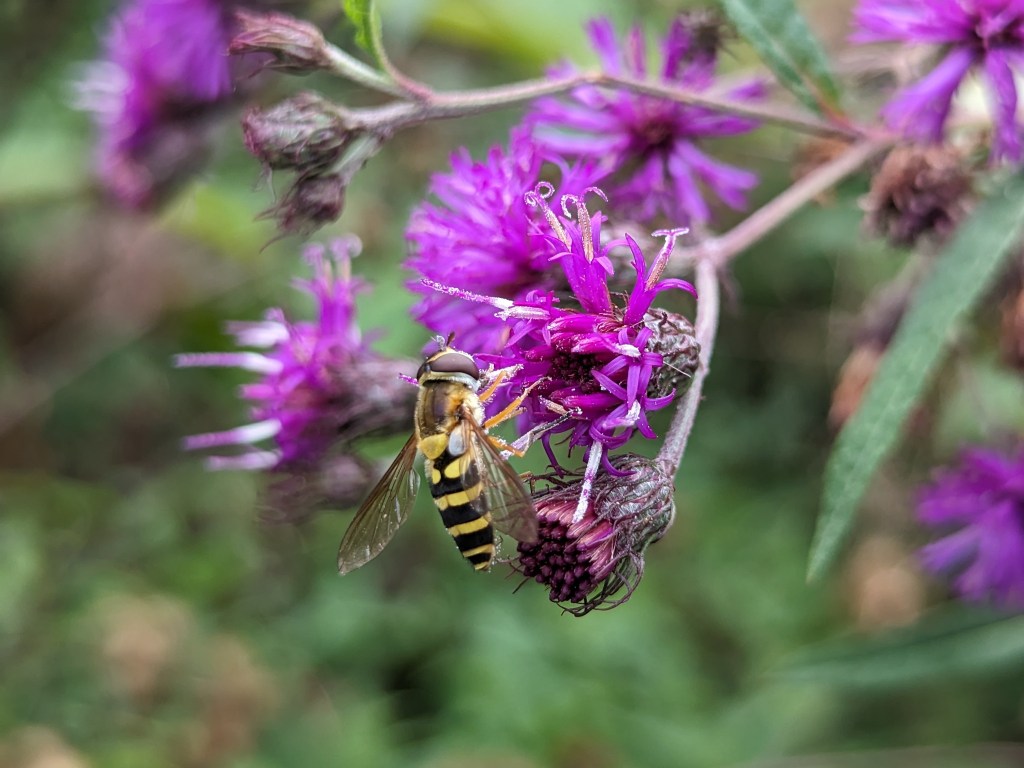
I’ve noticed that pollinator gardening plant lists seem to focus on bees and butterflies, but are there other insect pollinators? How do we support them?
Indeed, bees and butterflies are the most familiar pollinators, arguably among the most approachable for many people, and for some plants, bees might be their key flower visitors. Still, plenty of other insects contribute to pollination, or at least benefit from visiting flowers, even if they don’t move much pollen around to cross-fertilize them.
Pollinators include wasps (to skip over some nuance, bees are essentially fuzzier, vegetarian wasps), flies, beetles, and moths (butterflies are basically day-flying moths). Outside of insects, the only local birds that pollinate flowers are our hummingbirds, and Maryland doesn’t have pollinating bats (our local species eat insects).
Plants that rely on pollinators often employ a “pollinator syndrome,” which admittedly makes it sound like a disease. Syndromes are floral traits that influence pollinator use. They include color, the presence of nectar guides (runway markings to show them where the nectar is), floral shape or structure, flower scent/odor, and the presence or absence of pollen and nectar.
Here are sample traits for what certain underserved insect groups generally find appealing in flowers, plus some species suggestions to attract them to gardens:
● Beetles: white and green colors; bowl-shaped with lots of pollen; strongly scented, whether fruity or fetid; no nectar guides; Magnolia, Pawpaw, Jack-in-the-Pulpit, Waterlily, Goldenrod, Aster, Carolina Allspice
● Flies: dark brown or purple, or pale colors; funnel-shaped or having a complex shape; fetid or putrid scent; no nectar, but having pollen; Dogbane, Red Trillium, Pipevine, Jack-in-the-Pulpit, Skunk Cabbage, Pawpaw; syrphid flies (also called hoverflies or flower flies) will also feed on nectar and visit a wide variety of common flowers
● Wasps: shallow-faced (not deep-throated) blooms, given their relatively short tongues, which overlaps with bloom structures favored by butterflies; Mountain-mint, and many members of the Aster family (like Goldenrod)
● Moths: white or pale colors (especially for the many night-flying species), but also dull reds or purples; clustered flowers as a “landing platform,” like butterflies prefer, though some species hover while feeding and can use tubular flowers; strong, sweet scents (again, especially at night); no nectar guides, but lots of dilute nectar and little pollen; Evening Primrose, Phlox, Common Milkweed, Liatris, Yucca, Mayapple
Protect pollinators you attract from pesticide exposure by using other methods to manage pests in the garden. Fungicides, for instance, are used to suppress disease-causing pathogens like blights and leaf spots, but might also impact beneficial microbes that live in flowers. Fungicide use could harm bees and other visitors in surprising ways, such as by killing those microbes that the bees ingest and need for gut health.
Can you suggest a few underused native species for use as either a street tree or a smaller accent tree? They don’t have to have showy features, just be tolerant of minimal care.
I think several of our locally-native large shrub or small tree species deserve to be grown in home landscapes, but for some reason they’re hard to source. Maybe they’re harder to propagate, or maybe it’s just an issue of low demand because they’re not as flamboyantly showy or not well-known.
American Bladdernut (Staphylea trifolia) grows wild in much of Maryland, and in habit is more of a large multi-stemmed shrub than a tree, though it could be cultivated as either. On average, its white blooms appear late April to early May, and develop into interesting inflated three-sided seed pods by autumn. It is adaptable once established to drier or periodically wet soils, in full sun to understory shade, and a near-neutral soil pH. Thriving plants might sucker a bit.
Blackhaw Viburnum (Viburnum prunifolium) is usually sold as a shrub but can mature into a small tree if you let it. Found statewide, it adapts to many soil types and tolerates drought. It blooms about the same time as Bladdernut and the autumn berries are a colorful medley of mint-green changing to pink to dark blue-black as they ripen. Foliage may turn burgundy-maroon in autumn.
Hophornbeam (Ostrya virginiana) could be suitable for street tree use (as well as an in-yard specimen) due to its tolerance of rocky soils that skew dry, though moist (not wet), acidic soils are ideal. Slow-growing, it is an understory species, but can do well in full sun in cultivation. Named for the interesting seed pods that resemble hops, it is related to American Hornbeam (Carpinus caroliniana), as both are members of the birch family, but where Hophornbeam prefers upland soils, Hornbeam prefers floodplains.
We think of oaks as large shade trees (most are), but a more obscure native that is almost shrublike in stature is Dwarf Chinquapin Oak (Quercus prinoides). Once established, it has good drought tolerance, and it prefers acidic soils. If too short for use as a specimen tree (genetics and soil traits will influence its mature size), a group of them could serve as a thicket to block a view, or a minimally-pruned or unpruned hedge. Despite being an oak in a much smaller package, its foliage and acorns still support lots of wildlife.
University of Maryland Extension’s Home and Garden Information Center offers free gardening and pest information at extension.umd.edu/hgic. Click “Ask Extension” to send questions and photos.
Comments are closed.