

Listen to this article
Estimated 5 minutes
The audio version of this article is generated by AI-based technology. Mispronunciations can occur. We are working with our partners to continually review and improve the results.
Two local musicians are hoping to uncover a niche but critical piece of Garden River First Nation’s history in the Second World War through song.
Joel Syrette of Batchewana First Nation and Peter White of Sault Ste. Marie, Ont., teamed up to write and record a song they’ve called Chi Migwetch Ogichidaa, which translates to: Thank You Warrior.
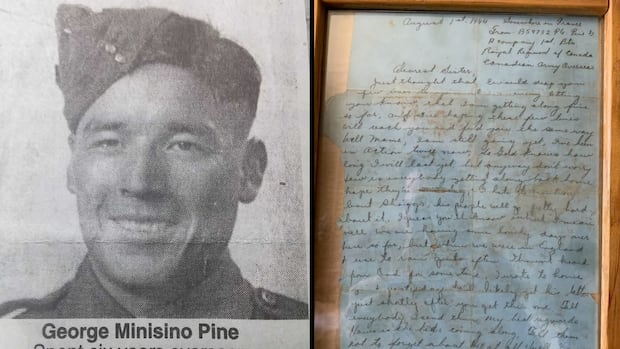
It’s dedicated to Syrette’s late great uncle George Minisino Pine and three other men from Garden River who are believed to have volunteered together overseas in the Second World War as code talkers.
Code talkers were vital to the war effort as they used their traditional languages — in this case, Ojibwe — to communicate messages and tactical information to one another on the battlefield that could not be deciphered by enemy forces.
“When they were in the war, the British commanders at the time paired them up in sets of two,” Syrette said.
“The commanders had the foresight to realize the enemy forces wouldn’t be able to understand the language that was being used.”
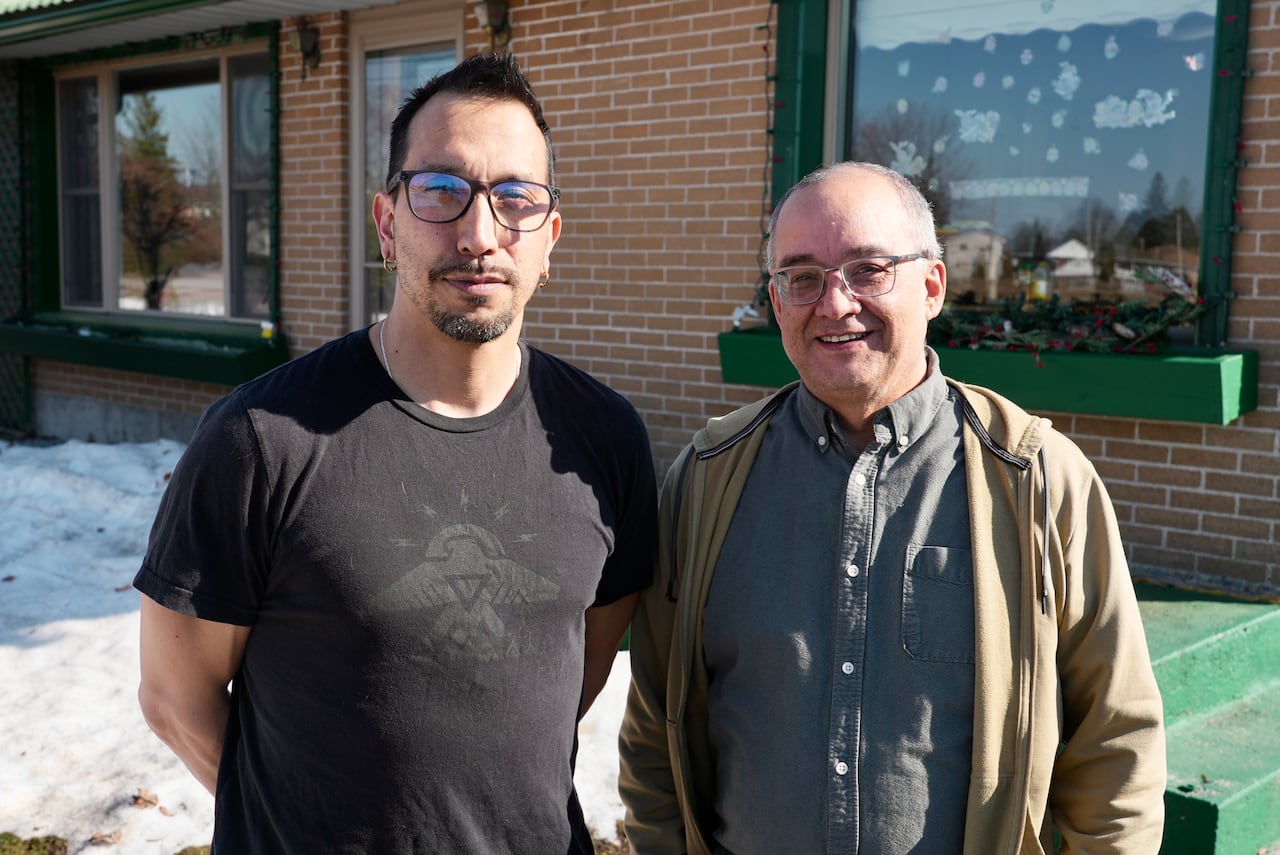 Joel Syrette, left, and Peter White spent 10 months writing, recording and producing a song that highlights Garden River First Nation’s code-talking contributions in the Second World War. (Alex Flood/CBC)
Pine had shared stories of his code talking experience with his relatives and descendants over the years, according to Syrette.
Syrette’s family still has a letter that Pine wrote to his sister Hilda from “somewhere in France” in 1944. She was attending Shingwauk Indian Residential School at the time.
“It’s ironic,” Syrette said. “While the Ojibwe language was advancing the war effort, it was being forcibly removed back home.”
Little known about Anishinaabe code talkers
Scott Sheffield, a history professor at the University of the Fraser Valley in Abbotsford, B.C., told CBC he’s not aware of the Canadian army ever deploying an institutionalized code talking program.
But that’s not to suggest Anishinaabe code talkers didn’t exist, he said.
“I’ve always suspected that within certain battalions that were recruited in regions that have perhaps a high number of speakers of an Indigenous language, that an enterprising battalion or brigade commander might have capitalized on that informally,” Sheffield said.
 History professor Scott Sheffield wasn’t aware that Anishinaabe code talkers assisted in the Second World War prior to the release of a local song. (University of the Fraser Valley website)
Sheffield’s work over the years has focused on Indigenous peoples’ involvement in the Canadian military, noting their contributions can sometimes be forgotten.
The only case of Indigenous code talkers from up north that he’s aware of were Cree personnel from the Canadian army and possibly the navy — information he said was made more available in just the last 10 years.
“They were seconded to the U.S. air force in Britain for about a six-to-eight-month period because they wanted to run a trial of using Cree,” Sheffield said. “It was a trial basis, and the air force opted not to push ahead in formalizing it.”
In the case of George Pine and his three fellow servicemen from Garden River, Sheffield anticipates they would have been very close to combat.
“They would typically be managing battlefield communications in real time,” he said. “The benefit of it was trying to code communications that might be intercepted by the enemy, which slowed down communications.”
“In the heat of battle, that was a detriment to the enemy.”
One of Pine’s military colleagues died in the war while the other two returned home, according to Syrette.
Pine passed away at the age of 74 in 1994.
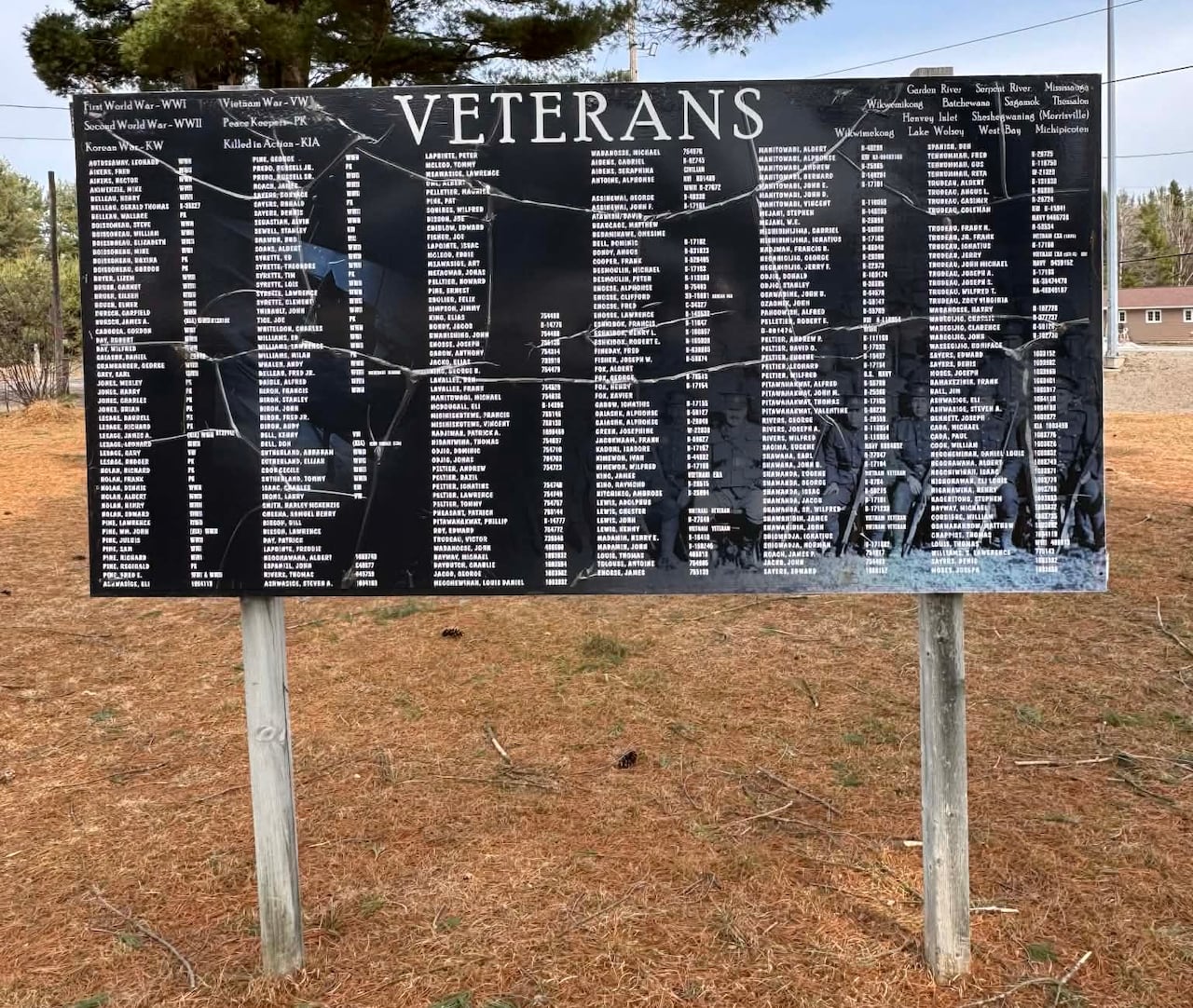 A memorial honouring Indigenous people in the area who served in various wars stands outside the Garden River First Nation band office. (Submitted by Luis Moreno)
Syrette said his great uncle’s unit remains the only one in the region they know for certain had served this specialty role in the Second World War.
“Outside of the family histories that have been preserved and handed down through stories, it’s not widely known,” he said. “It’s also not something we ever really talked about, unless he wanted to talk about it.”
New song ‘a contribution to reconciliation’
Ten months after developing the concept, Syrette and White finished recording Chi Migwetch Ogichidaa this past February.
Featuring cultural elements like the Ojibwe language, pow wow singing and a wooden flute, the song touches on what Pine may have wanted to say in the letter to his sister Hilda — had he been able to speak freely about the war.
“This was a passion project,” Syrette said. “It’s not about blame or shame, but about resilience and what happens when cultures work together for the common good.”
WATCH | “Chi Migwetch Ogichidaa,” by Joel Syrette and Peter White:
White, a retired high school music and Indigenous studies teacher, is not Indigenous himself but felt compelled to be part of sharing this story.
Syrette taught him to sing a pow wow song in the Indigenous language as part of the piece, which the musicians say was a calculated decision in advancing reconciliation efforts.
“It’s a great honour,” White said. “We’re a pair of musicians, Indigenous and non-Indigenous. This is our tiny contribution to reconciliation.”
Comments are closed.