
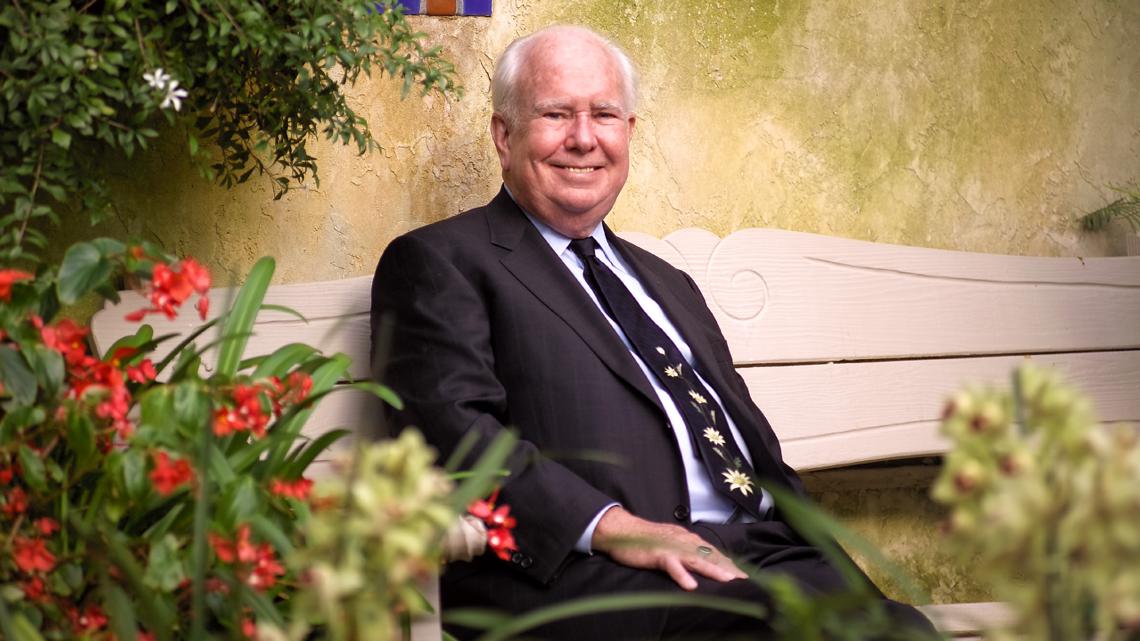
Peter Raven, who led the Missouri Botanical Garden for nearly 40 years, died Saturday at 89. He is credited with turning the garden into a world-class institution.
ST. LOUIS — Peter Hamilton Raven, an internationally known botanist who transformed Missouri Botanical Garden into one of the world’s premier centers for plant science and became a leading global advocate for biodiversity conservation, died Saturday. He was 89.
Raven led the garden for nearly four decades as president and director while also serving as the George Engelmann Professor of Botany at Washington University in St. Louis.
When Raven joined the garden in 1971, it was a respected but small institution. By 2010, when he retired, the garden had become an international hub for botanical research, horticulture, education and sustainability, with scientific partnerships on several continents.
Under Raven’s leadership, the garden added major public attractions including Seiwa-en, a Japanese garden; the Margaret Grigg Nanjing Friendship Garden; the William T. Kemper Center for Home Gardening; and the Doris I. Schnuck Children’s Garden. Its herbarium tripled in size, becoming one of the world’s largest botanical collections, and its library expanded into one of the most comprehensive botanical libraries anywhere.
The staff grew from about 150 employees when Raven arrived to nearly 500 by the end of his tenure, including almost 50 Ph.D.-level research scientists working in St. Louis and overseas.
“Peter Raven didn’t simply lead the garden; he redefined what it could be,” June McAllister Fowler, chair of the garden’s board of trustees, said. “His vision elevated it to a world-class institution while deepening its roots in St. Louis.”
After he retired, Raven remained active as president emeritus and professor emeritus, arguing for the protection of plant life and ecosystems.
Outside the garden, Raven helped establish St. Louis as a center for plant science. He co-founded the Donald Danforth Plant Science Center and played a key role in the growth of Gateway Greening (now Seed St. Louis), which helped create more than 200 community gardens in the city. He also helped establish a sister-city relationship between St. Louis and Nanjing, the first such partnership between the United States and China.
Raven’s influence extended far beyond Missouri. He spent 35 years as co-editor of the Flora of China project, a landmark scientific collaboration. His research helped shape modern understanding of plant evolution and coevolution.
Raven also mentored generations of scientists who later led institutions throughout the world.
“Peter was among the rare scientists who understood the importance of plant diversity science, but who also marveled at the vast sweep of life’s history,” said Peter Crane, the former director of Royal Botanic Gardens, Kew in the United Kingdom.
Raven received many of science’s highest honors. In 1985, he was awarded a MacArthur Foundation fellowship. In 2000, President Bill Clinton presented him the National Medal of Science. China awarded him its National Friendship Medal, the country’s highest honor for foreign citizens.
Raven served on the council of the National Academy of Sciences and later as its home secretary. He also was a fellow of the American Academy of Arts and Sciences and a member of numerous academies worldwide.
Time magazine named Raven a “Hero for the Planet” in 1999. He frequently warned that the loss of biodiversity was one of the central threats of the modern age.
Raven served on the President’s Committee of Advisors on Science and Technology and as a trustee of the National Geographic Society. He was also a life member of the Pontifical Academy of Sciences.
Raven co-wrote two leading textbooks: “Biology of Plants” and “Environment.” In 2021, his autobiography — “Driven by Nature: A Personal Journey from Shanghai to Botany and Global Sustainability” — was published.
Raven was born in Shanghai in 1936 to Walter and Isabelle Breen Raven. He earned his doctorate from University of California, Los Angeles in 1960 after undergraduate studies at University of California, Berkeley. Early fieldwork in Mexico studying folk taxonomy helped shape his lifelong interest in the relationship between people and plants.
Before moving to St. Louis, he spent nearly a decade as a professor at Stanford University.
He is survived by his wife, Patricia Duncan Raven; four children, Alice Raven, Liz Raven McQuinn, Francis Raven and Kate Raven; and four grandchildren.
A celebration of Raven’s life will be held at the Missouri Botanical Garden at a later date. Donations may be made to the garden’s Dr. Peter H. Raven Memorial Fund.
Comments are closed.