
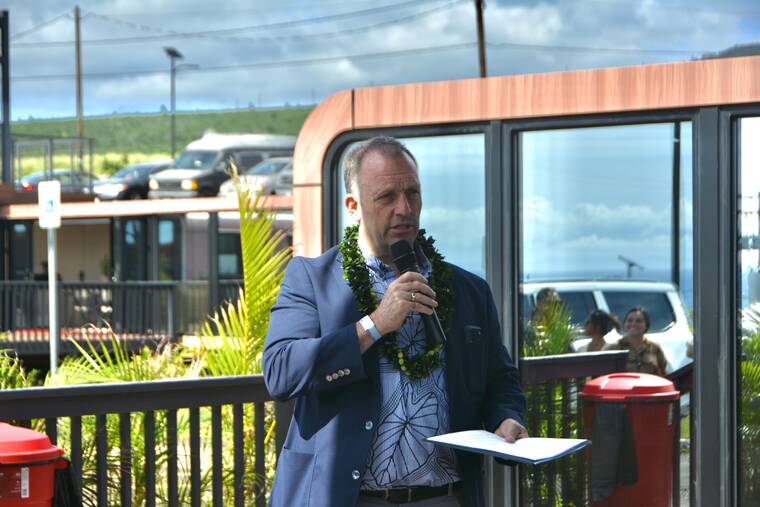
KAANAPALI, Maui — Nearly three years after the devastating 2023 Maui wildfires that killed 102 people and destroyed most of Lahaina, state leaders say Hawaii is making measurable progress in disaster preparedness and recovery, but also warn that entrenched systems, limited resources and a changing climate continue to test the pace of change.
Gov. Josh Green pointed to a series of improvements, from wildfire mitigation to emergency coordination, while acknowledging that rebuilding efforts — particularly in Lahaina — remain incremental.
“We had major improvements on getting rid of some of the invasive grasses by putting up fire breaks with the state Department of Transportation in partnership with the state Department of Land and Natural Resources team and our firefighting advisers,” Green said during a break Monday at the two-day Western Governors’ Association Spring Policy Forum on Maui. “So we’ve moved forward also with better resilient infrastructure.”
At the same time, the governor emphasized that systemic changes — especially in the insurance and construction industries — are slower to take hold.
“Everything goes incrementally,” he said. “I would love to get it all done. There’s always some of that (regulatory hurdles).”
Rebuilding Lahaina
Green said the state remains committed to rebuilding Lahaina with stronger safety standards, including wider streets and more defensible space between homes.
“I know that we will build Lahaina back better,” he said. “It’ll be less risky.”
But rebuilding efforts are intertwined with complex financial and regulatory realities. Green noted that multibillion-dollar decisions often slow consensus.
One major milestone, he said, was the settlement of wildfire-related lawsuits within the first year — an unusually rapid resolution that unlocked recovery funding.
“That was a very big deal because that helps you to just go ahead because you get your money,” Green said, contrasting it with disasters where litigation can stall rebuilding for years.
The state also has begun collecting revenue from a newly enacted climate impact fee, known as the “Green Fee,” which raises the transient accommodations tax by 0.75% to fund environmental stewardship, hazard mitigation and climate resilience efforts.
Officials estimate the fee will generate about $100 million annually for projects aimed at strengthening infrastructure and addressing the strain of roughly 10 million visitors each year.
Enacted in the wake of the Maui wildfires, the measure is part of a broader push to ensure visitors help shoulder the cost of protecting Hawaii’s natural resources and preparing for more frequent climate-driven disasters.
Decisions on how the funds will be allocated are expected soon, Green said.
The Lahaina wildfire was followed by repeated emergencies, including severe flooding from a Kona-low storm in March, underscoring what Green described as a defining feature of his administration.
“We are a communication governorship, and we also are in a crisis governor era,” he said. “We had fire, floods, COVID-19 … there’s been a lot of challenges, but we’ve had to be focused on disasters and we will continue to be.”
Green said the state has strengthened the Hawaii Emergency Management Agency and established a resiliency team within the governor’s office, with a heightened focus on communication.
He said he also has become more adept at working with federal partners, including the Federal Emergency Management Agency and administrations from both political parties, and is now more comfortable engaging with new leadership.
By embedding FEMA in a joint damage assessment process, the state has streamlined evaluations so agencies document the same damage at the same time, avoiding duplication. While additional resources are still needed, Green said faster coordination and earlier response can accelerate reconstruction and reduce long-term losses and delays.
“Time is recovery,” Green said.
Still, he acknowledged constraints, including limited federal funding and the absence of a fully passed homeland security budget.
While recovery continues, investigators are still working to fully understand how the Lahaina fire escalated so rapidly.
Derek Alkonis, senior program manager at the Columbia, Md.-based Fire Safety Research Institute, which was contracted by the Hawaii Department of the Attorney General, said researchers have taken an unprecedented, granular approach — reconstructing the fire minute by minute.
“We want to know what happened minute by minute, even before the incident unfolded,” Alkonis said during a Monday panel discussion at the Western Governors’ Association forum.
The team collected georeferenced data, including videos and images, and documented damage across every destroyed property in Lahaina, to understand how a fire spreads from a single structure to “five houses, to 100, to 1,000.”
“And you would think … we’d have a pretty good handle on answering that question,” Alkonis said. “But the answer is: we don’t.”
Despite advances in technology, he said fire behavior does not scale predictably, and computer models or artificial intelligence cannot fully replicate how large, fast-moving fires evolve in real conditions. Instead, researchers rely on detailed, on-the-ground data collection — documenting events minute by minute and analyzing how different factors and agencies interacted — before comparing those findings to established best practices to identify strengths and weaknesses.
“We discovered so many acts of courage, of heroism, of amazing stories,” he said. “But at the same time, we identified areas of vulnerability.”
Those vulnerabilities span prevention, preparedness and response, and have since prompted statewide priorities. Among them was reestablishing the state fire marshal position — now held by Dori Booth — which was reinstated in June 2025 following the Lahaina wildfires as part of broader efforts to strengthen coordination and wildfire readiness.
Statewide coordination
More than a year after the release of the institute’s final report in January 2025, Alkonis said the state has made significant progress implementing recommendations.
“From our vantage point, we’re impressed by the amount of work that’s been completed or in progress,” he told the Honolulu Star-Advertiser.
He cited increased coordination among state and county agencies, expanded weather monitoring systems and improved wildfire education efforts. New remote weather stations now provide more localized data, helping fire departments anticipate risk and adjust staffing before conditions worsen.
“In Hawaii, there wasn’t a large state infrastructure (that was) addressing all these different issues related to prevention of wildfire,” he said. “Now the state fire marshal … getting that organization up and running … is what’s important.”
Booth said recent heavy rain could set the stage for heightened wildfire risk later this year as vegetation dries out.
“One of the biggest things at this stage is getting ready for what we can only assume is gonna be a pretty intense wildfire season,” Booth said.
Efforts are underway to improve coordination across islands, including the creation of a statewide wildfire cooperators group and standardized training for agencies.
Booth said a major focus is strengthening coordination across islands, alongside expanding wildfire education programs, improving communication systems and updating codes and standards.
Efforts are underway to improve coordination across agencies, including the creation of a statewide wildfire cooperators group and standardized training.
“Each island really operates a certain entity,” she said. “And what we’re doing now … is bringing everybody together with standardized training, communication.”
Booth said communication — both among emergency responders and with the public — remains one of the most critical priorities. That includes ensuring infrastructure can withstand disasters. Power outages during the recent Kona-low storm highlighted vulnerabilities in communication, including the need for backup systems for cell towers.
Balancing priorities
Even as preparedness improves, officials acknowledge the scale of investment needed. Green estimated that infrastructure upgrades on Oahu alone could reach $20 billion, including projects like undergrounding power lines and improving dam safety.
“It all comes down to priorities,” he said.
In the meantime, the state is trying to address immediate needs alongside long-term resilience, which includes directing disaster mitigation funds toward food security, for instance, to stabilize communities during recovery.
As Hawaii enters another wildfire season amid climate uncertainty, officials say the lessons of Lahaina are reshaping how the state prepares for, and responds to, disaster.
“We’re evolving and growing,” Booth said. “The more people we reach to educate, the more we can reduce the impacts.”
Comments are closed.