
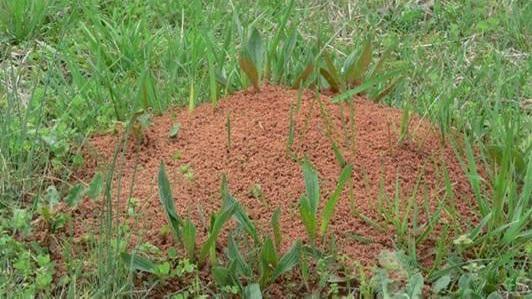
I'm a native Texan so I grew up knowing about fire ants. I've only started gardening in Texas in the last five years or so and I'm now wondering if our house in Austin is built on top of a massive red ant hill. How often do you discover a mound like this in your yard? For me, it's almost a weekly occurrence. I know red ants so well at this point that I can see differences in how aggressive they are and how venomous their bites are.
Also, what do you use to get ride of them? I sprinkle off-the-shelf ant bait on their mounds but it feels like a whack-a-mole situation where I eradicate one colony and they pop up a few feet away.
Thanks in advance for sharing your experiences.
by glsanders65
7 Comments
Such a nuisance. Tarro ant traps work really well. Yesterday I discovered a yellow jacket nest inside of my ant trap box, so I remedied the ant hill with boiling water and diamectus earth. I did it at night so it wouldn’t bother the bees.
Thanks for posting this. Fire ants are awful, my current house has them worse than my last one, I think because the lot is slightly lower down and the neighbors irrigate their lawns heavily, which the fire ants love above all else.
There is no way to not play whack-a-mole forever with these, as queens will still fly in from elsewhere and start new colonies even if you get rid of all yours.
The ants are always there, but they only mound up like this after rain. Which is awesome for us, because it concentrates their brood and queens in ways that are easier to knock down. I boil a kettle of water, open the mounds with a shovel, and pour the scalding water in, sometimes 2-3 times in a row. If you manage to kill all the queens, that’ll do it. The boiling water strategy leaves a dead patch on the lawn, but works better than the baits. If you do this for long enough, targeted removal of fire ants, you should see a resurgence of non-fire ants, and once those get dense enough they’ll help.
Three other things help in the long term. Fire ants dislike shade, so if you can grow an extra tree or two it will discourage new queens from arriving and will encourage existing mounds to migrate to sunnier spots. You can water less, as fire ants are a floodplain species and thrive with extra water. Finally, you can encourage your native ants, especially the Pheidole big-headed ants, as those don’t sting, compete with fire ants, and can provide a buffer if given the chance.
Follow the instructions, sprinkle on top and in a circle several feet wide around the mound. The mound underground is *much” larger than what you see above ground. And the ants aren’t “moving” they just open a new exit which is why you see them “pop up” again nearby.
Boil a gallon of water. Add 2 ounces of dawn soap and 2 ounces of orange oil (or limonene). Pour it on the mound.
(This is the treatment recommended by Texas A&M). You can look it up on YouTube.
I can’t tell if my ant hill is regular ants or fire ants. I left one hill alone and it got big and then 3 more hills popped up within a few weeks. It made mowing my lawn difficult so I decided to pour ant killer on them. The hills get pretty big, it’s impressive
You have to not only do the bait on the mound but in a big circle around the mound and then hit all the mounds at the same time.
But if your neighbors have them they can invade from there
You need multi pronged approach. I use some sort of sprinkle bait for the regular mounds that pop up along the property. Boiling water plus soap for in garden beds or compost. That nasty powder for mounds that pop up where the kids are playing but away from fruit trees and garden beds