
James Hitchcock was 20 years old and fresh out of an Arkansas prison in 1976 when he moved in with his brother’s family in a small home in Winter Garden.
Two weeks later, he went to a local bar to throw back beers, smoked marijuana and then snuck back into the house during the early morning hours through an open window.
He quietly went into his 13-year-old stepniece’s bedroom and raped her, prosecutors say.
When young Cynthia “Cindy” Driggers started screaming and threatened to tell her mother, Hitchcock dragged her outside through a back door, beat her and strangled her to death, according to court records detailing his confession.
Hitchcock went back inside, took a shower and went to bed. Cindy’s bloodied body was found by her stepfather the next afternoon on July 31, 1976 in nearby bushes after a daylong search by family members and police.
This past week, Cindy Driggers’ tight-knit family said they felt a sense of finality after Gov. Ron DeSantis signed Hitchcock’s execution warrant on April 1. The 70-year-old death row inmate is scheduled to be put to death by lethal injection on Thursday.
Hitchcock — first sentenced to death in February 1977 — is now the fourth-longest sitting inmate on Florida’s 246-member death row, following convicted killers Harold Lucas, Henry Sireci, and infamous quadruple murderer Tommy Zeigler, who also committed his crimes in Winter Garden.
More than a dozen of Cindy’s relatives plan to witness Hitchcock’s execution, having waited nearly 50 years. Last week, the Florida Supreme Court denied an appeal by Hitchcock’s public defenders to stay his execution.
Family members said it’s been a long road of frustration, agony and sadness watching Hitchcock’s death sentences get overturned three times amid the nearly a dozen appeals his attorneys have filed over the decades.
“I’m not joyful, but I really, really hope it does happen this time,” said Cindy’s mother Helen Judy Hitchcock last week. “But we’ve been down this road before. I hope and pray that now is the time.”
Hitchcock’s execution would not provide a sense of closure, but it will bring the family a long-awaited step toward healing, said Ginnie Meadows, Cindy’s cousin.
“Most people on earth will never experience these kinds of emotions that we’re going through,” she said. “It’s so emotionally raw right now.”
Coincidentally, Hitchcock killed the teenaged girl just two weeks after fellow death row inmate Zeigler was sentenced to death for the brutal killings of his wife, her parents, and a customer at his furniture store on Christmas Eve 1975, less than a mile from the Hitchcock home.
Hitchcock was also sentenced to death by the same Circuit Court judge, Maurice Paul, months after he sentenced Zeigler to death row in July 1976.
Before his trial, Hitchcock pulled back his confession and said his brother, Richard Hitchcock — Cindy’s stepfather — killed the girl in a fit of rage after discovering James Hitchcock and the girl willingly in bed together.
The jury didn’t buy it. And Hitchcock wiped away tears at his initial death sentencing, according to Sentinel reports.
But that first death sentence did not last. It was followed by multiple successful court challenges from his public defenders, leading to three consecutive death sentences overturned by the Florida Supreme Court over the decades. Hitchcock is now facing his fourth death sentence.
Meadows said she and other family members are angry that appeal after appeal by his attorneys has delayed his execution for decades.
“My anger is about what this has done to my family and what this has put them through,” she said. “When you go to the court, time after time, and you see a public defender put her arm around him in court, that will set off your anger thermometer way up there.”
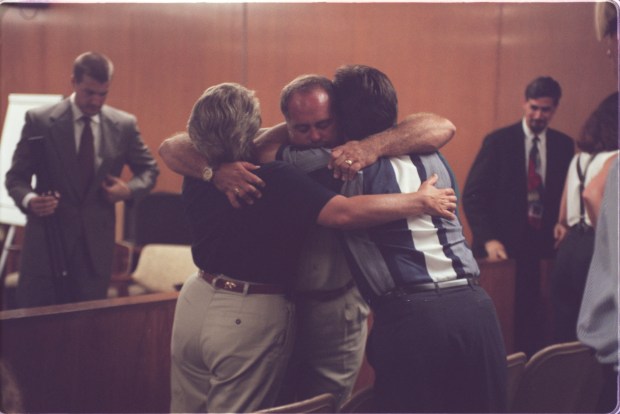 Cynthia Driggers’ loved ones hug after a jury recommend James Hitchcock be put to death. (Orlando Sentinel file)
In 1983, a federal judge issued a stay on the eve of Hitchcock’s execution in Florida’s electric chair.
Then in 1987, the U.S. Supreme Court unanimously overturned Hitchcock’s death sentence, ruling that the judge had erred in limiting evidence in defense of Hitchcock. A year later, Hitchcock was re-sentenced to death after a jury’s recommendation.
In 1992, the U.S. Supreme Court overturned Hitchcock’s death sentence again, along with five other death row inmates, because of improper instructions presented to the juries. Months later, Hitchcock was sentenced to death for the third time.
In 1996, the Florida Supreme Court overturned Hitchcock’s death sentence after finding that the jury may have been prejudiced by unverified child sex abuse allegations against him.
He was sentenced to death for the fourth time several months later by the late Circuit Judge Michael Cycmanick.
Meadows spoke before the Florida Legislature in 1997, unsuccessfully urging lawmakers to require attorneys for death row inmates to “stack” appeals, or cluster them together within a five-year window.
“Otherwise, cases drag on for years or decades,” she said. “Think of what that does to the families of the victims.”
Other family members — including Cindy’s siblings — would not speak publicly about Hitchcock’s execution.
“Their fear is that they will die before he is executed,” said Meadows, describing awaiting the execution for decades as “an emotional blender.”
At a press conference last November in Jacksonville, DeSantis said “the lengthy reviews and appeal, I think, should be shorter.”
As of Thursday, DeSantis had signed 9 death warrants this year, after signing 19 in 2025.
“There’s a saying: Justice delayed is justice denied,” DeSantis said. “So I do think the death penalty could be a strong deterrent if you had this stuff happen quicker.”
But he added that “I still have a responsibility to look at these cases and to be sure that the person is guilty.”
Even so, Meadows and other of Cindy’s family members agree that Hitchcock’s execution will not bring closure. Their memories of her will live on.
Meadows — who was 20 years old when her cousin was murdered — remembered Cindy as a bright, quiet, but “delightful” girl who loved to read.
“She had this great little laugh that was almost like a little giggle,” Meadows said. “And I still hear it in my head some days…Even at her young age, she had a genuine compassion for people. She had this true innocence that life was beautiful.”
Helen Judy Hitchcock, who now lives in Sebastian, said her daughter was looking forward to starting out as a freshman at West Orange High.
“She didn’t even make that far,” she said. “I think when this [execution] happens, she’ll finally be able to rest in peace.”
Comments are closed.