
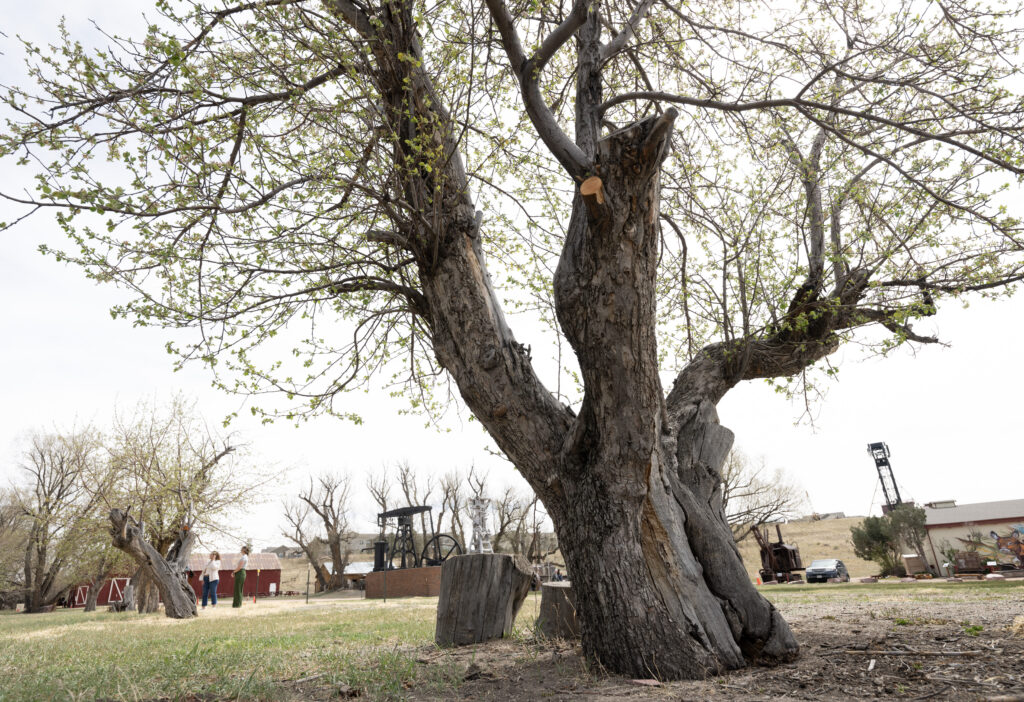
A variety of apple tree once thought to be extinct was found in Colorado Springs.
The two Walbridge trees, planted about 130 years ago, stand in front of the Western Museum of Mining and Industry, living remnants of the Reynolds farm that used to occupy the property.
Ten years ago, staff with a nonprofit focused on identifying and preserving heritage apple trees, the Montezuma Orchard Restoration Project, visited the museum and took cuttings from the trees to get DNA samples. Early in April, the nonprofit announced the trees’ identity.
“For over a decade, the once popular Walbridge was one of Montezuma Orchard Restoration Project’s most WANTED ALIVE lost apples. Turns out, we had it almost the entire time,” the nonprofit said on social media. The identification process is lengthy, in part, because accuracy is so important, said Jude Schuenemeyer, who founded the nonprofit with his wife, Addie, in Montezuma County, in the southwest corner of the state.
Walbridge apples were previously a common apple in the U.S. because they can be kept in storage for months, an important trait before refrigeration was invented, and eaten over the winter. They have a starchy texture and taste better after being stored, Schuenemeyer said.
Since first visiting the trees in town, Schuenemeyer said the nonprofit found similar trees on the San Juan National Forest, in Howard, a small town south of Salida, in New Mexico and in Washington state. The nonprofit has identified about a dozen Walbridge trees so far.
Since the Walbridge trees were planted in Colorado Springs around the turn of the 20th century, the variety of apple species has dropped dramatically from nearly 18,000 to about 6,000.
Many of those forgotten varieties are still growing in neglected orchards waiting for rediscovery.
A group of experts and nonprofits, including the Montezuma Orchard Restoration Project, called The Historic Fruit Tree Working Group of North America, is working to identify and preserve the trees.
Once a rare variety is identified, even if it’s called “unknown”, those working on preservation will clone the rare trees by cutting a living branch from the older tree and grafting it onto another tree.
But even once clones are made, the populations are fragile. Each tree is either nearing the end of its life or a baby, Schuenemeyer said. So the nonprofit has lost some varieties.
“You can’t get away from the mortality,” he said.
The nonprofit works to ensure trees are planted in more than one orchard so if a catastrophe, such as voles or deep drought, hits, representatives of the species survive.
Schuenemeyer is hopeful that the hardy nature of the trees could make them a good option for small-scale growers looking to diversify their offerings to sell direct to consumers, he said. If growers can market an apple as a known variety that’s one of the rarest in the world, it can create solid demand at venues such as farmers’ markets.
“An apple with a name is far less likely to go extinct than an apple without a name,” he said.
He realizes they may never appeal to a grocery-store audience because such apples are produced at an enormous scale with huge marketing budgets behind them.
But if small growers put in rare varieties, it will help ensure their survival.
“We are trying to plant the next generation of 100-year-old trees,” Schuenemeyer said.
In Colorado Springs, while the trunks of the newly identified trees are gnarled, they support healthy branches that typically produce a harvest, said museum employees Allison Robenstein and Hunter Hall. The trees are part of a small orchard of 10 trees near Smith Creek, which, while small, was flowing on Wednesday.
“They seem to be doing really well,” said Robenstien, the museum’s volunteer coordinator.
At least a few of the young trees from the Montezuma Orchard Restoration Project will be planted alongside the aged orchard, Robenstein said.
Comments are closed.