
National Building Museum (NBM): Introduce yourself! Who is Terremoto?
Terremoto: Terremoto is a landscape architecture office based in Los Angeles and Berkeley, California, co-founded by David Godshall and Alain Peauroi in 2012.
Terremoto has always questioned the dominant norms of landscape and garden-making. We started with modest home gardens, and though our body of work continues to grow and diversify, we will always revere small gardens as our foundation and inspiration for all projects. Our goal is to create what we like to describe as Radical Gardens of Love and Interconnectedness.
NBM: Why is the idea of kinship important for you, and what does it mean in landscape architecture?
Terremoto: So much of our current world runs on division and antagonism, but kinship is the antidote to that. Kinship can be found in the garden in a multitude of ways – living alongside plants, but also cultivating and caring for them and using them for food and medicine. These all deepen our ties to nature.
We design gardens and landscapes that ask people to share their space with non-human beings. Providing habitats and resources for insects and animals is not only critical in combating our biodiversity crisis, but it is a beautiful practice in generosity and decentering yourself. The ways in which living with nature brings us into greater kinship with each other, whether it’s through gardening, sharing a meal, or experiencing a performance together in a garden, remind us of what is so magical about being alive.
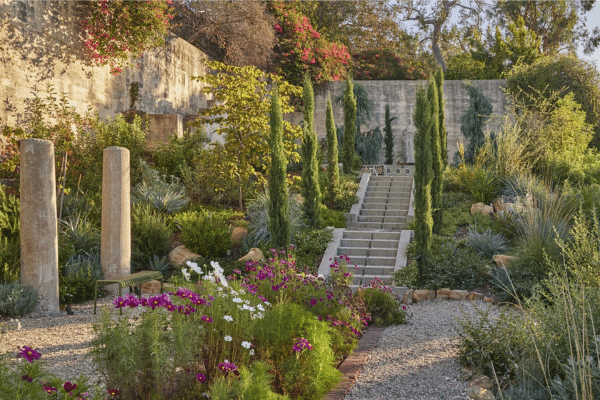
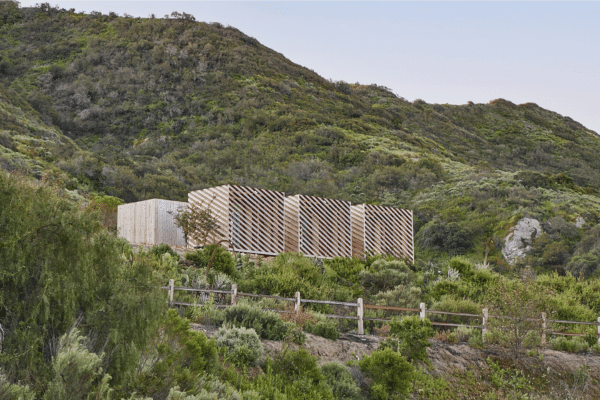
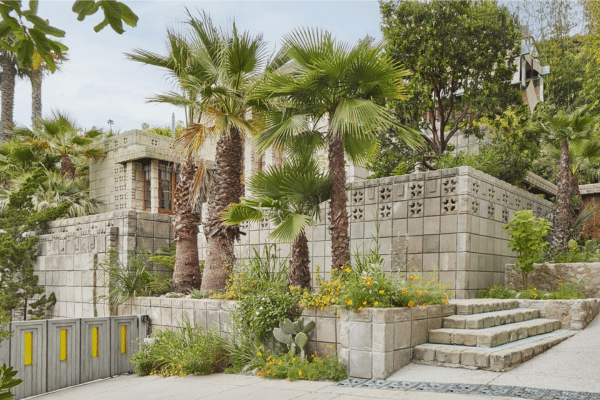
Left to right: Baxter, Laguna Canyon Foundation, The Storer House. Photo credit: Terremoto.
NBM: How do you interpret critical regionalism, and how do you achieve critical regionalism in projects where you are new to the site?
Terremoto: For Terremoto, to be critically regionalist is to honor the place you’re in. This often means ignoring style trends and instead observing how local folks have been building and gardening for a long, long time. Styles come and go, especially with the impact of the internet and Instagram on landscape architecture.
We’re more interested in working with the vernacular of a place’s native planting palettes and local materials. Most of our projects are in California, where we live, and so much of our work reflects that. While it might look like we have a “style,” what you’re probably seeing is the vernacular of California coming through.
We do have a handful of projects further afield, but they tend to be in places where we have roots and experience. When we find ourselves in new places where we don’t know the landscape, we always bring in old and new friends to consult – land managers, horticulturalists, ecologists, gardeners, builders, craftspeople, and even other landscape architects. We acknowledge that learning a landscape can take a lifetime, so we humbly ask for guidance when working in new places. We adore the collaborative process of co-creation with others more knowledgeable than us.
NBM: Tell us about your work and writing on landscape and labor. How did you get involved in labor practices in landscape production as a designer?
Terremoto: Our Land and Labor efforts have been evolving since the very early days of Terremoto. While not a design-build studio, we have always worked closely with the crews on site, translating our sketches and designs into the gardens and landscapes that you see on the website.
We started by simply documenting the entire process of garden-making, featuring the people who build and maintain these landscapes, sharing the beauty and honor of their craft on our website and Instagram. The seeds of care and respect for labor then grew over the years into office-wide discussions about how best to support the people who bring our gardens to life.
These conversations were galvanized in the overdue social reckoning that took place in 2020. We felt like it was time for us to really stand up for workers and to defend them against exploitative, classist, and racist norms that have been insidiously pervasive within the design and construction industries. As a studio, we authored an article in Metropolis titled Landscape Architecture Has A Labor Acknowledgement Problem where we argued that the invisibility of labor is problematic for many reasons, namely the social harms it causes. But we also believe that when you devalue labor, you devalue land itself, which perpetuates harm to our planet. Since this initial article, our network of collaborators on this topic has expanded, and we continue to speak out and to interrogate our own practices as well. We will be working on this topic for years to come, especially with escalating attacks on the people who are the literal backbone of the landscapes that are built and farmed in America.
NBM: Terremoto frames its practice through land, labor, materials, and plants. How do these lenses come together in the early stages of a project?
Terremoto: Every project is different and requires its own approach to getting to know the site and the people who will be stewarding it. But in general, we always start with the land, like any good landscape architect. What is the context, historically, geographically, politically, and economically? What are the natural processes playing out on site, in terms of flows of matter and energy? Who are the inhabitants and how do they interact with the land? On most of our projects, we seek to both honor the past and carry a site into a generative future. Every garden is a piece of land art, where the beauty of healthy relationships is made manifest into form.
Materials and Plants are the literal elements of the garden that we bring together into form. Our goal is to push the boundaries of conventional sourcing, using as many recycled, reclaimed, or hyperlocal materials as possible (including plant material). Not every client is open to a fully recycled, rewilded garden, but we do our best to inject it where we can.
As for labor, we love to think about it early on. Who is building this garden, who will maintain it, and how can we bring them into our early design conversations? Even though we usually create conventional drawing sets, we always leave room for improvisation on site, which is where much of the magic happens. We have some projects that lend themselves to an even more experimental, improvisational approach. We think of this as ‘design through maintenance’ where labor is foregrounded, and where the design emerges over time through collaboration with a client, gardener, or land manager.
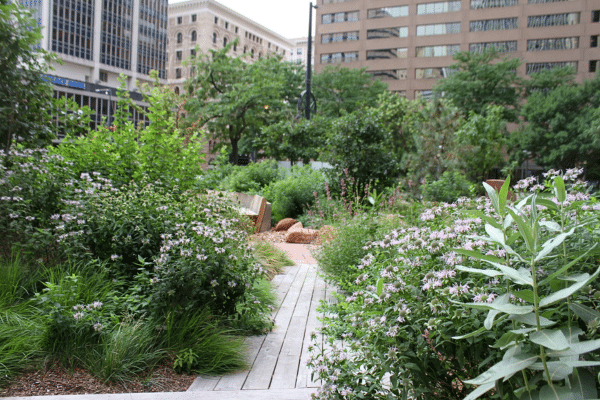
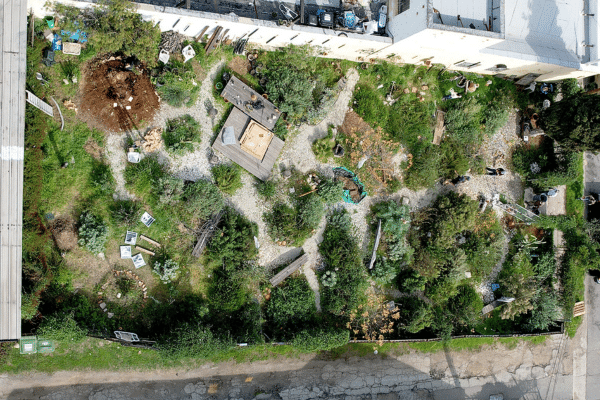
Left to right: Denver Plaza, 7th Ave Garden. Photo credit: Terremoto.
NBM: You’ve worked across private gardens, public parks, and schools. How does your approach shift when designing for different publics and levels of access?
Terremoto: It all depends on the client’s openness to try new things, but in general, private gardens allow for more improvisation and experimentation. We acknowledge the tradeoffs of working on private gardens: we are helping build equity for private landowners, but we often have more openness to radical garden-making, and are creating vital patchworks of native ecologies to support biodiversity efforts across entire regions.
We are starting to work on more public projects and institutions open to trying a more radical approach, which we are thrilled about. We are collaborating with the California Academy of Sciences, the Hollyhock House at the Barnsdall Art Park, and the Columbus Museum of Art’s Pizzouti Collection on experimental projects that are ‘designed’ through time, labor, and care.
We would love to see our profession push for more radical gardens that are public-facing. The model is nothing new – it’s essentially that of community gardens. But too often our profession sees community gardens as just a small piece of a project, something that comes after the landscape is ‘finished.’ We would love to see the model of community gardening serve as more of a primary framework within which landscape architects operate. This model of work inspired our Test Plot projects, where we bring community-led land stewardship and ecological restoration to underfunded public parks across California. We’re delighted that these ideas will be more formally explored and adopted as part of the wider team we’re currently working with on the Elysian Park Masterplan in Los Angeles, where Test Plot began in 2019.
NBM: Can you share an example of a project where community engagement meaningfully changed the design outcome? What did you learn from that process?
Terremoto: In both Test Plot and the 7th Avenue Garden – a weirdo art garden we’ve been working on for the past several years with the artist David Horvitz – community engagement has been the primary driver of design. In both projects, plantings and material installations have been done intuitively over time through various community work events, which usually also serve as social gatherings.
In these projects, the hand of volunteers is present in the form of the plots and paths, reflecting their care and movement throughout the sites over time. Intuitive co-creation leads to design outcomes that might be less conventionally legible or photogenic, but are much more meaningful in terms of real community engagement and impact, not to mention in terms of ecological and climate benefit. We like to call our Test Plot gatherings ‘Plant Church,’ because what’s important are the acts of communal care that bring us connection and joy, not the design itself.
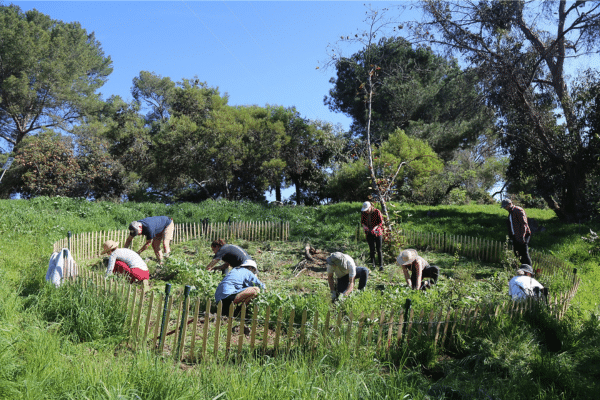
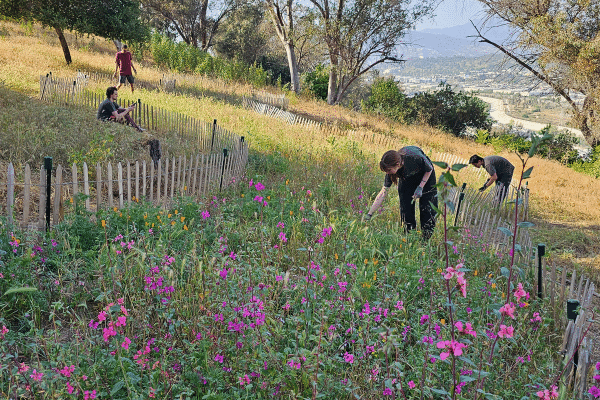
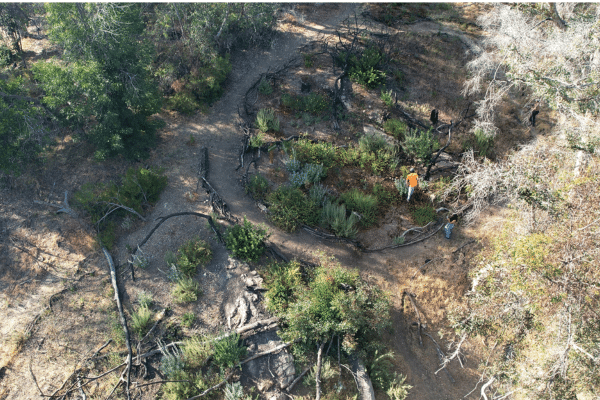
Test Plot. Photo credit: Terremoto.
NBM: What excites you about what’s next for Terremoto or landscape architecture as a field?
Terremoto: Terremoto is excited to continue working with adventurous clients who are willing to experiment with radical garden-making ideas, whether big or small, private or public.
We are also really hopeful about the next generation of landscape architects — we see a lot of students who are hungry for experimentation, for a more hands-on approach to garden-making, and for radical gardens that consider fuller webs of human and non-human relationships. We are curious to see where these students lead the field in the coming years.
Comments are closed.