
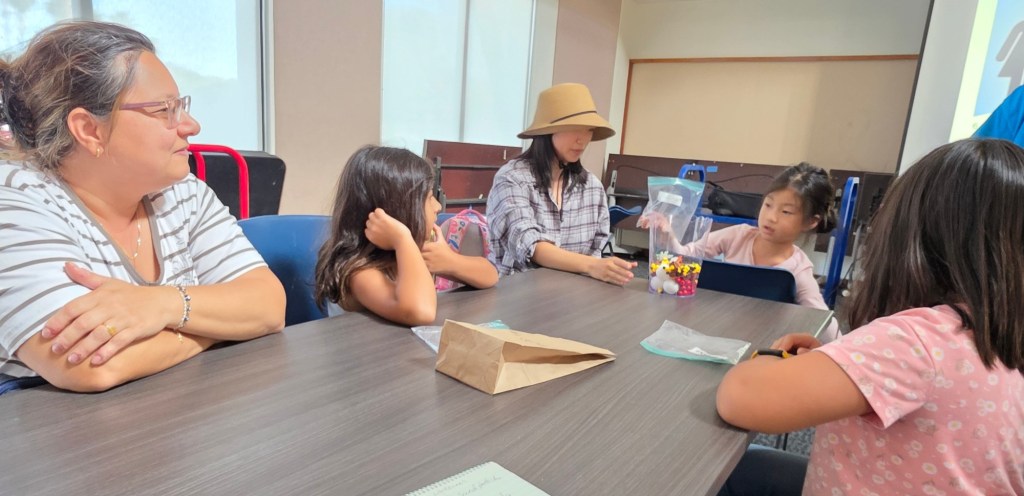
When Nilay Donmez heard about Poway Library’s science, technology, engineering, art and math activity STEAM Kids with a Master Gardener they didn’t hesitate to attend the program.
Donmez brought her two daughters, Lara, 10, and Eva, 6, to the April 8 event — which focused on how soils can be an important aspect in gardening — because they’re all involved in gardening.
“We like plants and the environment,” the Poway resident said. “We have a vegetable garden. We planted the garden with seeds to watch them grow.”
“I said, ‘We’re going to learn more,’” Nilay said about the event. “It’s important for kids to engage in the environment. I’m a registered dietician and this is a healthy activity that can teach my kids to eat healthy.”
Master Gardener Niki Vollrath was the featured presenter that day. The retired soil scientist led a demonstration on different types of soils and explained their effect on the environment.
Julie Gallant
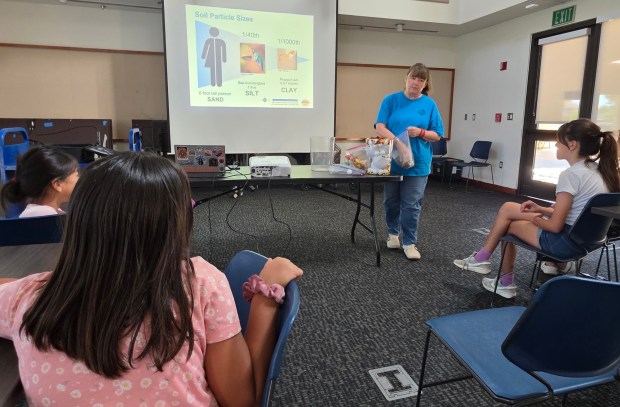
Master Gardener Niki Vollrath, right, talked about soil particle sizes during her STEAM Kids activity at Poway Library. (Julie Gallant)
Soil is one of three ingredients along with sunlight and water that plants need to grow, she told a couple dozen attendees. She said dirt is dead but healthy soil is alive and very valuable.
“Healthy soil is a living dynamic system that deserves our care, concern and curiosity,” Vollrath said. “Soil is a resource like air and water that you learn to take care of.”
Soils vary from place to place but they have four components — minerals such as fragments of rocks, organic matter, air and water.
The organic matter can consist of fungi, microbes and leaves or can be sourced from creatures that burrow underground such as insects, gophers, snakes, worms and bugs, she said. When an animal dies underground, microbes and fungi break the material down. The organic matter that is a product of decomposition becomes part of the soil, she added.
Vollrath listed the five functions of soil:
It controls water movement by allowing water to either seep into the soil or move across the surface; provides a home for plants and animals; removes pollutants from water such as soaps and chemicals; makes nutrients available to plants; and provides support for plants, buildings and cultural resources.
“Soils can be sick or healthy,” Vollrath said. “You know if you have healthy soils if your plants are green and healthy – that’s a good sign. If the leaves are droopy and sad, that is something you need to fix.”
Healthy soils generally have a good texture, she said, noting that texture can be identified by the particle sizes — either large grainy sand, medium-sized silt or very fine clay particles.
Vollrath used a clear plastic container to show participants that large particles of sand have large spaces between the particles while clay has small particles but a lot more spaces between them, she added.
Optimally, she said good soils include three particle sizes — sand, silt and clay.
Healthy soil leads to healthy plants, she said.
“If your soil is not holding water you can put compost or other organic matter on it,” she said. “You want good, dark soil in the top 12 inches of a landscape so the roots can grow. If the soil is too compact you can’t grow healthy plants.”
Julie Gallant
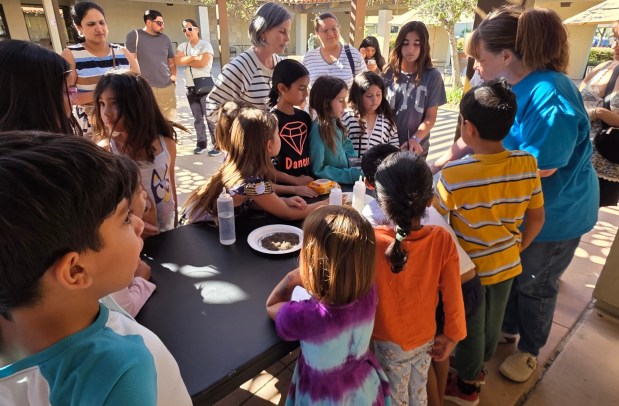
Samples of sand, silt and clay were provided to STEAM Kids participants so they could see the different sizes of soil particles. (Julie Gallant)
Comments are closed.