
What can we be doing in our gardens right now?
The two most active times in the garden in our climate are October to November, and April through May. For each of these transitional periods we can make our garden successful by enriching the soil, by planting the seasonal flowers and vegetables that will bloom and yield for the next six months, and by planning and taking action to control and prevent weeds.
Plant when the weather is right for each type of plant.
Optimal temperatures vary by species. Everyone likes to plant early, but we are just now getting to the best season for planting heat lovers: summer vegetables and flowers, and subtropical plants such as citrus and bougainvillea.
Summer vegetables and herbs for planting in April: tomatoes, squash, cucumbers, green beans and basil.
Wait until nights are consistently warmer than 50 degrees.
While these can be done from seed, they will get off to a faster start from young transplants. With our very long growing season here you can plant these all the way into July.
Plant these in May when it’s consistently warm: Plants that originated from subtropical or tropical origins can be stunted all season if the young plants are exposed to low temperatures in their early growth period.
Peppers and eggplants go best into warm soil. Keep them in pots near the house until nights are consistently in the mid-50s. Transplant them into larger containers if it’s going to be more than a couple of weeks.
Okra needs very warm conditions. It’s best planted after mid-May.
Other heat lovers include sweet potatoes, yardlong beans and roselle hibiscus grown for tea. These prefer soil temperatures around 70 degrees, which is usually the end of May at the earliest.
Plan for cucurbits: If you have the space, it can be fun to grow the vigorous members of the squash family that reward us with huge fruit, and these are all planted from late April through June.
Muskmelons (cantaloupes), pumpkins, winter squash, and watermelons are very deep rooted and spread several feet out in all directions. They all need deep watering, plenty of sunshine, and limited competition from weeds and taller plants.
The key to sustaining the rapid expansion and ripening of, say, a 30 lb. watermelon is having a vine that grows rapidly over a large area to create lots and lots of leaves to feed that growing fruit. Plant the seeds or seedlings when they can hit the ground running, and plan early for where they’re going to go.

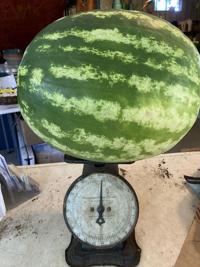
It’s fun to grow a 24-pound watermelon! The plant took about 50 square-feet of space.
Don Shor/Courtesy photo
How big do they get? I’ve found that a cantaloupe plant needs about a 6-by-6-foot area to produce three to fouur fruit. A large watermelon may need twice that, and pumpkin vines can run twenty to thirty feet in any direction.
Plant summer flowers for cutting, drying and wildlife: Seeds can be planted in April, transplants into the garden May through June. Planting flowers in and near your vegetable garden improves pollination and leads to natural insect control as the flowers attract beneficial insects that feed on pests.
* Zinnias give more bloom for the buck than almost any other summer flower. Butterflies love them.
* Cosmos bloom late summer into fall and strongly attract beneficial insects.
* Nasturtiums are planted for the edible flowers and as trap crops. Best in our climate in light shade.
* Sunflowers (Helianthus annuus) can be planted every couple of weeks for continuous bloom. For more bloom, look for the branching-flowering types. It’s amazing how many insects visit sunflowers when they’re in bloom and songbirds visit afterwards for the seeds. Mexican sunflower (Tithonia) is a bright orange relative that is very popular with butterflies and hoverflies.
* Celosia and amaranth are planted in late spring and early summer. They have showy blooms in very vibrant colors and are often used for drying. Some may self-sow. Crested cockscomb is a type of celosia with weird, contorted flowers that fascinate youngsters of all ages.
Other summer flowers that have impressed me for how easy they are to grow and how attractive they are to butterflies, hummingbirds and beneficials, include scabiosa (pincushion flower) and the ornamental sages (Salvia species, especially S. coccinea).
April brings a plethora of leaf feeders. Getting your flowers and vegetables off to a good start may take a little vigilance in protecting the young seedlings. Lots of folks asking about holes in the leaves of their new transplants right now.
Some recent culprits include:
* Earwigs, snails and slugs.
Vigorous seedlings can outgrow damage, but sometimes lethal measures may be necessary. Midnight patrols can be satisfying. Once you’ve squished earwigs by flashlight at midnight (wear gloves), you know you’re a serious gardener. Earwigs are attracted to the smell of cooking oil, so traps can be set out using aromatic types such as olive oil. They crawl in and drown. This is both satisfying and a good way to monitor the population. Earwigs peak in May and damage decreases by summertime.
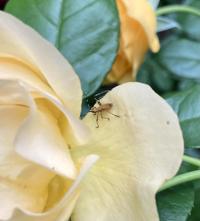
Katydids and grasshoppers have just hatched out. They move quickly and their damage is transient. Mockingbirds and scrub jays feed on them.
Don Shor/Courtesy photo
* Katydids and grasshoppers
They have just hatched out, cute little perfect miniatures of the adult. They feed rather indiscriminately, but the damage is transitory. By the time you see the holes, they’ve moved on. Jays and mockingbirds like to feed on them.
Shrubs, roses and citrus can be damaged by weevils (fuller rose weevil, black vine weevil) which often harbor in the leaf debris beneath the plants. Their damage is recognizable from the tattered feeding pattern along the leaf edges.
Holes in your roses, especially white-petalled flowers, may be from chafer beetles. These are the adult stage of some of those white grubs that you found in your vegetable garden several weeks ago. With just one generation, the damage is minor. Birds will feed on the exposed beetles, and possums and skunks will feed on the grubs.
Struggling with weeds?
Winter-germinating annual weeds are making seed heads right now, especially grasses. Mowing is useful, even if you can’t get the plants entirely removed, to reduce future seed load.
The benefits of mulch: One of the most beneficial things you can do at the start of the summer irrigation season is to apply mulch, and that’s one of the basic strategies for weed abatement as well.
The simplest and most economical is arborist wood chips, spread several inches deep over bare soil or areas where weeds have been mowed.
Dr. Linda Chalker-Scott of Washington State University Puyallup Research and Extension Center has done considerable research on the benefits of different mulch materials. Her conclusion:
“Studies have found wood chips to be one of the best performers in terms of moisture retention, temperature moderation, weed control, and sustainability.”
For effective weed control, “a successful wood chip mulch must be deep enough to suppress weeds and promote healthy soils and plants…. Wood chips maintained at a depth of 4 to 6 inches will control weeds without detracting from appearances.”
Landscape bare areas to reduce weeds: Weeds are opportunists that take colonize bare soil areas. Plan now to prevent future weeds. Planting can be done in spring or fall, or even during summer, so long as follow-up irrigation will be provided.
There are plants which can, once established, smother out weeds and prevent seed germination. Sage, rosemary, and sagebrush are especially effective at crowding out weeds. Whether from their dense growth shading over the soil, or allelopathic suppression of other plants by root secretions, not much grows in or through these shrubs. The key is getting good soil coverage quickly and mulching to reduce weeds around them as they grow outward. A deep layer of wood chips around new plants can reduce weeds initially.
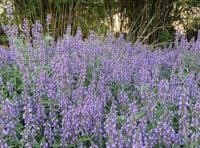
Dara’s Choice is a hybrid native sage that has a dense, spreading habit capable of smothering weeds. It blooms heavily from late March through April, attracting hummingbirds and butterflies. Easy to grow, fine with irrigation but tolerant of drought.
Don Shor/Courtesy photo
Two impressive native sages: Woody native sages from coastal California have really impressed me with their vigor and competitive nature. These bloom heavily from late March through April. They have some shade tolerance, flourish when irrigated, tolerate drought, providing cover for wildlife and flowers for bees.
Garden hybrids and selections of the Sonoma sage are particularly useful. Bee’s Bliss, a hybrid with Salvia leucophylla, grows to about 1 foot high and spreads several feet. Dara’s Choice, a hybrid with Salvia mellifera, is another spreading hybrid with even showier purple flowers. Both grow more vigorously with irrigation.
Other choices: Rosemary is a popular kitchen herb and landscape plant that grows very well here, blooms year-around and especially in winter, and can tolerate considerable drought. Exceptional varieties include Tuscan Blue and Renzel’s Irene.
Sagebrushes (Artemisia species), spreading forms of Lantana, low-growing types of Grevillea, and low-growing varieties of coyote brush (Baccharis pilularis) can also be used to cover soil and reduce weeds.
How does this work?
Spreading shrubs can be planted three to 6 feet apart, irrigated with drip irrigation, and mulched heavily when they’re young. They will do best with weekly deep watering the first summer. Drip systems for these plantings should run for at least a couple of hours each time.
Weeds that sprout the first year can be pulled or hoed. More intractable species may need deep mulch or digging out, or you can cover them temporarily with tarp or fabric. I’ve found that a small tarp secured over perennial weeds for a full 3-month season will often kill the entire plant, roots and all.
Once the shrubs have made a full cover, you can water less often and more deeply. Many of those listed will look very good when watered thoroughly just once a month.
Plant and mulch now for a bountiful summer!
— Don Shor and his family have owned the Redwood Barn Nursery since 1981. He can be reached at redbarn@omsoft.com. Archived articles are available on The Enterprise website, and they are always available (all the way back to 1999) on its business website, www.redwoodbarn.com.
Comments are closed.