
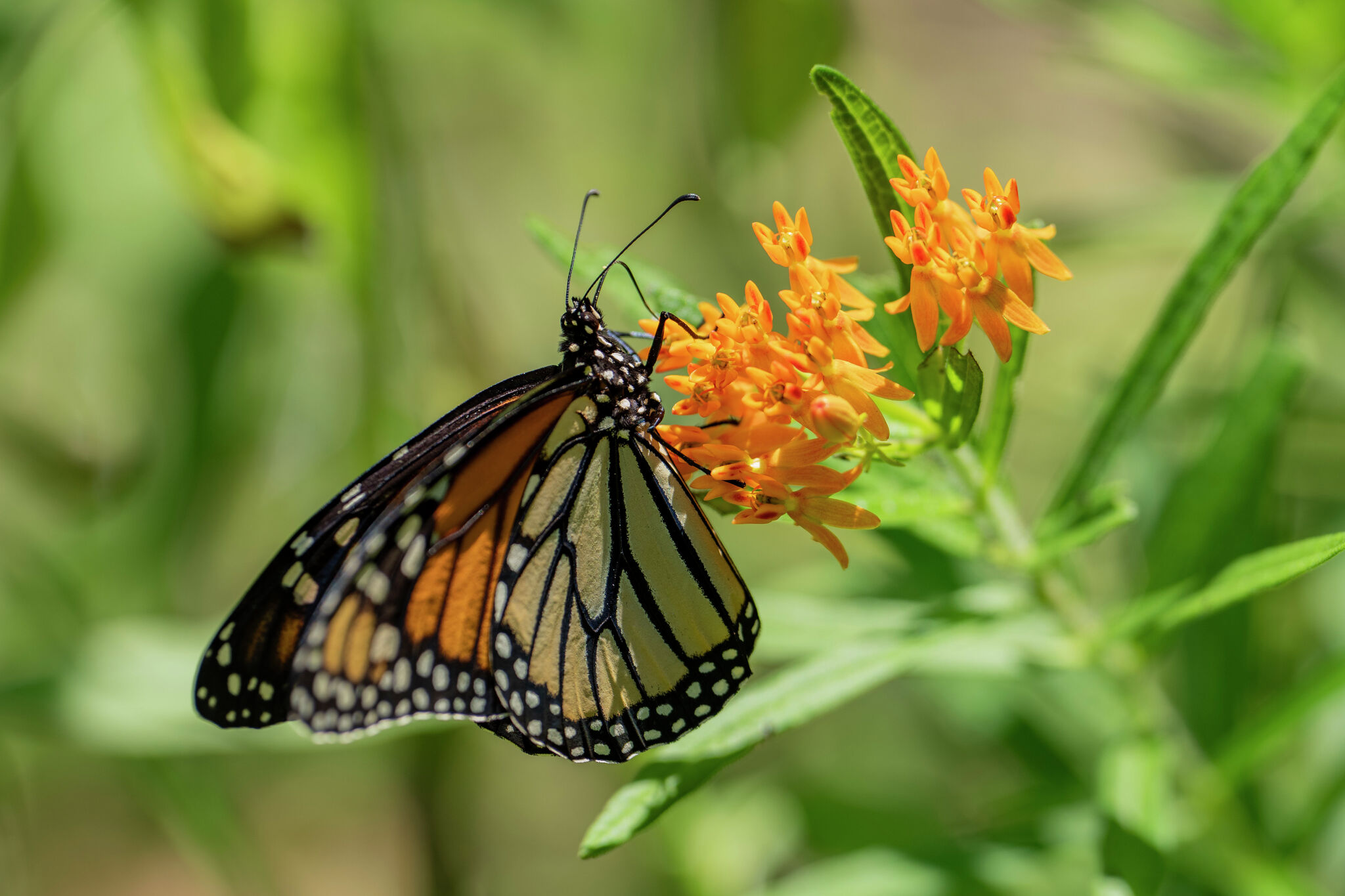
Good news: Counts at the wintering grounds show that monarch butterflies covered about 64% more wintering ground territory this year than last year. Populations remain considerably lower than in the past, but that 64% increase is encouraging.
Expect migrating monarch butterflies to arrive in our area on their way from the Mexican wintering grounds to the Midwest and Canada. At the very least, they will need to load up on nectar from blooming plants to continue the trip north. Some of their favorite nectar providing plants in our area are zinnias, mist flower, porter weed, blue curl, coreopsis, pentas, salvias and lantanas. Blooming transplants are available at area nurseries if your existing plants don’t include a source of nectar for the April migrants.
If there are milkweed plants available, the monarchs may even slow down long enough to lay some eggs. The caterpillars only eat milkweed foliage, and it takes the caterpillars 30 days to mature enough to begin their migration north. An important complication is that the monarch parents die after they lay a new batch of eggs.
The native milkweed plants in our area are zizotes, antelope horn, butterfly weed, green, showy and swamp. An exotic milkweed plant popular with gardeners and the monarchs is the tropical milkweed. Milkweed is a tough weed for farmers to control once it matures. It stimulates lots of pesticide applications, but it is also ironic that milkweed is such a tough plant for gardeners to grow when we are trying to increase its availability to monarchs for egg-laying sites.
More than 1,000 gardeners have attended our monarch and milkweed classes over the past four years. They have received more than 2,000 seeded milkweeds in containers to transplant and evaluate, reporting their results to help determine which milkweed is easiest to grow and which is monarchs’ preferred egg-laying site.Unfortunately, the results have not been very exciting. Only approximately 10% of the 50% seeds in containers that germinated successfully were reported to transplant successfully. The most successful selections were zizotes and tropical milkweed.
The quest continues. This year’s classes provide one free germinated seedling in a container, as well as a small packet of stratified seeds, so gardeners can see if whether direct seeding into the garden is more successful than transplanting. The seed is stratified, which means it was put through a refrigeration process in an attempt to release any chemical or physical mechanism that the seed has to limit germination. We also hope to improve data collection by including a data sheet in an addressed envelope that also includes an online address for reporting the milkweed transplant and seed germination success. It has been getting more difficult to collect data entirely by the phone.
Two classes in San Antonio, sponsored by Milberger’s Nursery and the Dreamhill Estates Education Center, have been completed and two more classes re scheduled. The Wilson County Master Gardeners have a class scheduled for 6 p.m. April 23 in Classroom 10 of the AgriLife Extension Center, 1103 4th St., in Floresville. Call 830-299-0069 for more information or to reserve a seat. The final class of the spring is at 9:30 a.m. May 2 at the Comal County AgriLife Extension Center, 325 Resource Drive, in New Braunfels. It is sponsored by the Master Naturalists. Call 830-620-3440 to reserve a seat.
Comments are closed.