
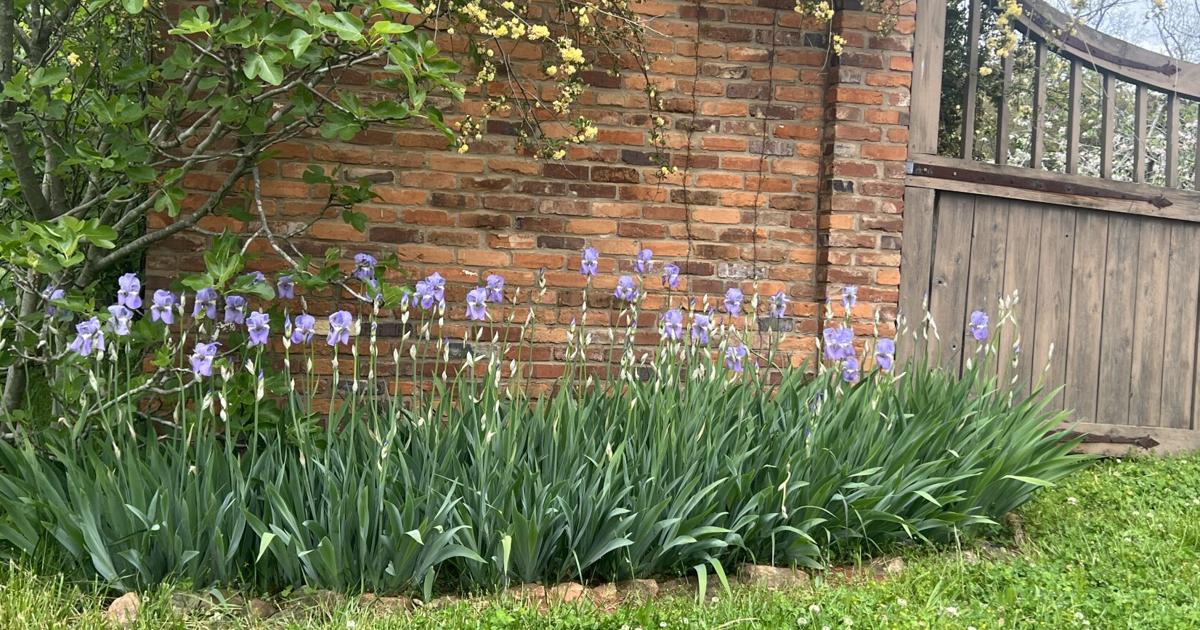
(AUTHOR’S NOTE: This column refers to Bearded Irises.)
Irises grow like weeds in our region. Obviously, deer resistant. If you have irises, you know their virtues.
If you have the “iris virus,” consider joining Historic Iris Preservation Society. They promote focused collections of rare, endangered irises. Until recently, I have been an accumulator not a collector of irises, both will bring iris joy. As a member of the “guardian gardens” network you will receive rare irises for the postage costs with the agreement to grow and share these irises with other members. It’s a dig and divide society! The website for HIPS offers wonderful information for the novice, the irisarian, and the curious.
They suggest a starter iris garden with varieties that are “super-tough.” We grow several of their suggestions: ‘Coronation’ a yellow iris, ‘Wabash’, and ‘Queen of May’. ‘Pallida dalmatica’, 1597, is blooming now, and fills the room with the scent of concord grapes. It is an iris for perfume and gin making. Old House Gardens describes the ‘Pallida dalmatica’ as “Stately but down-home, it’s a quintessential iris.” A tall, pale iris at 36 inches.
From Schreiner’s Gardens we learn that “newly set iris plants need moisture to help their root systems establish…. once established, iris normally don’t need to be watered, except in arid areas”. Schreiner’s go on to say that overwatering is a common error. Our irises are planted in small, amended beds or under trees with dappled light, some are in full afternoon sun. We do not water our established irises. We follow the advice of bearded iris societies and do not mulch, nor do we spray any herbicides around our irises. Some of the beds will see annual spring weeds like henbit that I may or may not pull out. I can overlook this “problem” because spring is so busy on the farm and when the iris blooms, they appear on stalks two to three feet above the henbit. In the vase, there is no evidence of my weedy iris bed.
Most of our irises have come from Old House Gardens, and now the Historic Iris Preservation Society. Historic irises are defined as being introduced at least thirty years ago. Pass along iris plants are the ones that usually go under a tree, because it’s easy to remember who gave me the irises. Melanie’s irises are under a crepe myrtle, Ruth’s irises are near a dogwood.
For iris reading: Dream Gardener the story of Bertrand H. Farr an iris grower, breeder, and nurseryman. His methods were “old school” and successful. Classic Irises and The Men and Women Who Grew Them by Clarence E. Mahan is a book I turn to again and again to be inspired and encouraged when the toil-of gardening seems too much. Some collectors choose an iris breeder as the basis for their collections. I’m starting a Grace Sturdevant iris bed. You may know her as a founder of The American Iris Society. A few of her many iris introductions are ‘Taj Mahal’, ‘Sea Foam’, ‘Flutter-By’, and ‘Rose Madder’ a red violet that became a parent to ‘Dauntless’ by Clarence Connell. ‘Dauntless’ won the American Dykes Medal in 1929.
From the above-named resources you will find detailed information on planting irises and dividing irises. The dividing of irises is such a lasting happiness, to share or to make new beds for your own garden.
Comments are closed.