
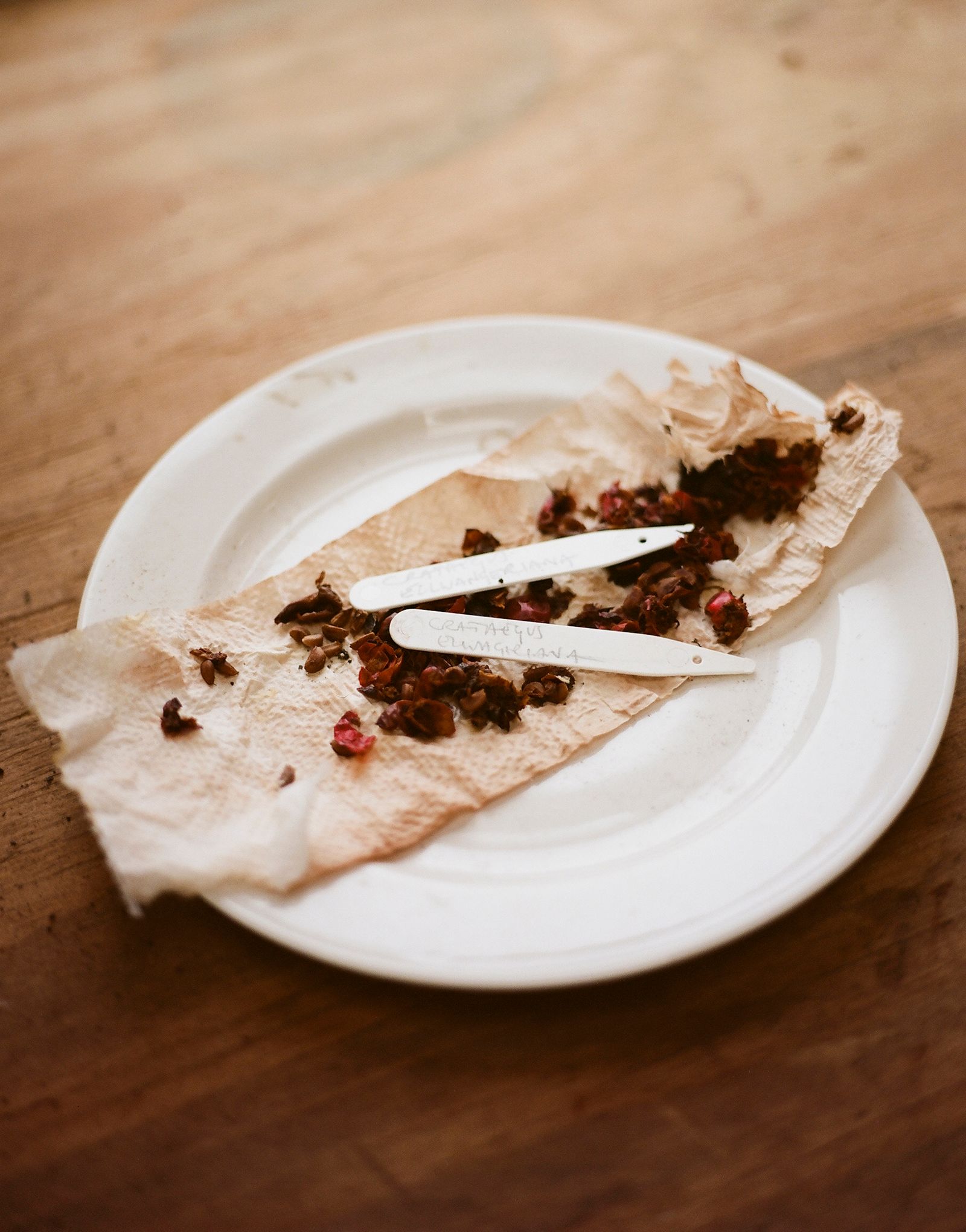
Crataegus (or howthorn) seeds drying on some paper
Jooney Woodward
From 2016 to 2020, Jonny worked at the pioneering nursery De Hessenhof, an experience that has shaped his approach to The Field Nursery. ‘It was wonderful to go to Hessenhof and find Hans and Miranda [Kramer] growing plants in a sustainable way and doing it profitably,’ he says. Offering more than 3,000 different plant varieties, mostly propagated in-house, the nursery integrates a series of mother beds containing plants used for propagation. ‘The stock beds were like a huge living plant catalogue. In such a dynamic system, we couldn’t plan the layout, so you’d get chance combinations, which could often be a spark for designing borders.’
Inspired by this model, The Field Nursery has stock beds and more designed areas to show how plants can be grouped together. ‘What I loved about Hessenhof is that you always had the feeling of being within a garden,’ says Jonny. ‘The garden’s evolved from the nursery rather than the other way round.’ As well as providing visual inspiration, the stock beds are a source of propagation material. ‘Our aim is to propagate almost all the plants ourselves. We need to resist the impulse to grow things too quickly under glass with excessive fertiliser. If you put a tablespoon of fertiliser into every two-litre pot you’re selling, you get a plant with lots of foliage and flowers, but the root system won’t be strong. I think people are starting to understand this isn’t a viable future for how we grow plants.’
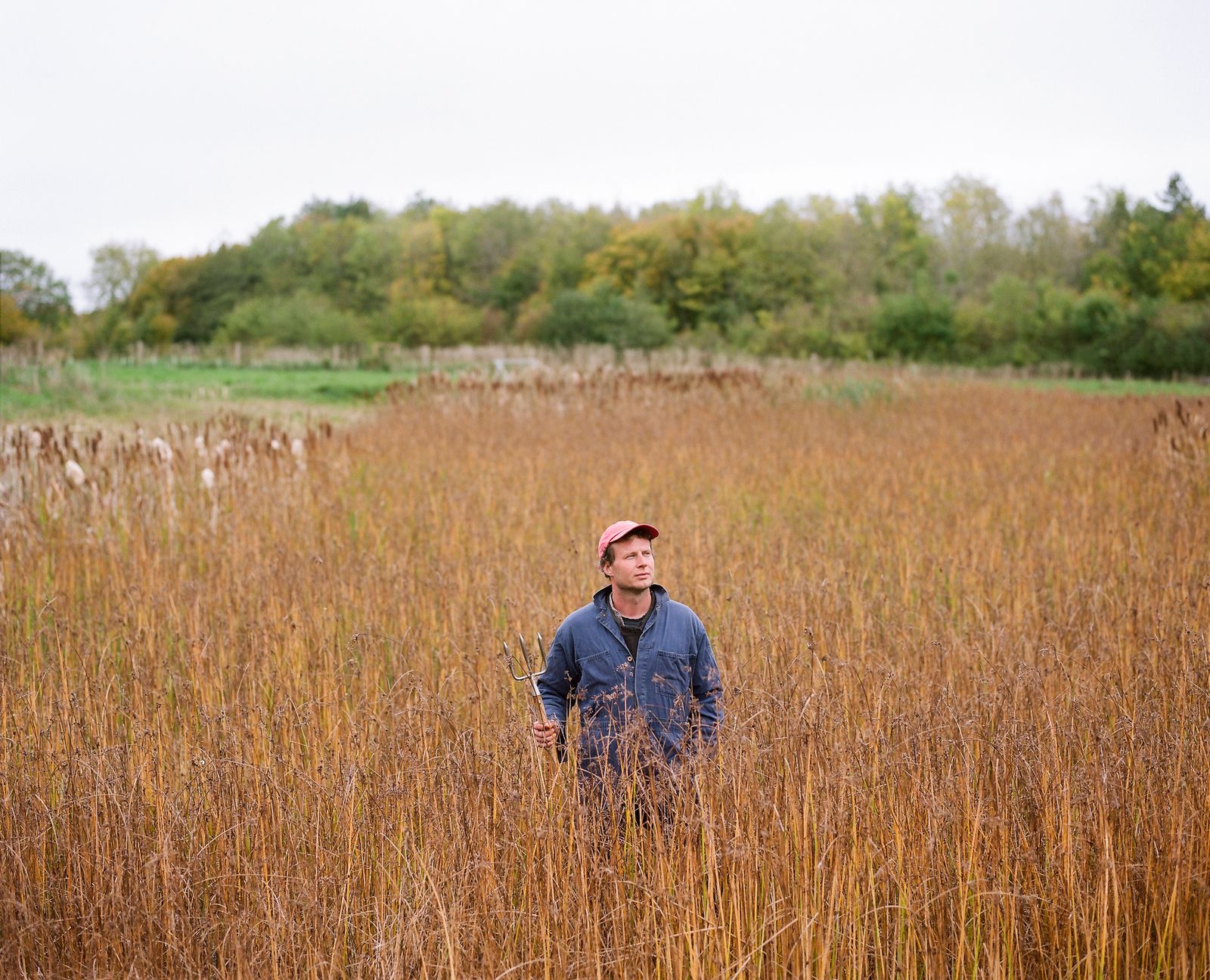
Jonny in reeds at the edge of the nursery’s pond
Jooney Woodward
Alongside organic, slow-grown potted plants, The Field Nursery will offer bare-root perennials. This is a return to traditional nursery practice, in which plants are lifted to order from the ground – reducing the need for plastic pots. With a focus on hardy herbaceous perennials, the plant list will include garden stalwarts as well as rarer varieties. Many of these fit into the meadowy, naturalistic aesthetic now fashionable – from umbellifers like the lacy white Athamanta turbith subsp. haynaldii, and Heptaptera triquetra, with acid-yellow flowers held on wiry stems, to silvery-leafed Klasea bulgarica.
Comments are closed.