
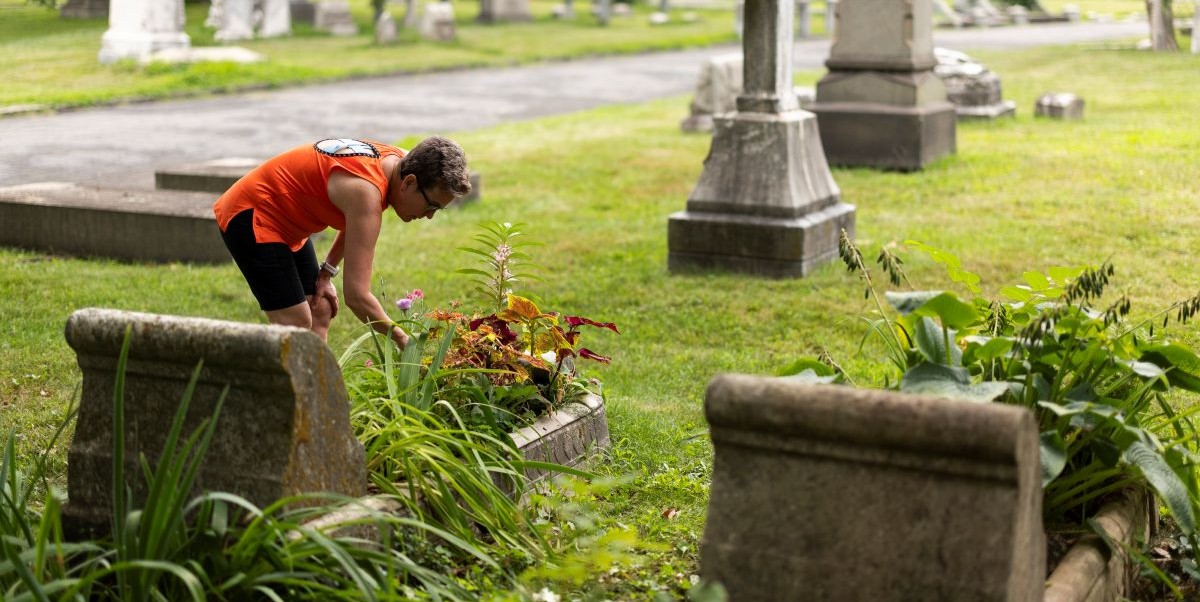
Back when The Woodlands launched a program in grave gardening, Executive Director Jessica Baumert thought maybe 20 people would sign up. Instead, 75 people filled out the application. That first year — 2016 — Baumert had to stretch the historic West Philadelphia riverside cemetery’s modest resources to get everyone the materials they needed. She did, and the result has been transformational, not just to the historic cemetery and green space, but also to the people who tend it.
Listen to the audio edition here:
Grave gardening is a fairly uncommon form of urban gardening. People don’t grow vegetables there. They don’t have their own keys to the space, or sell what they grow at markets. Instead, grave gardening requires tenders to care for a space that belongs to strangers they’ll never meet — those who are buried in the graves — and whose loved ones they’ll likely never encounter, while performing that act in a public setting, among other strangers. Still, a decade later, the program has become a tentpole of The Woodlands’ yearly operations.
“It’s made the site more beautiful, and added a lot more plant variety, but it’s bigger than that physical change. The community of people it’s brought together to care for The Woodlands … we’ve seen a lot of friendships develop,” says Baumert.
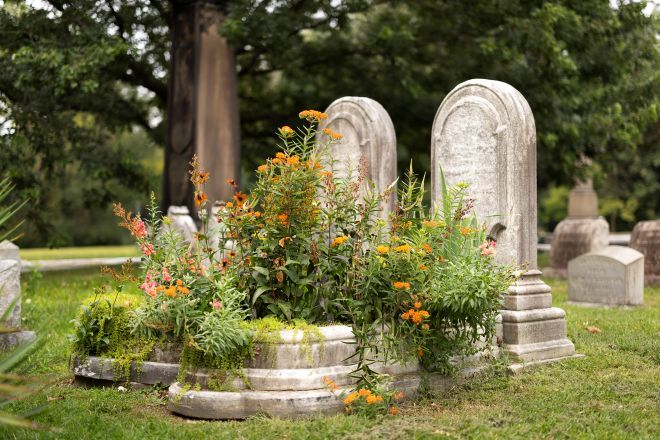 Photo by Ryan Collerd. The Woodlands
The Woodlands began as the 300-acre country estate of 18th Century botanist and plant collector William Hamilton. After the Revolutionary War, Philadelphia-born Hamilton visited England and came home inspired to create his own such landscape. He went on to transform his comparatively modest villa into a grand, Federal-style mansion. Hamilton also set to work transforming the landscape into English gardens, using plants he and his contemporaries (among them, eminent botanist John Bartram) sourced during their world travels.
The outcome earned Thomas Jefferson’s praise: “The only rival I have known in America to what may be seen in England.”
Hamilton died in 1813. In 1840, The Woodlands Cemetery Company formed to preserve the estate and its grounds. They did this by transitioning the land into a burial site that, common during the Victorian era, that doubled as a popular destination for outings. It was more of a community park than a quiet place of mourning.
“I come to The Woodlands all the time, and thought it would be so sweet to have something to do and a friend to check on.” — Grave gardener Carmel Gordon
According to a 19th century guidebook Baumert found, “One of the things that made The Woodlands unique was that it had ‘plentiful tombs in the French style’ that were full of mounds of flowers [growing],” she says. Through the years, even as the cemetery continued to build gravesites, it also continued as a community greenspace, especially in summer, when the temperature there is often several degrees less than the surrounding city blocks. But over the years, the graves’ flowerbeds disappeared.
Baumert long dreamed of restoring the gardens. So, back in 2016, she went to work, obtaining funding from the Philadelphia chapter of the Garden Club of America and reaching out to the Pennsylvania Horticultural Society for resources.
The results were almost immediately satisfying: One season — even one day — the gardening was, “wildly successful … we really started to transform the site.”
On that first workday, the gardeners visited a grave that was full of irises that hadn’t bloomed for a long time. “We divided them and spread them to all the grave gardens,” she recalls. “Now those irises from that one grave are all over the whole site.”
A community hub
Baumert believes the secret to her success is her neighbors. Even today, with all the tourist-centered hubbub around the 250th, at The Woodlands, she says, “our number one priority is to serve the community directly around us.” That community includes the busy 40th Street Trolley terminal, the nearby ever-growing campus of the University of Pennsylvania, the also ever-extending Schuylkill River Trail, and a solid group of devoted residents. Still, the space feels like a hidden gem.
“In almost any other city, The Woodlands would be a main attraction, but it isn’t, here,” Baumert explains, due to the vast number of historical sites in the city. “In some ways that makes for a unique space for the neighborhood and the community to have as not only a place to walk or garden but as a reflective space and an escape from being across from the trolley portal.”
At this year’s grave gardener kickoff on a Saturday in late March, the site buzzed with volunteer grave gardeners and community gardeners (The Woodlands has a small community garden next to the former stables), along with folks out for a stroll or a run. In front of the stables stood two folding tables, one with a box of coffee and some snacks, the other stocked with a few early spring options: seeds and violas.
To kick-start the season, volunteers receive training on the unique aspects of grave gardening, along with some gardening basics. No experience is required. “It’s a blend of experience level, which lets this exchange of information happen between gardeners,” says Program and Operations Manager Emma Max. While some family plots encompass a larger space with multiple graves, most gardeners tend one cradle grave.
The gardeners visited a grave that was full of irises that hadn’t bloomed for a long time. “We divided them and spread them to all the grave gardens,” Baumert recalls. “Now those irises from that one grave are all over the whole site.”
Victorian era cradle graves each have a headstone, footstone, and two stone walls that connect them, creating a rectangular planting area in the middle, resembling a bed. They also have a base with a drainage hole, making gardening in a cradle grave container gardening. Some cradle graves at The Woodlands are made of marble and some are made of granite, so gardeners learn about the specific material of their assigned grave and how that impacts planting. (Marble graves, for example, are made from separate pieces, which means robust roots can push the marble out of place.)
In total, about 160 gardeners tend to 250 graves — almost all of the site’s cradle graves, with the exception of those that need repairs or are too far from a water source. While there’s no set rules about the number of hours spent gardening, gardeners are expected to maintain their graves throughout the summer season, which means watering frequently during hot weather and coordinating with fellow gardeners for coverage if they are going to be traveling.
Volunteers primarily tend to their graves on their own time when the cemetery is open (dawn to dusk) but the program hosts several gatherings throughout the season where gardeners can formally come together, meet, and work. That starts with workshops in the wintertime that cover the history of the site and how to plan your garden. In mid-March they gather for the first onsite workday, and there are several workdays in the spring. “By summertime people are self-sufficient, but we plan monthly social events to encourage the community and friendship,” says Baumert. “We end the season in the fall with a bulb brunch.”
In winter, volunteers can start seeds at Penn’s Biology Greenhouses & Bio Pond. The program has also grown to include donors and partners in Laurel Valley Soils, North Creek Nurseries, SWEETGREEN, the Pennsylvania Horticultural Society, University City Garden Club, and PCGCA: Philadelphia Committee of the Garden Club of America.
Returning to garden year after year
In March, after the group disperses, Bernadine and Eleanor Salgado, a mom-daughter team who live in the neighborhood, tackle the rosebush in their plot, pruning its prickly branches. Eleanor moved to West Philly about 20 years ago and discovered “this beautiful green space.” The two started grave gardening in 2020, “right in the middle of the pandemic,” Bernadine says. “It was really nice to come here, and a lot of people were coming here to meet friends.”
The Woodlands provides everything volunteers need to get started, including plants and seeds. “[What we plant] depends on what they have to offer … and it depends on what the groundhogs eat!” Bernadine laughs. For five seasons, the Salgados have tended the grave of renowned 19th century New Jersey attorney and politician Benjamin Brewster. A tree that used to shade the site came down more recently. Now, it’s a full-sun spot, requiring them to adapt the gardening choices and techniques.
The experience has so grown on them that they plan to volunteer at Mount Moriah, a nearby cemetery that is still seeking grave gardeners.
Renee Wagoner also lives in the neighborhood. She often stops to tend her assigned, part-shade site on her way home from her job at Drexel University. “My backyard is overwhelming,” she says. “This is the perfect size.” She’s starting her second season as a grave gardener; returning gardeners are able to tend the same grave year after year.
“Last year, I inherited plants. I wasn’t sure what I was going to get, so this year I feel more ownership,” she says. She’s recently replaced plants that failed to bloom and is dealing with another challenge: Next to her grave, the “neighbor groundhog” has dug a giant hole. A. Hunter Wood, whose grave she tends, was “an iron ore magnate who lived at the 1500 block of Arch,” she shares. Wood’s grave is part of a larger family plot that the Woods likely used for picnicking.
 Emily Rice, photo by Ryan Collerd. Newbie gardeners
Each year, around 20 to 30 new volunteers begin as grave gardeners. One of them is Ray Armater, who retired to Philadelphia after a career in historical preservation in the Hudson Valley. Armater is keen to learn more about the person whose grave he now tends — and to meet more living Philadelphians.
“When I came [here], I underestimated what it would be like moving away from a place I grew up and my friends,” he says. A friend encouraged him to volunteer at The Woodlands on Tuesday nights. Armater says he enjoys the fresh air, companionship and history.
The program doesn’t require participants to do historical research, but he has, and will likely take part in a new Woodlands partnership with Pennsylvania Historical Society to teach volunteers to do the same.
Carmel Gordon is also a first-year gardener. “It got me through winter knowing that this would be a thing I’d be doing,” they say. “I love plants; I have a lot of indoor plants but not outdoor plants, and this felt manageable. I come to The Woodlands all the time, and thought it would be so sweet to have something to do and a friend to check on.”
By “friend” Gordon is referring to their plot’s occupant. The program, it seems, isn’t just connecting grave tenders to each other. It’s also connecting the gardeners to those who rest there, connecting the present and the past.
 MORE WAYS TO VOLUNTEER AND MAKE A BETTER PHILLY
Jackie McCrea. Photo by Ryan Collerd
Comments are closed.