
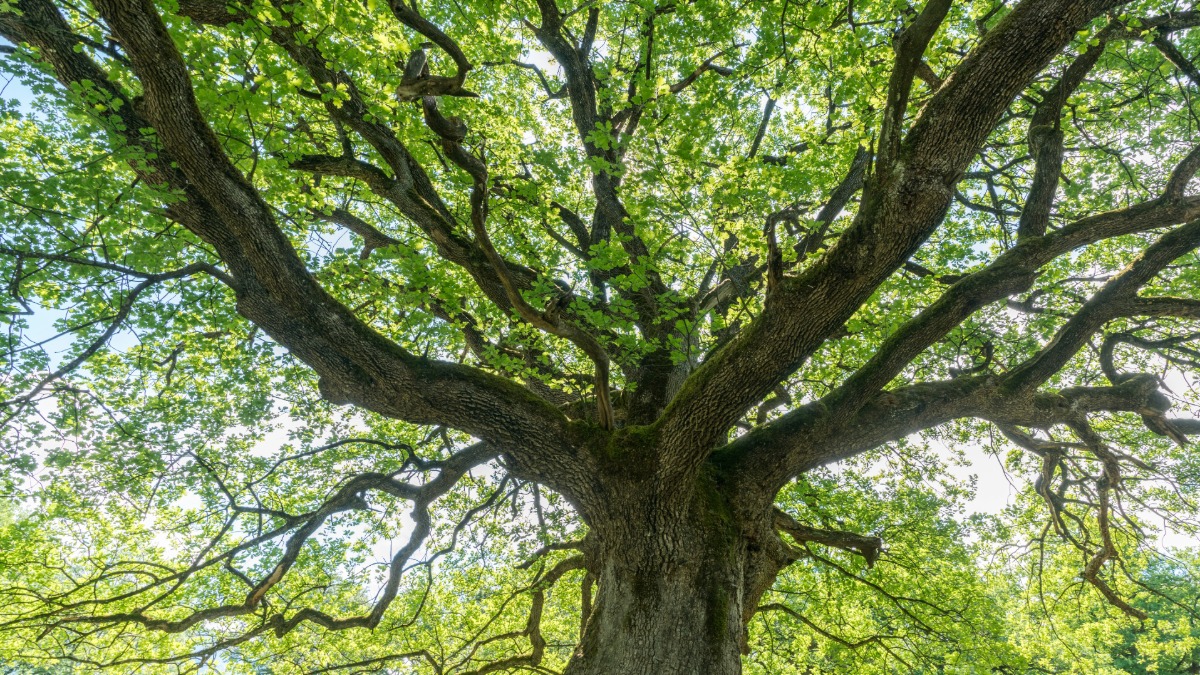
Since April 24 is Arbor Day, a day to reflect on the importance of trees, it’s a good time to learn about the State Tree of Illinois – the White Oak (Quercus alba). A special poll of 900,000 children in Illinois changed the State Tree from a vague “Native Oak” to “White Oak” in 1973. Senator Jackson of Rockford signed the original bill in 1908, and the amended bill was signed into law in 1973.
It is a long-lived, native tree whose name comes from the color of the undersides of its leaves, not its bark. It can grow to 100 feet at maturity in an urban setting, but much taller in a woodland setting. Leaves may grow to 10 inches long and five inches wide, turning red in the fall.
The fruits of the White Oak are acorns, making this tree a keystone species and key food source, providing habitat and food for many animals. The cap detaches at maturity, ripening in September. Acorns can germinate as soon as they ripen, taking only one growing season to develop into a tree, unlike Red Oak acorns that take two years. It takes about 50 years for the tree to produce large crops of acorns and even then, the number of acorns varies every year. The White Oak also supports over 500 species of caterpillars, essential for healthy birds. The lush branches provide cover and nesting sites, too.
White Oaks prefer moist, well drained slightly acidic soils and full sun to partial shade. They are slow growing but long lived with some living for 500 years.
If you’re looking for smaller native trees, Eastern Redbud (Cercis canadensis), American Hornbeam (Carpinus caroliniana), Serviceberry (Amelanchier) and Pagoda Dogwood (Cornus alternifolia) are good options. They offer spring flowers and fall color and grow only to 30 feet. They also are keystone plants, providing food and shelter for pollinators and birds.
Celebrate Arbor Day. Plant a tree!
Naperville Gardener – I Am Thankful for Trees
Comments are closed.