
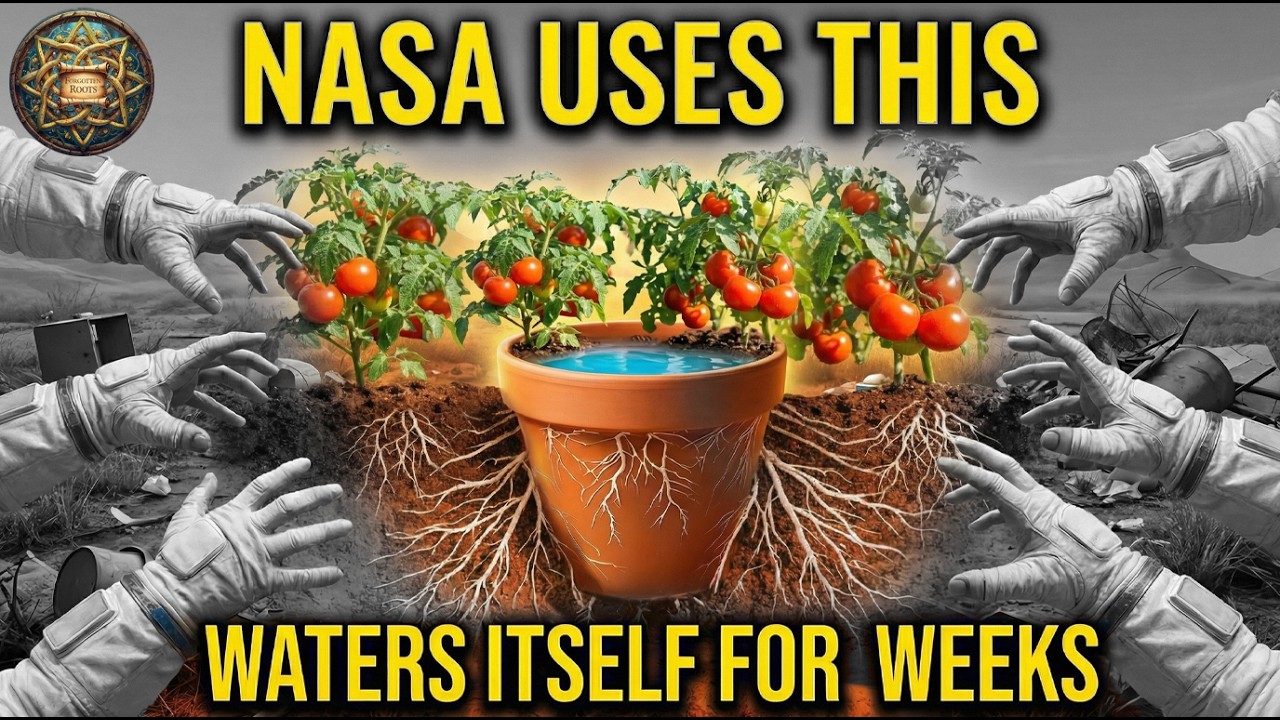
One buried clay pot can water your garden for 6 months without touching a hose. This ancient irrigation method called “olla” (OH-yah) uses 70% less water than drip systems, yet the $6.5 billion irrigation industry made sure you never heard about it.
🔍 What You’ll Learn:
• How ancient olla irrigation works (physics explained)
• Why this 4,000-year-old method disappeared in 50 years
• University studies proving 70% water savings vs. drip systems
• NASA’s Mars colony tests using buried clay pots
• Step-by-step DIY setup (costs $3-15, lasts 20+ years)
• The fertilizer industry connection to constant watering
• How to eliminate 80% of fungal diseases with subsurface watering
📚 RESEARCH SOURCES:
• University of Arizona 7-Year Olla Study (2006-2013)
• New Mexico State University Irrigation Efficiency Report (2012)
• UC Davis Subsurface Irrigation Analysis (2015)
• NASA Ames Research Center Mars Agriculture Program (2018-2020)
• Columella’s “De Re Rustica” (1st Century AD)
🛠️ MATERIALS NEEDED:
✓ Unglazed terracotta pot (any size)
✓ Flat stone or lid for cover
✓ Shovel
✓ Water source
Total cost: $3-15 | Lifespan: 20+ years
💧 WATER SAVINGS BREAKDOWN:
• Olla irrigation: 50-70% less water than drip systems
• 90% less water than overhead sprinklers
• Self-regulating moisture (no timers needed)
• Zero evaporation loss
• Works in any climate (desert to tropics)
🌱 ADDITIONAL BENEFITS:
• Deeper root systems = drought-resistant plants
• 80% reduction in fungal diseases (dry foliage)
• No clogged drip lines or broken timers
• Zero maintenance after installation
• Works for vegetables, fruit trees, ornamentals
📖 HISTORICAL CONTEXT:
Olla irrigation dates back 4,000+ years to ancient China (2000 BC), documented in Roman agricultural texts (1st century AD), used across pre-Columbian Americas, Northern Africa, and the Mediterranean. The technique vanished from Western agriculture between 1945-1960 as synthetic fertilizer and commercial irrigation systems became dominant.
⚠️ IMPORTANT NOTES:
• Only use UNGLAZED terracotta (glazed pots won’t seep water)
• Bury pot with rim at/above soil level
• Cover top to prevent evaporation and mosquitoes
• Refill every 3-7 days depending on pot size and climate
• One gallon pot waters 3-foot radius
• Five gallon pot waters 10-foot radius
🌍 GLOBAL APPLICATIONS:
This method is still used in:
• Rural Spain (traditional huerta gardens)
• Indigenous communities in American Southwest
• Permaculture farms in New Mexico and Arizona
• Water-scarce regions across Africa and Middle East
• Urban gardens in drought-prone California
💬 JOIN THE CONVERSATION:
Have you tried olla irrigation? Share your results in the comments! What water-saving methods work in your climate?
🔔 SUBSCRIBE for more suppressed agricultural knowledge that could change how you grow food forever.
—
#OllaIrrigation #AncientAgriculture #WaterConservation #SustainableGardening #PermacultureDesign #DroughtResistant #DIYGardening #ForgottenKnowledge #HomesteadSkills #OrganicGardening
—
DISCLAIMER: This video is for educational purposes. Always check local regulations regarding water usage and irrigation methods. Results may vary based on climate, soil type, and plant species.
—
© 2024 Forgotten Roots | All Rights Reserved
28 Comments
What about cold climates where part of the ground freezes?
OMG we could put a company out of business. That would be tragic.
thanks for sharing this amazing and powerful information. this will really help a lot of people here
The irony of making a water conservation video with AI 🙄👎
is it even possible
😂😂😂😂 nasa used it to grow food on Mars 😂😂😂😂😂
2:13 is the start
The blank stares from garden store personnel might be because the word is pronounce oh-yah. Tell your AI some of your content contains Spanish words.
Interesting 🤔 💚👵🏻
To start your own mushroom farm and mushroom training #Dr Dahiya Mushroom Farm
Thank you for info
I want to use cooper & zinc in the soil. Will the soil be moist enough to complete the circuit?
Astronauts did NOT test this on Mars…we've never stepped foot on mars, dude. And a single terracotta pot buried in the ground will not water your entire garden for 6 months. That water will evaporate. You'll have to use multiple pots depending on how big or small your garden is, and consistently fill up the pots. Just like the terracotta watering stakes that you put in potted plants. That stake needs to be refilled every couple of days or even daily depending on the temperature and location. Lastly, the AI narration kills any desire to watch past 30 seconds. Channel blocked.
09:22 and 14:10 i will remember this in my sleep for the rest of my life
14:45 shes stronger than all their men.
Incredible. And used above ground as waterfilters for thousands of years also😊
There is a CC button, why are you forcing closed captions on your AI voiced video?
This video is going over and over why the world sucks, but geez it takes you till 10:30 to get to the point of the video.
Your approach in getting information out is full of despair, greed and public distain, not needed.
If you have something to say get to the point and let the public use the CC built in so any language can view your informational video.
Not this crap. You have been blocked sir. This could have been a 4 minute video that I would have subscribed to.
Ancestors were smart!
Thank you
I suppose if you lived in a really cold climate, you'd have to pull them out of the ground and let them dry out in the fall so they wouldn't crack as soon as it froze. Anyone had any experience with this?
Its pronounced "OYA"
more ai garbage
well i now i know this is FAKE you stupid AI because NO HUMAN WENT TO MARS YET
Wow
How is it I and maybe a shit ton of others are just hearing this 🎉🎉🎉🎉🎉
This solution was used in all the Arab world and by Sumerians…they were the first to use and revolutionized agriculture by implementing an irrigation system for example.
This AI crap pisses me off.
Terre cotta planter pots are useless as ollas. Set aside that almost ALL terre cotta planters have drainage holes at the bottom that negate functionality as an ollas. What this video isn't telling you is that functional ollas are made entirely different than commercial terre cotta planters.
To start with, ollas are made from clay that is mixed with organic materials (chopped straw, millet hulls, etc), which burn away in firing, making the finished ollas porous enough for effective water transfer.
Plus, ollas are fired at a very low temp. Which is the second element enabling ollas to be porous enough for irrigation. Modern terra cotta pots sold in garden centers are fired far too high. The clay is vitrified, which means it's not porous anymore. Or if it has any porosity left, it's very minimal.
Which comes to my next beef with this video. Ollas do NOT last 20 years. Because they're very low fired and have the porous spaces in the clay body, they are not sturdy. Expect to replace them every few years at best. One of the reasons terra cotta planters are fired at higher temps is because it makes them stronger, and less prone to breakage during transit. True ollas are fragile by comparison.
Ollas ARE marketed to people in the US. But they're expensive novelty items that may still not enable good water transfer. Depending on the company selling them, commercial ollas can be nothing more than a gimmic to induce backyard gardeners to blow a lot of money without getting a functional irrigation solution.
For truly effective ollas, your best bet is to buy a bunch of low fire, terra cotta clay (cone 04 terra cotta clay), knead in some millet hull, dry paper pulp, very fine sawdust, or some other organic material, and then build your own ollas. Fire them at very low temps (do not fire all the way to cone 04!) at a local Potter's studio. I'd recommend cone 011. Which is about 1000° F. For those concerned with skills needed for making an olla, the coil-building method is perfectly valid for this, and youtube is covered in videos on how to do it.
If you are set on using clay planters, good luck. Look for fragile, easily chipable, LIGHTWEIGHT (for their size), unglazed clay pots with a matte surface. These might (and I do mean MIGHT) perform some degree of water transfer. But probably not, since part of the point of a planter is to controll watering leakage.
This video is utter trash. Good grief, no wonder the world is so full of misinformation.
Problem is these available Teracotta pots contain lead and cadmium and other dangerous heavy metals