
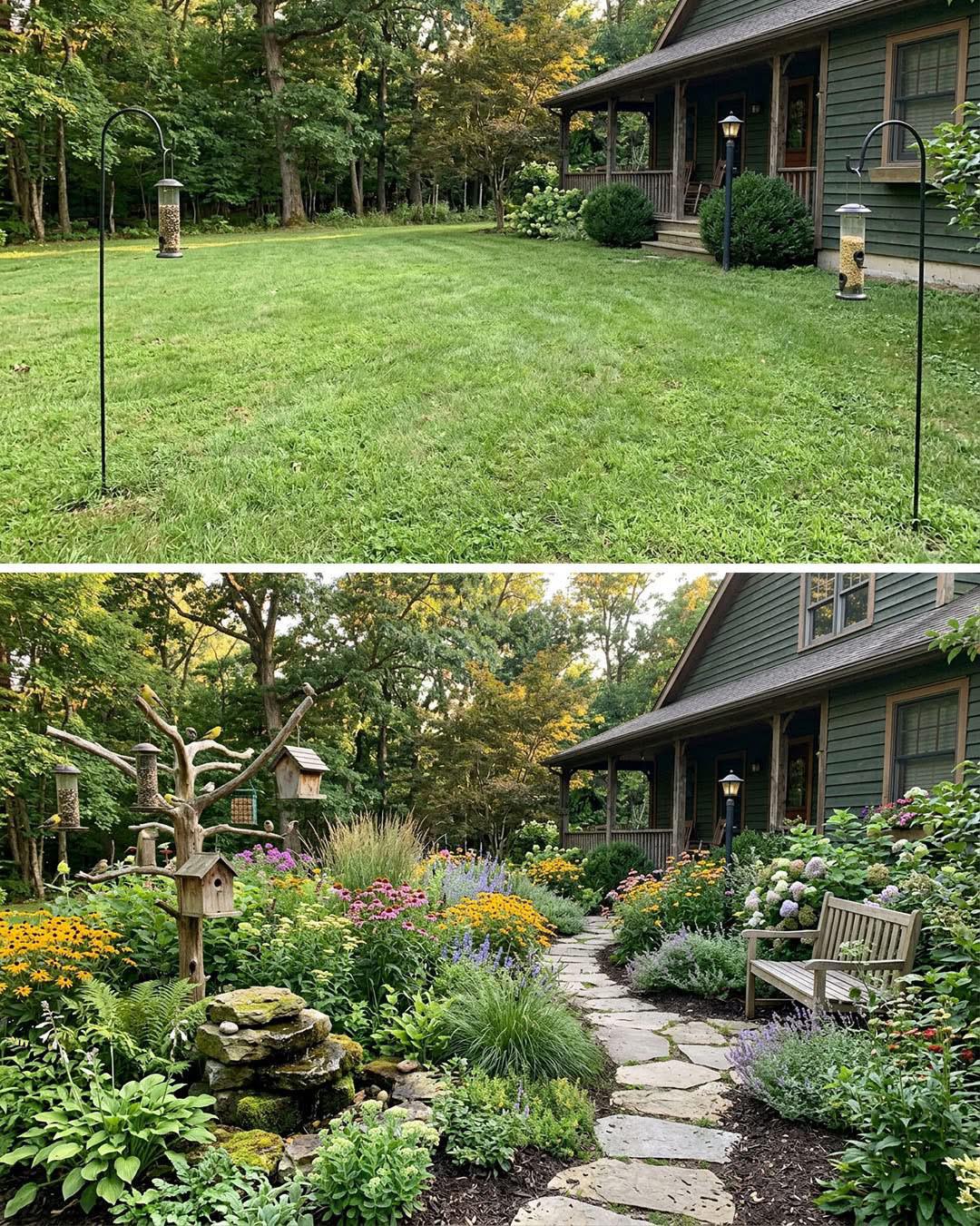
My yard looks similar to this top pic. Literally with the birdfeeders. Does anyone have any advice on wanting to go from mowing the lawn planting a few plants here and there to getting to the bottom pic? My wife and I are wanting to create a safe space for nature as we are in a neighborhood that frequents fox, raccoons, opossums, birds.
by SnooPoems6719
13 Comments
Make landscape beds around the feeders and expand them outwards over time.
Add trees too, they make great focal points.
Use the cardboard method to save the soil microbiome as much as possible. You can also cut and “roll” up sod as well but you may still need to cardboard. Definitely plot out your whole garden first and start with larger bushes/plants. Try to use mostly native species too! This lush picture will take several years so commit to a plan 🙂
First of all, they definitely hired someone to do that.
The first thing I would do is find out what plants are good in your climate.
This is AI. The lighting on the trees is the exact same.
figure out where all your utility lines are.
then use this website [https://easyscape.com/](https://easyscape.com/) to search your exact area for natives and climate-suitable plants, I love this website!
If you have deer, take that into consideration.
Try using seeds when you can to save money , etc
be patient – have fun!
I’ve spent the last 3 years doing exactly this. My yard is 90% for wildlife and 10% for my wife and I, so I let it get pretty messy.
My advice to get started would be to map out where you could make a path. I made a path around the perimeter of my yard and then that gives you easy spots to plant shrubs/perennials.
One thing to heavily consider is how much sun your space gets so you know what to plant and where. But another thing I’ve learned on my journey is to never be afraid to dig something up and move it to a new spot. I’ve never had a shrub or perennial die from being moved.
Send me a PM if you have more detailed questions. I have learned of so many sources to find out what to plant in my region, host plants, keystone species, etc. it’s extremely rewarding work.
https://preview.redd.it/0cd9gmzhkrtg1.png?width=1733&format=png&auto=webp&s=a1aa6d8cac34775b7e970ed4f04ec40613630db2
First step is to plot. Walk your yard with a can of spray paint or a long rope to lay out. Start drawing out the paths and beds. What makes sense for the traffic flow. What do you want to highlight? Then do a scale drawing and add in your proposed paths and beds. Hard features like the bench or waterfall. That’s like the garden bones. You don’t hang the pictures first when you move, you position the sofa.
Then spend time researching plants. Make a plant plan.
Execute piece by piece what makes sense for you. Maybe it’s placing the path, or maybe it’s cardboarding the beds and the actual path comes later. Maybe the path stays grass for now.
Fake as hell
Have a plan first. Envision and map out the whole yard on paper and then break it down into smaller projects that you can complete in a season. May take a few years to get to the end goal but you’ll be able to adjust things as you go and it won’t break the bank or the back
Start small and experiment. You may find the first year deer and rabbits kill everything. It’s better they killed $50 of plants than $5,000. Work to figure out what pressure you have and what solutions work.
Anything bigger than 1/4 acre lot is going to need height differences and trees, shrubs, and big ass plants will be needed. Step them down by planting in groupings like mounds so tree-> shrubs-> tall plants->medium-> ground cover.
Look at your topography. What natural features does your yard have? Where do you want to walk around it already? Where does the water go? Does that shape suggest any way to put the big plants? Walkways? I love sinuous curves and follow the natural movements with my garden plans. Straight lines are boring and don’t unfold the landscape before you like curves do.
I planted my shrubs (purchased small) and dotted them as the backbone for where I wanted to go with my garden beds. As I waited for them to grow bigger, I added trees. I then began to plant tall and medium plants around the shrubs, expanding them over the years until they all expand together. That way, I could still mow grass (easy) around them, rather than weed out lots of mostly empty beds with tiny babies (hard).
Grasses are often overlooked and satisfyingly easy to work with as nothing really wants to eat them to the ground.
As you’re getting started making garden beds, buy big plants so you can identify them the next year. Spindly babies are going to be near unidentifiable year 2 when they are surrounded by unknown spindle weed babies.
Spent seed is going right into that water feature, making it harder to maintain. Plus, birds visit the feeder will appreciate a wide birth so the foxes and feral cats cant sneak up on them. I’d give myself easy access to facilitate maintenance, because making it easier to clean will keep it cleaner, which is better for the birds.
I might approach this in a trio-formation where the feeder, water feature, and bench are low-grow spots with pathing or least a clear desire path to each, but clearly separated.
Thats awesome! Use cardboard and woodchips to get rid of the grass quickly. Take note of the area you want to plant – sun level, soil quality and amount of water it gets. Research native plants for your area. There are a lot of great resources, books (Doug Tallamy), subs on this. Choose plants based on how well they will do in the conditions you have. Look up native plants sales/greenhouses in your area or go to prairiemoon.com for lots of varieties and information on the specific native plants. I would start with larger plnts like trees and work from there. Oaks support the largest amount of life and will bring the most wildlife into your yard. Def focus on natives if your goal is to see wildlife. You wont even need a bird feeder anymore
Just to echo start small, pay attention to how much sunlight different parts of your yard get.
My first stab at this a couple of years ago went great until my late blooming trees bloomed and half of my work died. Started going to a local conservation shop here in Baltimore they focus on natives and are super knowledgeable so I was able to talk through my yard setup and they gave great advice pivoted the shadier part of my yard middle of summer happy to report that half of the yard is coming back this year looking great. I add things throughout the year working towards my end game definitely wasn’t a one or two week project.