

Mostly, what was there were trees – and therefore lots of shade. A magnificent mature oak halfway down the lawn was met by a dense holm oak looming over the neighbour’s wall. At the back, a eucalyptus leaned in, dropping pale furls of bark. ‘The trees were beautiful and crying out to be noticed,’ Taryn says. ‘I could see the potential for showcasing them.’
For someone who grew up with the strong light of Australia, so much shade might have been bothersome. But dappled light is something she’s come to appreciate. ‘All London gardens are shaded in some way,’ she notes. ‘This kind of light is particularly lovely.’ Taking out only one tree, too close to the oak, she decided the garden would be all about the movement of light and making that walk down the garden worthwhile. The space was already divided roughly into three segments. Taryn began by sculpting these more definitively, adding a multi-stemmed cherry to pinch in the planting a third of the way down. She filled in gaps to conceal what lay behind; a sense of intrigue is essential, she says, to any journey. Near the house – the most formal part of the garden – she created a square of lawn for the husband to mow (a job he likes), softening the geometry with squares of meadow in the corners as a hint of what’s to come. A terrace of tumbled cobbles draws a graceful arc by the house, with the main seating area off to one side, leaving the façade of the house unbroken. A Lutyens-style bench, also curved, is underplanted with Geranium ‘Rozanne’.
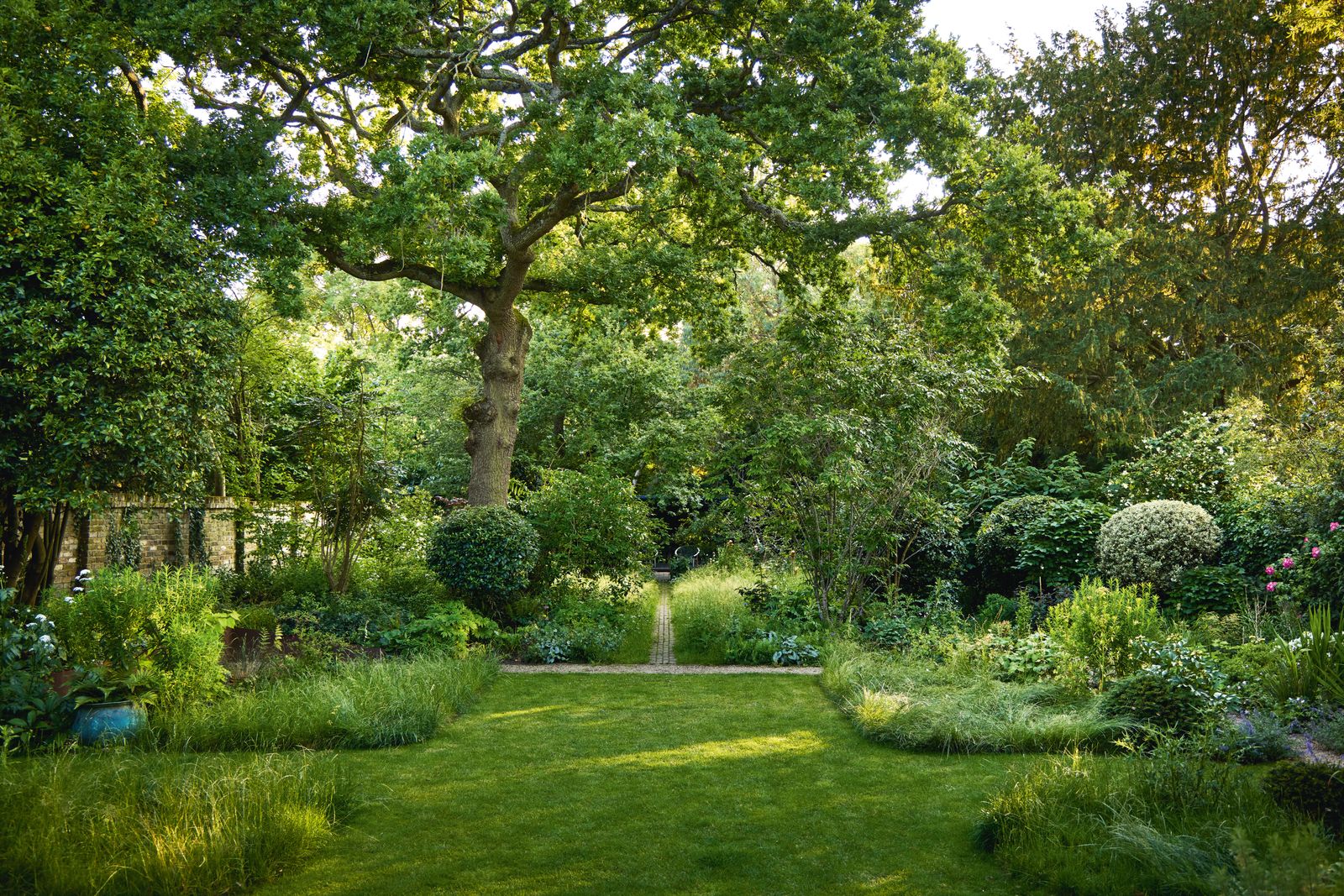
A mature oak and topiarised shrubs, including philadelphus and euonymous, divide the lawn from the wildflower meadow beyond.
Alister Thorpe
Taryn’s masterstroke is the path that begins at the pinch point and invites you to discover what lies beyond. Just four cobbles wide and with grass growing through the gaps, it can take only one person at a time. ‘The usual rule is that paths should be wide enough for two people to walk side by side,’ she says. ‘But this path refuses to comply.’ So, like a child exploring, you arrive in the wildflower meadow alone to find gnarly old fruit trees and occasional roses that have been left to ‘go slightly feral’. In spring, the meadow bursts with bulbs: snowdrops, blue camassias, fritillaries and orange, purple and red tulips. In summer, yellow Welsh poppies, ox-eye daisies and lilac cranesbill geraniums dot the grass.
From here, the garden becomes what it always wanted to be – a woodland, with the light picking out one interesting stem or leaf at a time. As in nature, the woodland floor is relatively sparsely planted, with space around the hellebores, ferns and foxgloves for squirrels, birds and Wolfie the dog to nose around. Now, instead of a football pitch, we arrive at an asymmetrical curved wooden deck with a firepit and a large garden room.
Comments are closed.