
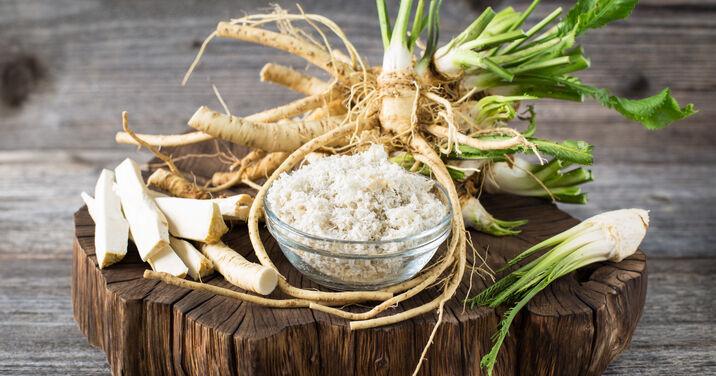
There are plenty of plants that I fear for after this miserable winter with its thaws and rains and freezes. But do I fear for my horseradish? I do not. It is stalwart. Dependable, fun and tasty. I will go out on a warm day sometime before early April (or what passes for a warm day in Montreal in early spring) and I will poke around in the snow and ice and road salt and find a crown beginning to put out green. I will dig and pull out of the ground the eponymous root looking like a dirt-encrusted face-hugger from Alien. I’ll prepare it the day before Passover for use as the maror the bitter herb of the Passover seder served to remember the sufferings of the Jews in ancient Egypt. I understand some Christians also eat horseradish root at Easter to remember the sufferings of Christ. You say potato, I say horseradosho.
Scrub off the dirt, peel it and cut it into small slices or shred it. The root turns spicy when it gets injured through crushing or shredding and then loses its kick with time which is why I wait till the last minute to harvest and prepare it. Some people pickle it with vinegar to help preserve its spiciness.
Horseradish is the earliest crop I get out of my garden, and because it heralds spring, it is one very dear to my heart. The squirrels and myriad other garden critters leave it alone because of its powerful punch. It grows quite a handsome display of large, tall leaves, a little like a rhubarb but without the red in the stalks and it can take up a fair amount of real estate.
Again, think rhubarb. The leaves tend to flop over after a while and then the snails and slugs munch away, which can be less than pretty, but it is easy enough to cut the leaves that have passed their prime. The leaves are also edible. Picked when they are young and steamed, they taste like other bitter greens with a bit more kick, not dissimilar to mustard greens. In fact, mustard greens and horseradish are both members of the family, Brassicaceae.
Horseradish practically thrives on neglect, grows in indifferent soil, doesn’t care much about soil moisture (that deep root helps keep it going through most dry spells we encounter here) and does not need full sun. My kind of plant. It spreads through roots, but I haven’t found it to be terribly aggressive in doing so. If you are worried you can put it in a heavy planter. It will overwinter even in a relatively small planter with a minimum diameter of about 60 cm.
Occasionally, horseradish produces a tall stalk with flowers that are surprisingly sweet-smelling, white and delicate. It then goes to seed but this seems to do nothing to harm the growth of the plant, so no need to pinch it back. The root will get woody and less tasty if you leave it for several years.

Horseradish roots growing in organic soil.
Photo: Getty Images / Andreas Häuslbetz
Horseradish grows easily from a root-cutting that has some green on it so if you have a friend who offers to share, just put it in a likely spot, green end facing up. Or you can do what I did and go to the supermarket after Passover and buy a root with some green and plop it in your garden. Wait a year or two before harvesting to give it time to establish itself. When you harvest it, you can cut off a bit and put it back in the ground to keep the cycle going.
Jeremy Wexlerlives and gardens in Montreal. He also loves reading great garden writing. Do you have a question, a tale of woe or a favourite plant you are waiting to see emerge from the snow? Jeremy will read everything you send.
jeremywexler9@gmail.com
Comments are closed.