
Our last measurable rainfall was Feb. 19, when a half-inch fell. The top foot or so of soil is dry, affecting new plantings. Young trees that I planted in November have already needed irrigation a few times.
While our rainfall for the year is not far below average, and the entire state of California is ‘drought free’ for the first time in 25 years (https://www.drought.gov/states/california), I am concerned that new flower and vegetable plants are going into unusually dry soil during a period of anomalously high temperatures.
We went through this last year, with barely an inch of rainfall in March 2025. Lots of folks planted vegetables and flowers, set their irrigation systems for the usual settings, and then the plants just sat there or struggled to grow.
The soil was dry, and this year it’s even drier: we had 5.6 inches of rain in February 2025, vs 2.7 inches in February 2026.
I strongly encourage you to water the whole garden very thoroughly at the time of planting. Roots will not grow into dry soil. Early establishment of your vegetable and flower plants is crucial to their later success.
Mulching with compost or straw can help the soil retain moisture as well.

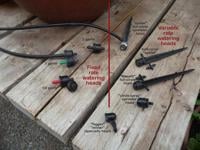
Drip systems are efficient and can be effective, but their output varies considerably. Emitters shown here vary from 1/2 to 2 gallons per hour, and even higher output from the sprayers and bubblers. It’s important to calculate or measure your output in order to know how long to run your system.
Courtesy photo
Water new plants thoroughly
* Each irrigation needs to get to a soil depth of at least a foot for flowers and vegetables, 18 inches or more for trees and shrubs.
* Measure or calculate your output. Check the depth with a probe (a long screwdriver works well) or trowel a day or so after running your system. Monitor plant performance and know the signs of inadequate soil moisture.
* Drip systems need to run for a long time.
* Sprinklers on heavy soil may need to have multiple start times to avoid runoff.
* Don’t hesitate to bypass your sprinkler system now and then to provide a deep watering to your trees and shrubs.
* California native plants do benefit from occasional deep soakings here, particularly those that are from coastal or higher-elevation parts of the state.
* Poor growth. New growth will typically abort if there isn’t sufficient moisture.
* Leaves ‘burnt’ along the margins.
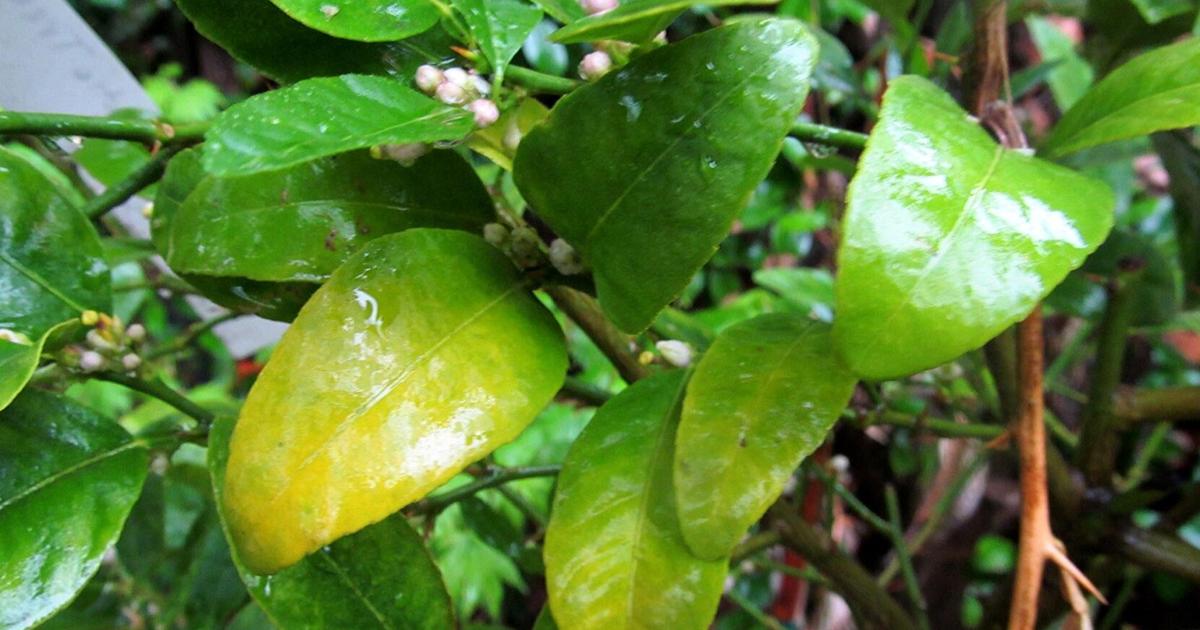
* Leaves yellowing, though there can be other causes of that.
* Poor fruit set and development.
* Sunscald on fruit during heat waves. The waxy protective coating on peppers and tomatoes thins out when the plant is drought stressed.
As noted, it’s important to measure or calculate your output, but I can give you the typical range.
Sprinkler systems usually take 30-40 minutes to apply an inch of water. Conventional lawns (perennial ryegrass with fine fescue and sometimes some bluegrass) need that twice a week.
Lower-water turf (tall and dwarf fescue, Bermuda grass) can get by with once a week.
Drip systems for flower borders and vegetable gardens need to run for one to two hours. Frequency will depend on your soil type. Regular garden soil can go about three days between waterings. Raised beds, due to the faster draining soils and effect of gravity, may need to be watered every other day. Mulching with organic material can help a lot with water retention.
Note that tomato plants can be deep rooted if they are watered correctly. A vigorous plant with a deep root system can continue to flower and set tomatoes all through the summer, producing heavy yields into the fall. If your tomato didn’t continue to yield, it’s likely that it wasn’t watered deeply enough.
Exceptions include the determinate and dwarf tomatoes. These don’t need as much water overall, since the vines are smaller. Determinate types tend to flower all at once and yield one large crop. This is great for freezing, canning, and drying, and allows you to remove the plants after the heavy July-August crop. If you want to save water in your vegetable garden, consider some of these varieties. Ace and Principe Borghese are good examples of determinate tomato varieties.
Drip systems being used to water trees and shrubs need to run for two to four hours, once a week. We see more problems with inadequate run times for drip systems than any other watering problem. I would love to see more people watering their young trees, shrubs, woody ground covers, and perennials deeply once a week.
Shade trees that are established should have a deep soaking every two to four weeks, depending on species. Water to a depth of at least 18 inches. This often will take longer than your current system or sprinkler timer program can readily accommodate, so just plan on using a soaker hose, or setting a hose at a slow flow and moving it around the drip line of the tree.
Why are the leaves of my shrub turning yellow?
Every spring we answer lots of questions about yellow leaves on evergreens, including citrus, in March and April. This is commonly due to a natural process of nitrogen mobilization in the plants at the beginning of the growth cycle.
Nitrogen is the plant nutrient linked to new growth of plants. It is mobile within the plant and moves to where it’s needed. As new growth begins, nitrogen translocates to the growing points from the older leaves where it was stored in winter. Many of those older leaves turn yellow, and many will drop.
This is perfectly normal, but on some broad-leaf evergreens it can be quite visible and causes concern. Examples right now include camellias, ceanothus, privets, xylosma, Pittosporum tobira. Shortly our live oaks, mostly coast live oak and cork oak, will shed numerous older leaves. While it is an indication that the plant is using nitrogen, it doesn’t necessarily indicate a deficiency.
What about citrus leaves yellowing?
Older leaves often turn yellow as the trees begin to grow. Overall yellowing of citrus leaves in winter and early spring is also caused by winter cold. The long spell of gloomy weather in November and December 2025 led to many citrus trees yellowing. Lemons and limes are most prone to yellowing; grapefruit, clementines, and oranges less so, and it’s uncommon on mandarins and kumquats. This actually reflects the cold hardiness of those different types.
You may be seeing both nitrogen movement in the plant and the lingering effect of cold winter temperatures. In either case, early spring is a great time to fertilize citrus trees.
What are these big grubs in my soil?
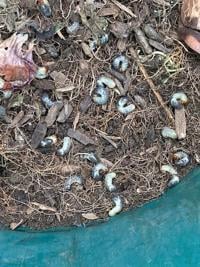
Grubs are common in the garden and compost pile as the adults are attracted to decaying plant material as they lay their eggs. The grubs are the larvae of various beetles and are generally not a serious problem in our area, so no control measures are needed. Birds and mammals consider them a delicacy.
Don Shor/Courtesy photo
People who are digging in their vegetable gardens, turning the soil in preparation for summer vegetables, often encounter large, plump grubs, sometimes in large numbers.
They are likely larvae of a hoplia (Hoplia argentea) or scarabid beetle (Phyllophaga). Related species include May beetles, rose chafers and others (we have masked chafers, which feed on turf, but we don’t have rose chafers here).
The adults and larvae of hoplias and scarabids are plant-feeders but generally not so numerous as to be worth any concern. They have one generation per year. Hoplias feed on rose petals, especially light-colored varieties, among other flowers. Both introduced and native species here are incidental garden pests whose numbers are normally held in check by natural predators.
The larvae do feed some on roots, but are typically pupating and ready to emerge as beetles by the time you’re planting your summer vegetables and flowers. Then they fly off to find flowers to feed on. They don’t do much damage to your summer garden, and it isn’t practical or necessary to control them.
Masked chafer beetles feed on turfgrass roots and can cause some die-out in your lawn. Most turf species can sustain the limited damage that they do without needing any treatment. Mostly these become a nuisance when skunks, possums, and raccoons dig in the garden to feed on them. For that problem, I suggest putting barriers over the soil area to discourage the mammals.
The larvae are very attractive food for larger birds as well as the skunks and opossums, so when you turn them up in your soil just toss them out onto the ground nearby. They won’t last long.
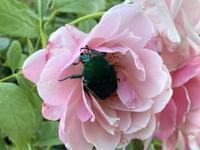
The large, shiny, green figeater beetle is a Southwestern-native beetle that has spread into much of the Central Valley due to its fondness for soft fruit, especially figs. The amount of fruit injury is minimal and figs tend to produce very heavily, so it isn’t necessary to control them.
Don Shor/Courtesy photo
A rather formidable looking larvae is sometimes found in our area: the figeater beetle. The grubs and adults of this beetle are much larger. As the name suggests, they like to feed on ripe or rotting fruit. Most homeowners have enough figs on a tree to share a small number with this charming giant visitor.
The beetle itself is very large and shiny green. It has an amusingly awkward flight pattern, barely able to navigate but showing remarkable persistence as it slams into things.
This is a native to the American Southwest which has happily expanded its range into the Central Valley due to the widespread planting of fruit tree crops. Figs have been grown in the Sacramento Valley since the late 19th century.
Figeater beetles are harmless to people, occasionally feed on flowers, but most attracted to soft fruit. The adults of all these beetles are attracted to the warmth of decaying plant material at the end of the garden season, ovipositing heavily in your vegetable garden or near rotting fruit under your tree. The damage they do is minimal and nothing to worry about.
If your household is anything like mine was as a kid, someone may wish to keep one of these as a pet for a short time. Compared to the tarantulas, scorpions, snakes, and stink beetles we tended to bring home, my mother would probably have considered these pretty tame. If so, they’re very easy to feed as they just like sweet stuff, flower petals, and pollen.
— Don Shor and his family have owned the Redwood Barn Nursery since 1981. He can be reached at redbarn@omsoft.com. Archived articles are available on The Enterprise website, and they are always available (all the way back to 1999) on its business website, www.redwoodbarn.com.
Comments are closed.