
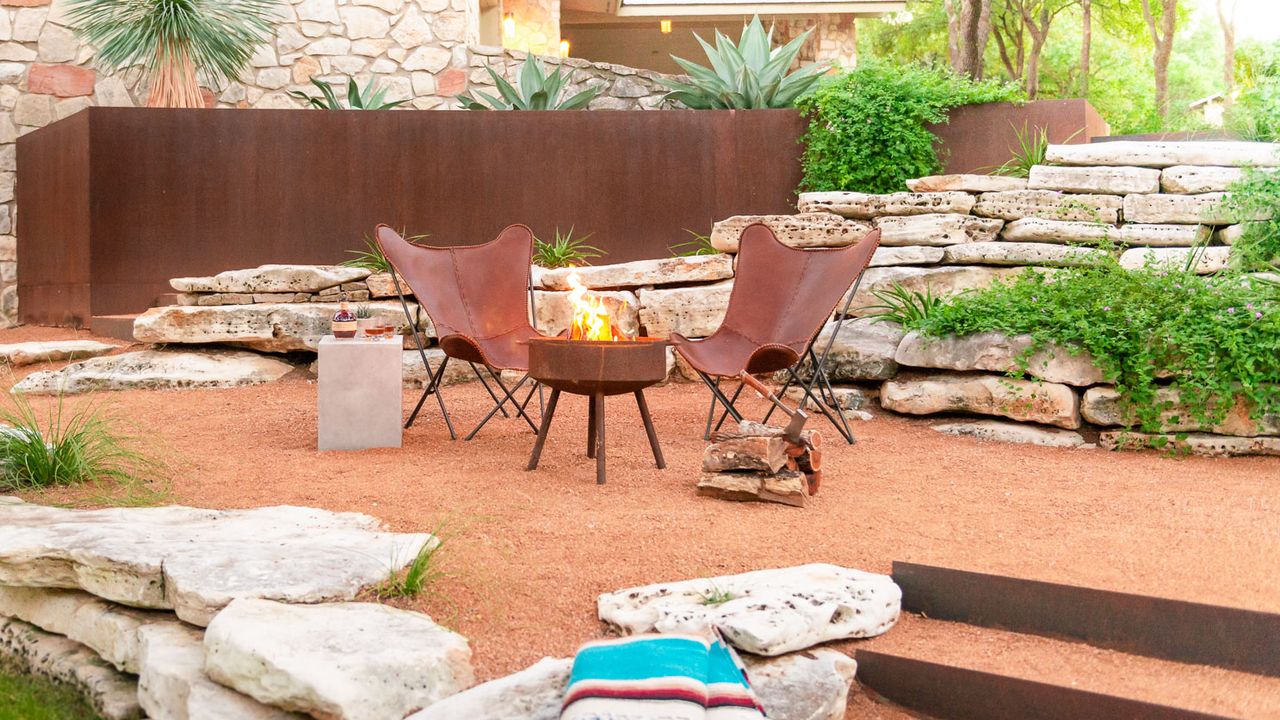
A simple backyard fire pit is a relatively easy and inexpensive project (though obviously without all the bells and whistles you’ll see in the ideas above). For a block pit on a lawn, here’s what you’ll need:
1. Pick your spot. Choose a location for your fire pit that’s flat, clear from overhanging tree branches, and at least 10 feet from your home and any other structures.
2. Mark the space. Whether you’re going with a round, square, or rectangular fire pit, lay out the first layer of your pavers and mark its perimeter. Feel free to use spray paint to do this as you’ll be digging a shallow hole and the base layer of pavers will be hidden. Once you have the pit’s footprint, remove all the pavers.
3. Build the base. Dig out the shape to a depth of about 6 to 8inches. Tamp the soil so it’s level, then add a layer of gravel (about 2 to 3 inches) for drainage and a layer of sand on top of that—this will help protect the ground from heat damage. Tamp once again to keep things level. Place the bottom row of your pavers, making sure the edges of the blocks fit together without creating gaps. Here’s where you may need to trim blocks with your circular saw to get the proper fit. You’ll also want to make sure this layer remains level—add sand beneath shorter bricks or use a mallet to pound down any height differences.
4. Construct the walls. Add additional rows of blocks, staggering them over the previous layer and using construction adhesive between rows. Most fire pits have three or four rows of blocks.
5. Add your Adirondacks. Place any fire pit seating at least three feet from the flames. Then all that’s left to do is perfect your roasting and toasting techniques.
What is the best outdoor fire pit to buy?
It depends. If you’re looking for a more direct-to-consumer model, Solo Stove makes a great option that can be moved around your backyard with ease. The company also recently released an easy-to-put-together Surround Tabletop, which enhances the outdoor experience by creating a rim that not only gives you a safer distance to the fire (a big perk for kids and pets), but works as the perfect ledge for hot cocoa and small plates.
“There are a variety of styles available today, from the traditional round fire pit to modern, linear designs and geometric shapes,” says Joe Raboine, vice president of design at Oldcastle APG. “There also are woodburning and gas options to suit any preference and style.”
For a more modern take, look to Rejuvenation fire bowls, like those made from glass fiber-reinforced concrete and technology to adjust the flame. Wayfair also carries plenty of woodburning fire pits made out of steel, many with intricate designs. You can also talk to landscaping experts about installing a more permanent feature.
You can also find DIY fire pit kits at most home-improvement stores that include pavers and all the needed supplies. Depending on the style and materials, you can usually find these for under $1,000, adds Raboine.
What is the best material for an outdoor fire pit area?
“The choice depends on the aesthetic you’re looking for,” says Sandy Schoettle, cofounder of Sea Island Forge. “A noncombustible hardscape like bricks, flagstone, or slate pavers, or a material like gravel or shells all work, and you can find them from your local landscape store.” The main thing is to look for a material that will ensure a fire won’t spread throughout your backyard. “Pavers are the best option to create a resilient fire pit,” Raboine adds. “Pavers are much more durable than brick, as clay tends to crack under high temperatures.”
For Bueno, the designer at Ten Plus Three, poured concrete is the way to go. “I love to create sophisticated and custom outdoor spaces with a fire element, and by making it a sunken circular social space we can offer unobstructed views from every seat,” he says. You can further enhance the space by planting flowers and foliage around it.
How do I care for outdoor fire pit furniture?
If you’ve noticed that the color on your Adirondacks (or other wooden chairs) have begun to fade, that’s all part of the unavoidable effects of UV light and moisture on wood, says woodworking expert Chris Marshall of Rockler Woodworking and Hardware. You can simply give in to the wood’s graying effect. “If it’s an outdoor-tough wood like mahogany, teak, or cedar, that gray color does no real harm,” Marshall says. Or, to keep your furniture looking new, you can reverse the graying by giving the wood a soap-and-water cleaning and then treating it with oxalic acid. “Oxalic acid is a main ingredient in many liquid deck-cleaning products,” says Marshall. “It is easy to use and will quickly and dramatically revive the natural color of the wood.” Follow that up with a coat of protective finish, such as General Finishes Outdoor Oil, or a semitransparent exterior stain.
Is an outdoor fire pit worth it?
“You can’t go wrong creating an outdoor space centered around one of our oldest and most timeless traditions,” says Cleveland-based Noelle Pangle, realtor with Howard Hanna. “A fire pit exudes warmth and welcome. While not a make-or-break upgrade, it is usually regarded by prospective buyers as a bonus feature.”
An alternative would be a patio heater, though they can be a bit industrial-looking. A fire pit is a great backyard feature for chilly nights and warm ones alike. At the very least, it’s a great option to create a gathering place in your yard.
What is a good size fire pit for a backyard?
This depends on the size of your backyard, but a good rule would be to find a fire pit around 36 to 44 inches. This will give you enough room to encircle it with furniture, but it won’t take up your entire space. And there’s plenty of room to get a roaring fire inside a pit of that size.
“Generally speaking, everyone will want to be close to the fire pit but not necessarily shoulder-to-shoulder,” Schoettle says. “A deciding factor should be the space you have to work with and having enough of it to accommodate approximately a seven-foot clearance around the fire pit for comfortable seating.” A 30-gallon fire pit can comfortably seat eight to 10 adults in standard chairs or four to six Adirondack chairs, which have a larger footprint. A 50-gallon fire pit can accommodate 10 to 16 traditional chairs or six to 10 Adirondacks.
Comments are closed.