
French actress Brigitte Bardot, who died at the age of 91 in December, had previously told Le Monde that she wanted to be buried ‘in her garden near the sea’. French law allows this, but only in particular circumstances.
In the 2018 interview, Bardot said she wanted to be buried in her garden, to avoid a “crowd of idiots” trampling on the tombs of her parents and grandparents.
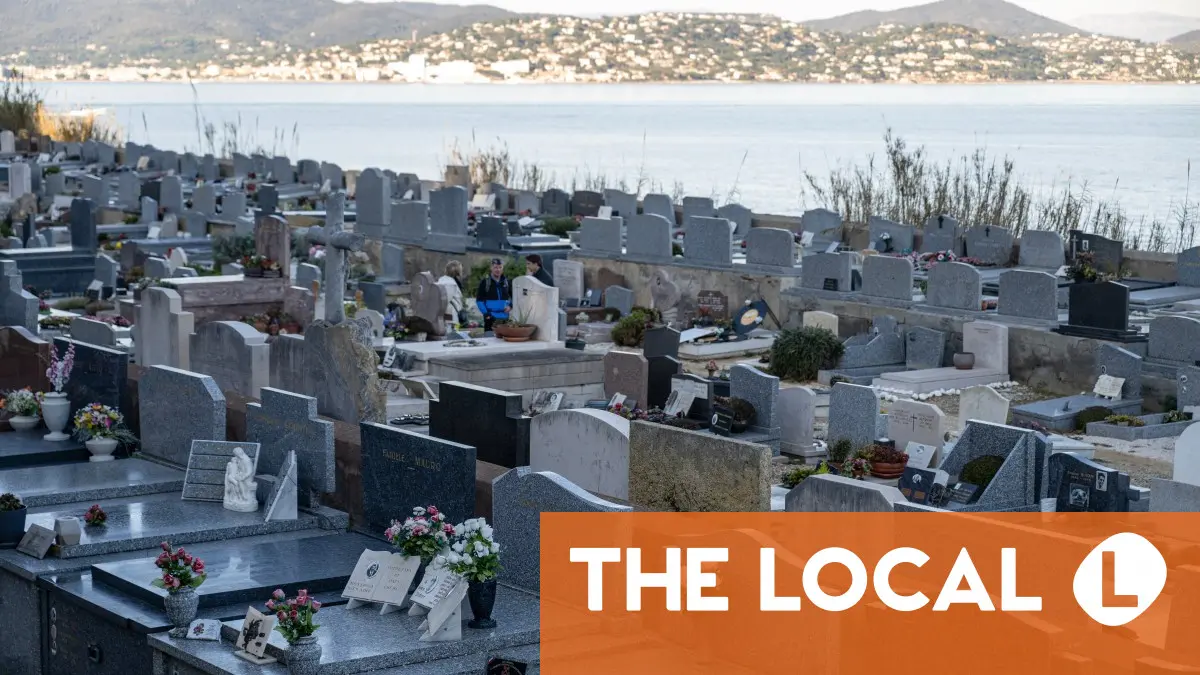
However, local authorities have confirmed that her remains will, in fact, be interred in the cemetery of Saint-Tropez, where her family has a vault, overlooking the Mediterranean.
The Var préfecture told Ici Provence it, “had not received any request for burial at the actress’s home”.
Either she changed her mind after giving the interview or her heirs didn’t get round to filing the paperwork.
But could you be buried at your French home, if you wanted?
The short answer is yes. French film star Alain Delon, who died in August 2024, is buried in a private chapel on his estate in the village of Douchy, Loiret.
And former French President Valéry Giscard d’Estaing, who died in 2020, was buried in the village of Authon in the Loir-et-Cher department, on private land belonging to the family. He rests beside daughter Jacinthe, who died two years previously.
READ ALSO How much can I expect to pay in funeral costs in France?
But there’s always a but, not everywhere, and — always, because this is France — bureaucracy.
In normal circumstances, a request for a burial ‘at home’ can only be made by the deceased’s family after their death and must be addressed to the préfecture where the property is located.
“The burial of the body of a deceased person on private property is authorised by the préfect of the department where that property is located […] and after consultation with an approved hydrogeologist,” France’s Municipal Code clearly states.
Furthermore, the burial site must not be in an “urban area”, as defined by the Institut national de la statistique et des études économiques (Insee).
The family has to show that the property on which the body is to be buried is at least 35m from any neighbouring properties, and a hydrogeologist’s report is required to verify that the burial would not risk contamination of the soil or water supply.
In reality, therefore, this is for people who own a large garden or chunk of land.
READ ALSO How to register a death and arrange a funeral in France
If the property is not owned by the deceased, then the owner’s permission is also required.
A burial at home also comes with constraints on the property owner. Loved ones must be able to visit the grave whenever they wish, even if the land is later sold. Future owners of the property are therefore obliged to maintain the grave and allow access to the deceased’s family.
It should be noted that permission for burial at home should be requested after each individual death, so any surviving family members are not guaranteed permission to be buried alongside the deceased when they, too, die, and the whole request process must be started anew.
Beyond the strict requirements on burial at home, there are other important rules on burial in France. Before any burial, authorisation is required from the town hall in the case of cemeteries or — as already explained — from the préfecture in the case of a burial at home.
“The act of carrying out or causing to be carried out the burial of a deceased individual without this burial having been previously authorised by the public officer […] is punishable by the fine provided for the contraventions of the 5th class”, the Penal Code states.
It’s not impossible that people burying a body without permission could also face prosecution for “concealment of corpse” or “damage to the integrity of [a] corpse”.
READ ALSO Widow convicted for keeping husband’s ashes
Some alternatives to traditional burial are available in France — memorial forests are increasingly popular, for example. In these places, designated by law and managed directly by the municipality, following a cremation, the deceased’s ashes are buried in a ‘tree urn’ under a sapling or with the seed of a tree.
If you opt for a cremation there are also strict rules on where ashes can be scattered so, for example, it might not be possible to scatter a loved one’s ashes at their favourite beauty spot.
If you want to transport ashes to another country, you will also need extra paperwork.
READ ALSO Can I take a loved one’s ashes from France to the UK or US?
Comments are closed.