
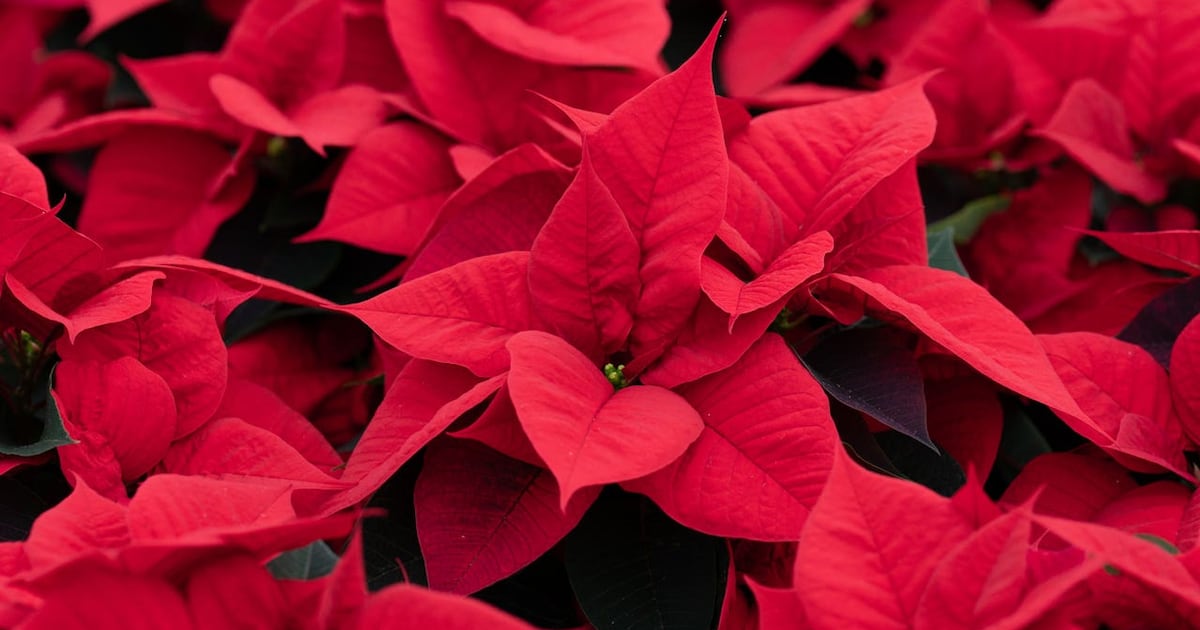
Bing can bang on all he likes about about a White Christmas but for me the colours that best encapsulate the festive period are red and green.
Thought by Christians to represent the blood of Jesus and eternal life respectively, the symbolism of pairing red berries and (ever) green leaves is thought to have been adopted from pagan winter solstice traditions, where the combination is believed to have warded off evil spirits and represented enduring life in winter.
In the plant world, few things pull-off this evocative seasonal coupling better than the poinsettia. Tens of thousands are sold across Ireland ever year, a large proportion of which are grown at Cafre’s Greenmount campus in Co Antrim.
These Central American natives and member of the Euphorbia family take their name from Joel Poinsett, the US’s inaugural ambassador to Mexico and an amateur botanist, who reputedly brought the plant to his South Carolina home in the early 19th century, before the Ecke family in California began cultivating them on a grand scale.

In their natural upland habitat, poinsettias are a slender, sparsely branched shrub that grows up to 8ft tall.
By early last century the more manageable varieties were a staple Christmas decoration inside many American households, a tradition that crossed the Atlantic in the subsequent decades.
The poinsettia’s sturdy, thin branches and foliage are unspectacular yet the latter provides the perfect foil to the bright red bracts (modified leaves) that surround the tiny semi-spherical, yellow flowers. There also varieties with cream, yellow and pink bracts but they don’t have the same festive allure.
They’re quite fussy plants that are averse to both hot, dry conditions and cold, draughty spots. They like a bright location but not direct sunlight, so best avoid windowsills. They prefer compost that’s just moist and neither dry or soggy. Stress will manifest itself in foliage withering and loss.
The drawback – or challenge – with all poinsettias is getting them to ‘flower’ in subsequent years, as this demands quite an exacting plant care regime – meaning these often-gifted plants are regularly not for life but just for Christmas.
A modest liquid feed in February, just as the flowers and bracts begin to fade, is the first step. Don’t be worried if you lose some leaves as the stems become woodier.
A hard-ish spring prune comes next, leaving the stems at about 10cm. Repot in early May using a gritty compost before placing in a cool shady place over summer – something I’d recommend for almost all houseplants.
Soon after you bring it inside again, the plant’s bracts should start responding to the shortening days by turning red, as the flowers appear. It’s advised that you limit sunlight and artificial light to fewer than 12 hours a day from September onwards if you want to ensure the poinsettia is in its prime at Christmas.
Popular varieties include the classical ‘Prestige Red’ and ‘Cortez Red’, while a little more daring is ‘Marble Star’, which has dusty rose pink bracts with with creamy white edges, or Jingle Bell Rock, with white bracts with red edges.
Sounding slightly garish on paper and appearing as camp as Christmas in the flesh is ‘Autumn Leaves’, which comes in multiple shades of orange and peach.
Comments are closed.