

It broke my horticultural heart the other day to see a festive display of red amaryllis in full bloom, their bulbs tightly swaddled in thick wax. They looked great, but I felt their suffering. Like a hapless herd of stray kittens, I wanted to take them all home and give them a better shot at life.
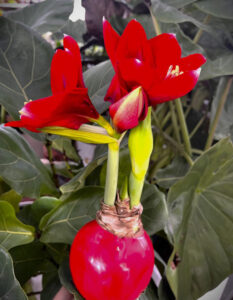
A red amaryllis bulb is encased in a wax coating for the holiday season. Though attractive for gift-giving, the bulbs require soil, light, and care to grow beyond the holidays. Gardeners who plant them properly can enjoy blooms year after year. Photo Courtesy of Felder Rushing
I’m not trying to be the Garden Grinch during this season of goodwill, but the harsh truth about most holiday plants being sold is that many are doomed. Not here for the long haul. This year, more than 70 million potted poinsettias – and countless millions more flowering cacti, cyclamen, Norfolk Island pines, kalanchoes, paperwhite narcissus, amaryllis, and tight little rosemary topiaries decked out with bows – will be bought. Sadly, precious few will make it past their first winter indoors, languishing in low light and near-zero humidity.
And sorry to burst any bubbles, but those beautiful cold-climate blue spruce and golden firs decorated as living Christmas trees also suffer indoors, usually dying in our hot, humid summers. Tropical Norfolk pines inevitably outgrow the living room but will freeze outdoors.
I’m not suggesting that horticultural crop producers, florists, garden centers, and other purveyors of seasonal plants are cynical; they genuinely want you to succeed with their “babies.” But if you don’t, they hope you’ll still want to buy more next year.
The good news is that many people have kept poinsettias, which are porch-shading trees in frost-free climates, alive for years and, with some care, get them to rebloom. The same is true for holiday cacti, which are often shared from cuttings and can rebloom every fall – and sometimes spring. By the way, you can tell Thanksgiving cacti from Christmas cacti easily: the former have pointy “crab-claw” tips on their flattened leaf-like stems.
To get flowering cacti, kalanchoes, and poinsettias to bloom on time for the holidays, greenhouse growers start in early fall by pulling shade cloths over production benches late in the afternoon and removing them the next morning. Once buds or leaves begin to color, the special long-night treatment can stop.
Home gardeners must rely on naturally shorter fall days and hope their porch or indoor lights aren’t too bright – or cover plants with a box (maybe topped with a big bow) each late afternoon. The manager of my local print shop has a poinsettia that flowers every year because all the lights in his office are turned off after work, giving the plants naturally longer nights.
These plants don’t do well if shoved into a closet for weeks. It’s new growth that flowers, so they must keep growing during the day, with hours of bright light and regular watering.
My favorites are amaryllis and paperwhite narcissus, both of which can be planted in the garden to grow and bloom for decades. Bulbs grown in just water or trussed in thick wax quickly exhaust their reserves, but they can be planted in potting soil (remove the wax from amaryllis), kept in a sunny window until the leaves fade, and set outdoors in spring.
We are all inspired by these holiday beauties. Though some people treat them as disposable, like cut flowers to be recycled as compost for next spring’s tomatoes, a little luck and garden skill can turn a handful into treasured heirlooms in the home or garden.
Felder Rushing is a Mississippi author, columnist, and host of the “Gestalt Gardener” on MPB Think Radio. Email gardening questions to [email protected].
Posted in Columns
Quality, in-depth journalism is essential to a healthy community. The Dispatch brings you the most complete reporting and insightful commentary in the Golden Triangle, but we need your help to continue our efforts. In the past week, our reporters have posted 43 articles to cdispatch.com. Please consider subscribing to our website for only $2.30 per week to help support local journalism and our community.
Comments are closed.